People of ScienceOnline, Tell Me What You Want

I mentioned a few months ago that I would be attending the wonderful ScienceOnline conference that kicks off on January 30th in North Carolina. It’s only two weeks away, woo-hoo!

So now would be a great time for my fellow attendees to take a look at my work and tell me if there’s anything you would like me to bring along so you can see it “IRL”. I will have all the various designs of silk scarves with me, plus a few one-offs. If there’s a particular painting or collage in my shop that you would like to buy, please let me know in advance – I can knock off the shipping cost and hand-deliver (don’t forget to use code TWEEPS for 10% off). Otherwise, if you have a few you would just like to look at, send me a message via etsy, email or twitter, and I will make sure to bring them. Continue reading “People of ScienceOnline, Tell Me What You Want”

The Art of Science: Encaustic Geology

Laura Moriarty, Vista, 2012, encaustic and monoprint

Artist Laura Moriarty says that the goal of her work is to “contemplate and compare human and geologic time.” Working mainly in encaustic, a mixture of wax and pigments, she creates many-layered sculptures that beautifully evoke geological strata, the earth’s archive of its past. Moriarty also makes monoprints from the sculptures themselves, reminiscent of the illustrations geologists make to express their work in 2D form. In 2011, she created a book, Table of Contents, that presented her artwork in the format of a geology textbook. “Art-rock” fans should add this one to the syllabus.

More at Laura Moriarty’s website.

The Art of Science: Blood Scarf

Laura SplanLaura Splan is an artist who is also a certified phlebotomist. Her two fields intersect neatly, if that is the right word, in Blood Scarf, a project from 2002, in which she knitted a scarf from vinyl tubing which then filled up with blood from an IV inserted in a person’s arm.  According to Splan, “The implied narrative is a paradoxical one in which the device keeps the user warm with their blood while at the same time draining their blood drop by drop.” (source)

No word on how many cookies that model needed afterward (or if it was in fact the artist herself), but wearing your blood on the outside never did catch on as a fashion statement. Prints of the work will appear in an upcoming exhibit of her work called “Gone Viral: Medical Science and Contemporary Textile Art” in the Cathy and Jesse Marion Art Gallery at SUNY in Fredonia, NY from March 8 to April 7.

The Art of Science: Spencer Finch and the Color of Water

finch-iwanbaan-700There’s an old saying that we never step in the same river twice, but the relentless pace of change in something we see every day still has the power to startle. In 2009, artist Spencer Finch captured a 700-minute period in the life of the Hudson River in New York City. The resulting artwork was called The River that Flows Both Ways.

“From a tugboat drifting on Manhattan’s west side and past the High Line, Finch photographed the river’s surface once every minute. The color of each pane of glass was based on a single pixel point in each photograph and arranged chronologically in the tunnel’s existing steel mullions. Time is translated into a grid, reading from left to right and top to bottom, capturing the varied reflective and translucent conditions of the water’s surface. The work, like the river, is experienced differently depending on the light levels and atmospheric conditions of the site. In this narrative orientation, the glass reveals Finch’s impossible quest for the color of water.” (source)

In 2011, Finch did a similar project in Folkestone, on the southern coast of England, taking photos of the sea over a period of weeks and using them to create a color wheel and 100 flags dyed in the various shades of the water under different conditions of light and weather.

Finch’s work, poised between scientific and artistic documentation, invites us to reflect on change as a constant. It also reminds us that virtually all of the seemingly fanciful shades that artists use to portray the earth, sea and sky are, in fact, found in nature.

More at Spencer Finch’s website.

The Art of Science: Bálint Bolygó’s Mesmerizing Mix

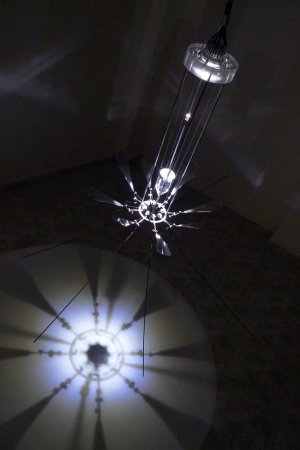
array

Bálint Bolygó, a Hungarian-born artist based in the UK, creates sculptures that explore the world using physics, particularly the bending of light and the movement of pendulums. One of his more recent pieces, ArRay (2011-2012) draws on his earlier work using optical physics and adds a new component – a material called nitinol, a nickel and titanium alloy. Continue reading “The Art of Science: Bálint Bolygó’s Mesmerizing Mix”