Friday Find: Giroofasaurus Vexed

barbie

Giroofasaurus Vexed  is a cool new etsy shop filled with ceramic jewelry featuring scientific motifs. Always wanted a pink bacteriophage to wear around your neck? Voilà. If viruses aren’t your thing, you can choose from paramecia, DNA, test tubes and many others. For those we prefer their science a little less microscopic, there are insects, spiders, birds and even dinosaurs.

The creator of Giroofasaurus Vexed knows her scientific stuff – she’s a Toronto-based lab rat with years of experience at the bench. She won’t tell you her real name, but you can follow her on twitter, where she drops hints about the life she shares with 2 gray cats and a husband – all three of whom are more notable for their looks than their brains.

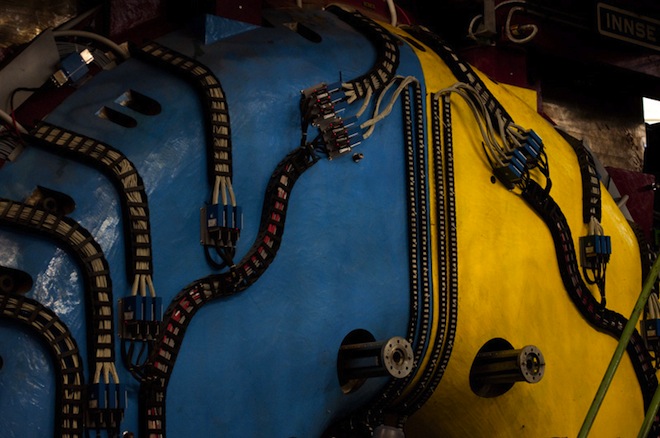
The Art of Science: A Peek at Particle Physics

b31_joseph_paul_boccio
Photo by Joseph Boccio

Ten of the world’s leading particle physics facilities invited hundreds of photographers, amateur and professional, for a behind-the-scenes look in September 2012.  The InterActions Physics Photowalk, an annual event, allowed photographers to visit top labs, including Brookhaven National Lab in New York, Gran Sasso National Laboratory in Italy, Chilbolton Observatory in the U.K., and TRIUMF in Canada.  An international panel selected this shot by Joseph Paul Boccio of the KLOE detector at Italy’s Frascati National Laboratory as the top prizewinner. Continue reading “The Art of Science: A Peek at Particle Physics”

Giving credit where credit is due

Earlier this week, the very popular Facebook science outreach site, I Fucking Love Science, came under fire for its seemingly systematic use of copyrighted material from a variety of artists without attribution or their permission. This sparked a “conversation” – most of which is depressing and not worth reading – about how content should be shared. Over at the Symbiartic blog at Scientific American, artist (and the guy you want to design your tattoo for you) Glendon Mellow has, in the words of Peter Edmonds, composed an “important, smart post” summarizing his thoughts on the issue.

As members of the online culture, we don’t have to accept that image theft will always be the dominant way of sharing visual information online: culture matures. Expectations change. But right now, large portions of science communication online are part of the problem. – Glendon Mellow, “Mash-Up This! Science Communication’s Image Problem”

*Hat tip to Peter Edmonds.

The Art of Science: Camille Lorin’s PIP Show

pip_2541960b

Overnight sensations are rare in the art world, but a one-night display in Marseilles, France of an artwork called “PIP Show” by an unknown French artist named Camille Lorin made a major media splash this week. The title of the work, a simple mixed media installation of silicone breast implants hanging inside black fishnet stockings, refers to the French firm Poly Implant Prothèse (PIP), whose top executives are currently on trial, facing charges of aggravated fraud, namely that the firm knowingly provided substandard breast implants and hid evidence from safety inspectors. More than 300,000 women in over 60 countries are believed to have received the implants, which experts say are twice as likely to rupture as other brands.

Lorin has said she wanted to shift the focus from the PIP trial to the prevalence of breast implants, and the pressure on women to conform to standards of beauty. Certainly, whether, or why, women feel the need for breast implants is a worthy subject for treatment in art. However, the timing of the exhibit in Marseilles to coincide with the trial has put the focus squarely on PIP, whose 73-year old founder, Jean-Claude Mas, has not only denied that the substandard implants posed any health risks but has dismissed the women seeking compensation as “fragile people, or people who are doing this for money”.

Doing it for money should, of course, seem reasonable to Mas, who has admitted filling the implants with a homemade mixture made of industrial-grade silicone gel and other unapproved ingredients, which investigators say allowed the company to save $1.6 million in one year alone. He and three other executives of PIP face up to 5 years in prison if found guilty.

So bravo to Camille Lorin, whose work reminds us that art can still strike a powerful chord and shine a spotlight on an ugly story of science, medicine, business, politics and society.

Photo by Christine Poujoulat/AFP/Getty Images

The Art of Science: Plant Biology Blossoms in Metal

janicehojho

Insect eggs and chloroplasts are among the inspirations for the beautiful handcrafted jewelry of Janice Ho. She describes her work as making “miniature worlds, three-dimensional snapshots of natural elements, and portraits of plants and their littlest parts in silver, gold, enameled copper, and porcelain.” Ho lives and works in an artists’ colony in Hannibal, Missouri that incorporates an old jail (!) and a big garden where she observes plants and insects up close.

She also studies plant biology diagrams, one of which was the basis for this piece, Not an Actual Life Cycle. She explains, “I’ve always loved the layout associated with these illustrations and have translated that into the framework of this piece. The elements represented include details of a poppy seed pod, a plant cell, mason bee house, and paper wasp nest.”

She has made other pieces representing mitosis, photosynthesis, pollination, and the miracle of stink-bug birth, among many others.

You can find many more examples of her work on her website, along with a schedule of upcoming shows.