For Better Science Meetings, Invite an Artist

Regina Holliday paints at a conference
Regina Holliday shows artwork that she live-painted at a conference

So you’re putting together a scientific conference. You’ve chosen your topic, location and date. You’ve booked a venue and lined up sources for coffee, lunch and cocktails. You have all your podiums in a row. You’re scouring the planet for the top experts in the field, hoping that you can get enough of them in one room at one time to spark a great conversation, launch a new initiative, maybe even shift a paradigm or two.  Here’s something that might help you accomplish that: invite an artist.

Why should conferences invite artists? What do they bring to the table? I asked Regina Holliday,  who has been live-painting at health care conferences for three years. “I disrupt them,” says Holliday. “I give them a different worldview,” adding that her “very visual” take on the proceedings of large meetings can cut through the massive pileup of verbal information that most conferences provide. Continue reading “For Better Science Meetings, Invite an Artist”
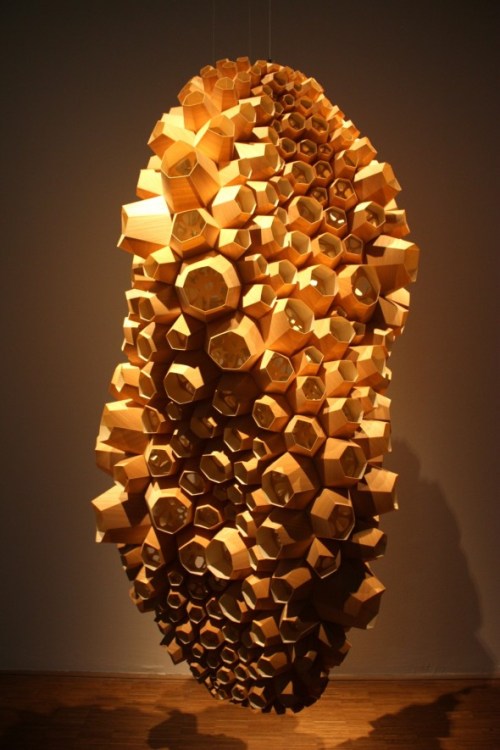
The Art of Science: Andrew Kudless’ Intelligent Design

Chrysalis III, 2012
Chrysalis III, 2012

Chrysalis III, a sculpture by Andrew Kudless and MATSYS Design, is a piece with elements to appeal equally to the naturalist, the computer geek and the art snob. The work is based on nature, specifically the self-organization of barnacle-like cells. He explains, “The cells shift and slide across the surface as they attempt to find a more balanced packed state through the use of a relaxed spring network constrained to the surface.” Continue reading “The Art of Science: Andrew Kudless’ Intelligent Design”

Pedantic Cow

The Laughing Squid is a font of linkjoy, like this stylized, but functional illustration of a cow’s digestive processes.

Cow from Nova Jiang on Vimeo.

Nova Jiang’s sculpture, Cow, is not, however, a “Rube Goldberg-style” machine, as described in the Laughing Squid piece:

“Cow” is an interactive wooden sculpture that demonstrates the complicated digestive system of a cow with a complicated Rube Goldberg-style mechanism. – EDW Lynch

Rube Goldberg-style machines are unnecessarily complicated. The game Mousetrap involves the construction of a Rube Goldberg-style machine. The “This Too Shall Pass” video from OK Go we featured as our Song of the Week shows the operation of a Rube Goldberg-style machine.

This machine is not unnecessarily complicated. It is necessarily complicated, because digestion in cows is complicated.

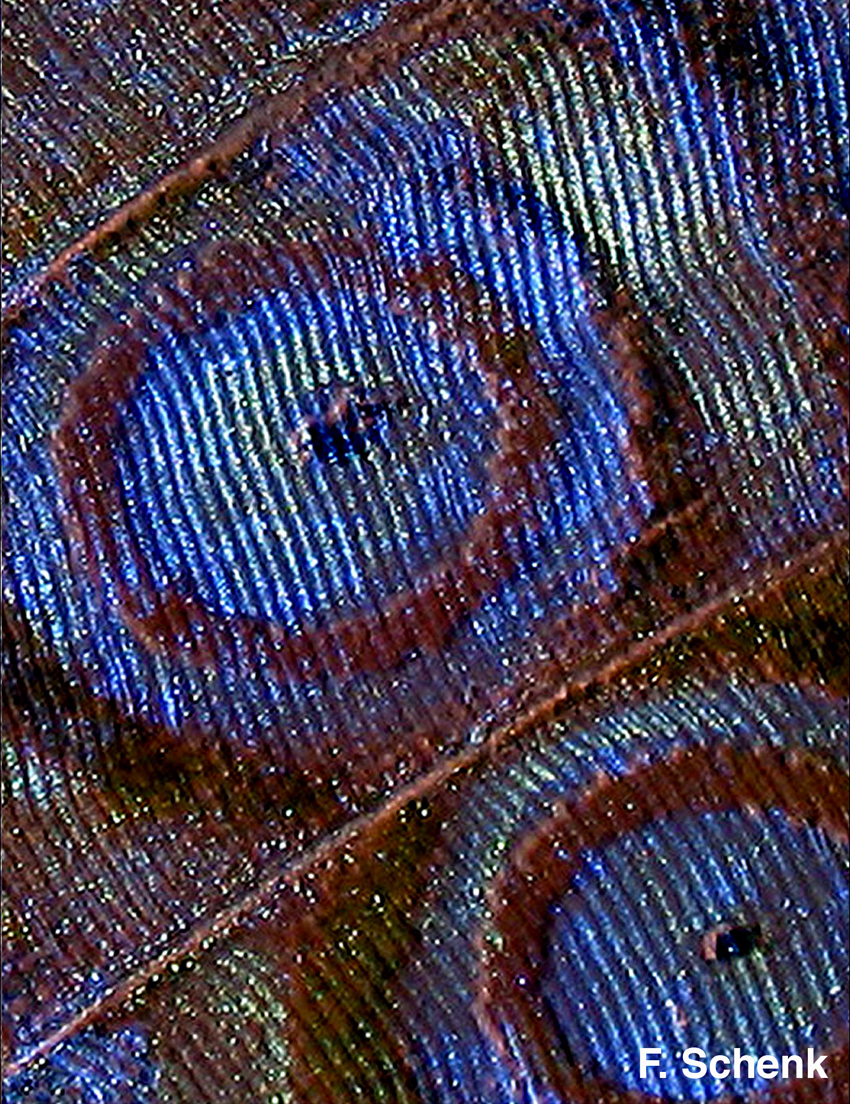
The Art of Science: Shimmer and Shift

butterflyaschenk
Detail of painting of butterfly wing from The Art of Iridescence, 2010-11

Like many painters, Franziska Schenk is inspired by what Darwin called the “endless forms most beautiful” of the natural world, and the dynamic processes of evolution, predation and camouflage. As she delved deeper into her work, she became particularly interested in iridescence, the property that allows some surfaces to appear differently colored depending on the angle or light in which they are viewed. Generations of painters have developed techniques to suggest the effect of iridescence – Schenk decided to apply a little science. Continue reading “The Art of Science: Shimmer and Shift”

The Art of Science: Symbols of Universal (Wireless) Connection

Technological Mandala 05, 2012

The mandala is an important symbol in both Hindu and Buddhist religious traditions, both as art form and as spiritual practice. In extremely simple terms, a mandala is a geometrically–based representation of an interconnected universe or cosmos. They are usually painted or drawn, although some are made painstakingly of sand and then swept away after their completion, as a symbol of the impermanence of all things. Italian artist Leonardo Ulian makes mandalas out of a more contemporary material – electronic components, including resistors, capacitors and microchips. Beautiful, intricate and delicate, they hint at a new interpretation of the idea of interconnectedness – the wireless kind.  Although he’s using an ancient religious style, Ulian refers to his artworks as “ephemeral gizmos”, which, like sand or new technology, can be quickly swept away.

See more of Leonardo Ulian’s work at his website.