Living in a pineapple under the sea is so 2010. Artist Stephen Turner recently took up residence in a wooden egg on the River Beaulieu in England, where he will stay for about a year. The Exbury Egg, Turner’s new home, is a solar-powered wooden pod which is tethered like a boat in an estuary, rising and falling with the tide.
The main idea of the Egg is to explore “a more empathic relationship with nature” linked more closely with the rhythms of natural life. However, the project does not reject modern technologies but rather seeks to use them in the most effective possible way. For instance, Turner has a computer and phone powered by solar panels. Continue reading “The Art of Science: The Exbury Egg”
As an artist looking at other people’s work, I am always intrigued by artists doing things that I couldn’t possibly do myself. Things, for example, requiring extraordinary patience, dexterity and complicated geometry. Things like the work of New Zealand artist Peter Trevelyan, who makes “built drawings” – fragile, airy sculptures made of fine graphite rods (the lead from mechanical pencils) held together with glue.
Trevelyan’s work is informed by a broad range of influences. His interest in mathematics, drawing and architecture are evident in his sculptures. Less obvious, perhaps, is his fascination with theories of social systems. Some of his sculptures look at social systems as a collection of individual decisions – each individual pencil lead – which combine to form a structure that can be symmetrical and beautiful or oddly misshapen and rather menacing.
You can find more images and information on the website of Trevelyan’s gallery, Bartley + Company.
The passenger pigeon, a thriving species in the United States at the beginning of the 19th century, was extinct by the end of it. As Carl Zimmer wrote in National Geographic:
“In 1813, while traveling along the Ohio River from Hardensburgh to Louisville, John James Audubon witnessed one of the most miraculous natural phenomena of his time: a flock of passenger pigeons (Ectopistes migratorius) blanketing the sky. “The air was literally filled with Pigeons,” he later wrote. “The light of noon-day was obscured as by an eclipse, the dung fell in spots, not unlike melting flakes of snow; and the continued buzz of wings had a tendency to lull my senses to repose.”
When Audubon reached Louisville before sunset, the pigeons were still passing overhead—and continued to do so for the next three days. “The people were all in arms,” wrote Audubon. “The banks of the Ohio were crowded with men and boys, incessantly shooting at the pilgrims… Multitudes were thus destroyed.” (source)
Done in by a combination of over-hunting and habitat loss, the passenger pigeon is now the subject of study by a group of scientists, led by Stewart Brand, George Church and Ben Novak, who hope to revive the species through genetic engineering and cloning. (This article gives a brief explanation of the science involved)
The idea of reviving any extinct species is fraught with practical and ethical issues. (Here’s an interesting post about a few of them) So where, you ask, does art come into this issue? Well, when it comes to this particular species, what image of the passenger pigeon you look at might just color your opinion of whether we really want this particular bird back.
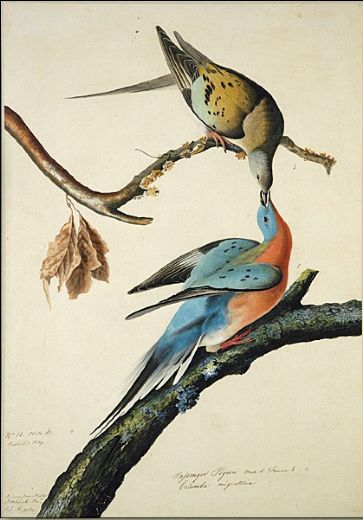
John James Audubon, from Birds of America, 1838
If you look at Audubon’s painting of a pair of billing passenger pigeons, one sleek, beautiful bird leaning down and appearing to kiss its mate on the bough below, you might just think, “Yes! Those are nice. We should bring back those birds.” Now look at Walton Ford’s 2002 painting, Falling Bough, (top) and read his description of it:
“The passenger pigeons were the most numerous birds that ever lived in the history of the planet. It’s almost disturbing how numerous- billions upon billions of birds. It was a fecundity that was almost disgusting. I started thinking about a blame-the-victim kind of attitude you could take to that…to make it seem like they had it coming, that there was this disgusting empire of birds and that it was corrupt like Rome…that it was bound to fall. So I invest the passenger pigeons with every kind of sin that I can imagine. And the bough, this gigantic branch, is falling under their tremendous weight. Meanwhile they go about their bickering and their lusts and foibles and all the disgusting things that they are doing.” (source)
Obviously, the artists had different goals: Audubon aimed to provide an accurate visual record of the passenger pigeon’s physical characteristics, while Ford set out to conjure a dramatic, violent fantasy. The reality of giant flocks of passenger pigeons undoubtedly fell somewhere in between these extremes. They were likely to have been somewhat more frightening, noisy and dirty than Audubon’s, but less menacing and dangerous than Ford’s. I recognize this, but I saw Walton Ford’s painting first. The image stuck. So I say no, no, no, don’t bring back these birds. At least not to any trees near me.
Aganetha Dyck gets a lot of help creating her artwork. But rather than employ studio assistants or take on interns, the artist collaborates with hundreds of bees. Dyck, who says her main focus is “how knowledge is transported and transcribed between humans and other species”, considers her work to be an equal collaboration with the insects. “My research has included the bee’s use of sound, sight, scent, vibration, and dance. I am studying the bee’s use of the earth’s magnetic fields as well as their use of the pheromones (chemicals) they produce to communicate with one another, with other species and possibly with the foliage they pollinate.” (source) Some of her most striking pieces are small figurines that she places inside hives, to allow the bees to adorn with honeycomb. She also sometimes places drawings or paintings inside hives and lets the bees add texture and color to them.
Dyck’s (and the bees’) small sculptures are particularly striking because of their uncanny effect of juxtaposing something highly refined but essentially useless (porcelain figurines of lords and ladies in fancy dress) with something raw, natural and made with a clear purpose (honeycomb). Both parts of the sculpture seem somehow alien, like something found in grandma’s attic on another planet. That quality may be especially appropriate for work made with bees, a crucially-important species whose numbers continue to drop dramatically. This unique artwork may one day be impossible to create if Dyck’s collaborators continue to die off.
Dyck’s work is featured in the exhibit “Nature’s Toolbox: Biodiversity, Art and Invention”, which opens at the Ulrich Museum of Art in Wichita, KS next month through December 2013.
You can see lots more art and information at Aganetha Dyck’s website
A pair of Parisian designers has one-upped Brandon Ballengée’s Love Motel for Insects (featured here last year) by building snazzy condos for some lucky French bugs. The Insectopia installation, by Quentin Vaulot and Goliath Dyèvre, consists of tightly-packed wooden “houses” for insects, mounted on poles in parks in the 13th arrondissement of Paris. From a distance, they resemble trees; closer up, they look a bit like Laputa, the flying island from Hayao Miyazaki’s Castle in the Sky. Vaulot and Dyèvre say that their intention was both to foster urban biodiversity and to “provoke an emotion” in people who interact with the art, by drawing attention to a world that is largely invisible but in constant motion. No word yet on which lucky insects have moved into Insectopia, or if the quiet, hardworking ants are complaining about the noisy cicadas upstairs. If any of our readers are in Paris, please go look and report back with photos.

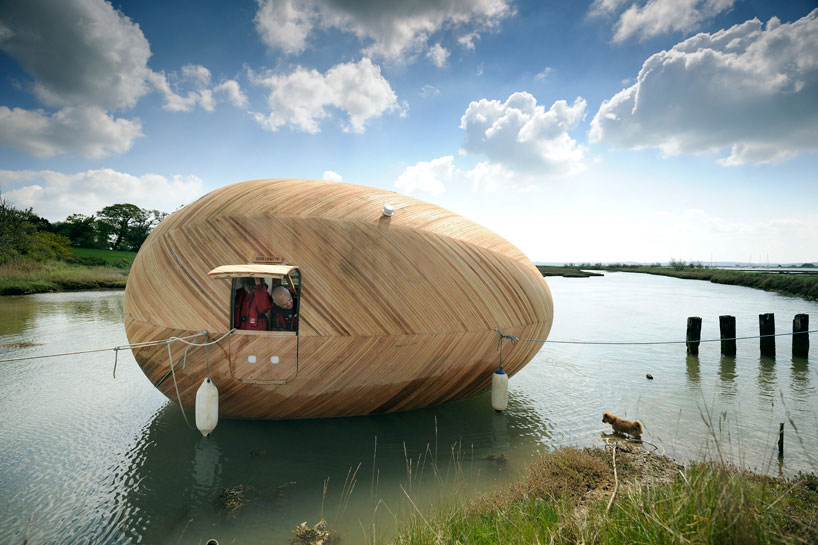 Living in a pineapple under the sea is so 2010. Artist Stephen Turner recently took up residence in a wooden egg on the River Beaulieu in England, where he will stay for about a year. The Exbury Egg, Turner’s new home, is a solar-powered wooden pod which is tethered like a boat in an estuary, rising and falling with the tide.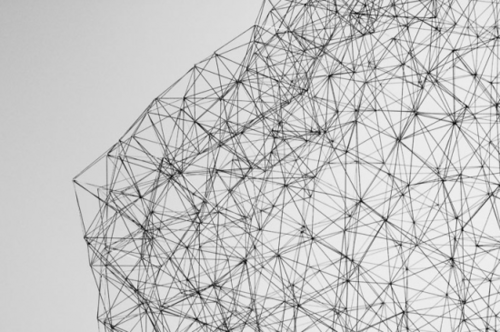



 The Finch and Pea