Hot damn! I can’t wait until September, even though I’ve got some of these:
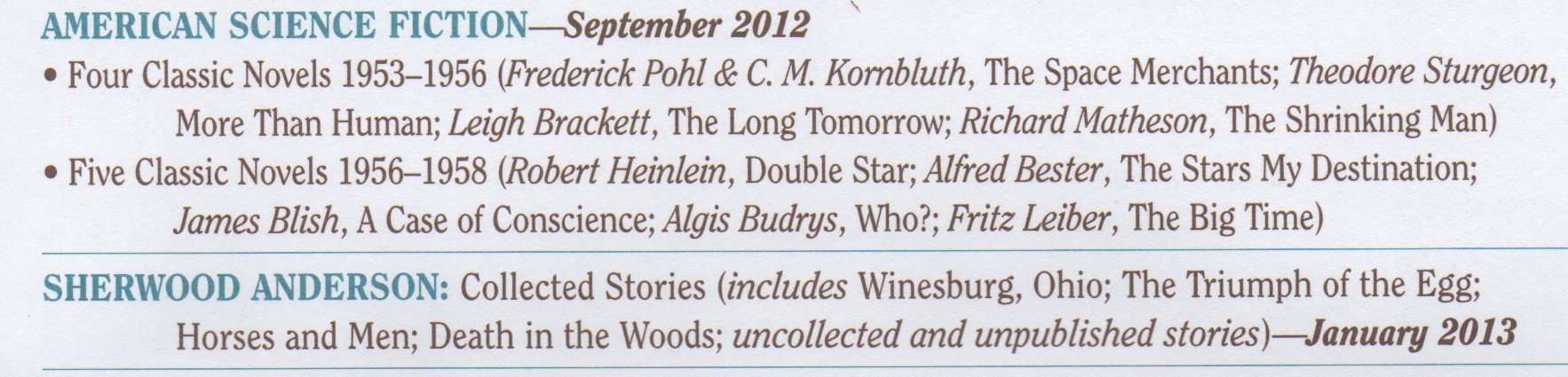
Plus the collected Sherwood Anderson!

Hot damn! I can’t wait until September, even though I’ve got some of these:
Plus the collected Sherwood Anderson!

 The Mathematics of Life was mathematician Ian Stewart’s most recent book, at the time I received it; but Stewart is prolific, writing a new book every 57 minutes or so. The Mathematics of Life is now his second most recent popular science book. In my opinion, your enjoyment of this book will depend upon your expectations. Continue reading “The Mathematics of Life”
I just discovered this treasure trove on the foundations and history of statistical mechanics:
Compendium of the foundations of classical statistical physics, by Jos Uffink (PDF)
The abstract:
Roughly speaking, classical statistical physics is the branch of theoretical physics that aims to account for the thermal behaviour of macroscopic bodies in terms of a classical mechanical model of their microscopic constituents, with the help of probabilistic assumptions. In the last century and a half, a fair number of approaches have been developed to meet this aim. This study of their foundations assesses their coherence and analyzes the motivations for their basic assumptions, and the interpretations of their central concepts. The most outstanding foundational problems are the explanation of time-asymmetry in thermal behaviour, the relative autonomy of thermal phenomena from their microscopic underpinning, and the meaning of probability.
A more or less historic survey is given of the work of Maxwell, Boltzmann and Gibbs in statis- tical physics, and the problems and objections to which their work gave rise. Next, we review some modern approaches to (i) equilibrium statistical mechanics, such as ergodic theory and the theory of the thermodynamic limit; and to (ii) non-equilibrium statistical mechanics as provided by Lanford’s work on the Boltzmann equation, the so-called Bogolyubov-Born-Green-Kirkwood-Yvon approach, and stochastic approaches such as ‘coarse-graining’ and the ‘open systems’ approach. In all cases, we focus on the subtle interplay between probabilistic assumptions, dynamical assumptions, initial conditions and other ingredients used in these approaches.
This will keep me busy.
Admit it, we all have a love-hate relationship with Wikipedia, as we do with anything that is both useful and frustrating, which seems to include just about anything related to the internet.
Here is yet another instance where the weaknesses of Wikipedia’s crowd-sourcing comes to the fore: enthalpy. Under the subheading ‘Origins’, we first encounter two sentences explaining the Greek roots of the word, when one sentence would have been sufficient. Next, we read three sentences explaining that the origins of the concept are often misattributed Clapeyron and Clausius. Five sentences later, in the second paragraph, we finally read something about the origin of the concept of enthalpy (but the emphasis still inappropriately remains on the origin of the word and not the concept).
Wikipedia’s biggest weakness is not inaccuracy, but lack of a filter and a proper sense of emphasis, which is why the articles often read like they’ve been written by high school students. Of course that doesn’t stop me from reading Wikipedia 20 times a day.
 The Finch and Pea