Christmas Shuffle [Repost]

The Best of ChristmasOriginally posted on 20 December 2012.

Last year our eldest daughter (then 3, now 4), The Frogger, fell in love with the song “Rudolph the Red-Nosed Reindeer”. This year she is obsessed with “A Holly Jolly Christmas”. It is no coincidence that both songs are performed by Burl Ives in the Rankin/Bass classic Rudolph the Red-Nosed Reindeer.

Cut to me, in the car, frantically pushing buttons to cycle through CDs and play Burl Ives singing “A Holly Jolly Christmas” in order to fulfill the heartfelt request of my child. Experienced parents will know that there are a variety of potential motivations for such behavior beyond simply avoiding a tantrum, for example cutting short a half-hour of repeatedly yelling the same three lines of the song with 73.21% accuracy.

Having found the correct CD and as I pushed buttons to get to the right track, I began to wonder if I was taking the shortest route to my song of choice. There are three possible routes to any given track on my car’s CD player. Continue reading “Christmas Shuffle [Repost]”

At-twitter-bution

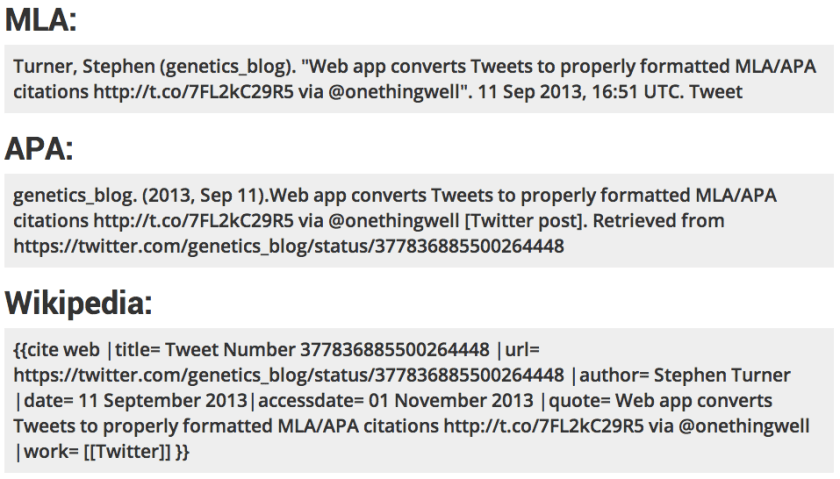
I’m not proud of that title; but I also lack shame. Ben Hedlund, however, should be very proud of his web app Tweet2Cite. Tweet2Cite takes the URL of a tweet and converts it into a properly formatted citation for MLA, APA, and Wikipedia styles. Here are the citations I generated using the tweet from Stephen Turner that brought Tweet2Cite to my attention*:

Screenshot of citations for Stephen Turner's tweet about Tweet2Cite generated using Tweet2Cite
Screenshot of citations for Stephen Turner’s tweet about Tweet2Cite generated using Tweet2Cite

And, for those of you wondering, yes, you do need to provide a citation or attribution for information/quotes/images/links extracted from other people’s tweets.

*I am ever so meta.

#standingwithDNLee

Blogger, post-doc, and science communicator DN Lee politely declined an offer to work for a money-making operation for free. The word “whore” was used in response. DN Lee wrote about this experience and what it meant from her perspective as a black, female scientist at an early stage in her career. The overlords at Scientific American deleted the post for very vague reasons without consulting with DN Lee.

But that is not how the Internet works. And that is not how the online science communication community works. As requested by Dr. Isis with DN Lee’s permission, we are putting up the censored post. Unlike Scientific American, we think the human experiences of scientists are of interest to people who are interested in science. To get a grasp on the issue you can read the following:

UPDATE 14 OcTOBER 2013

DN Lee’s original post is back up at Scientific American after the factual accusations were confirmed. She does not get the credit she deserves if you are reading this here in measurable ways that will benefit her career. So, we are removing the post as its utility has passed.

As many, including yours truly, guessed early on, the take-down was due to lawyers worrying if the alleged events (ie, emails) were authentic. The lawyers were not necessarily worrying that they were made up. The correspondent may not have been a real Biology-Online representative (he was).

Scientific American stepped in it by obfuscating about the real reasons for the takedown, allowing it to appear that they did not try very hard to discuss the legal concerns with the author before or immediately after the takedown, issued conflicting explanations, appeared to doubt the victim’s veracity, and used explanations that easily reminded folks of loaded rhetoric used routinely to dismiss and distract. They also seem to have failed to grasp the immediacy of response necessary to manage response on the internet.

It doesn’t make the folks at Scientific American bad or misguided. They aren’t. They were very unaware of the situation they were stepping into, and that isn’t a good excuse for such an organization. It was legitimate to expect better. The whole incident was about managing appearances, and they failed. Hopefully, this has been a learning experience.

 

Science for the People

sftp-fullsize-redbgProfessionally, I wear a lot of hats. Personally, I very rarely wear hats, except for in the dead of winter, which rarely occurs here in South Carolina, because my head is very large, and finding hats (but not commas) that fit is very hard. One of those hats is was as the “researcher” for the science podcast, Skeptically Speaking.

Today, Skeptically Speaking changed its name to Science for the People. Continue reading “Science for the People”

The Gruffalo, a spoken word performance

Last night I was requested to do independent readings of the British children’s classic The Gruffalo by Julia Donaldson & Axel Scheffler.

For Punkface MacGruder, my younger child, I performed Donaldson’s rhymes as a really bad beat poet (apologies to all beat poets that still exist).

My older child, The Frogger, requested that I do voices*.

Here are my Gruffalo voice inspirations:

Narrator – Me
Mouse – Cary Elwes
Fox – Greg Proops doing Jeremy Irons
Owl – Greg Proops doing Merv Griffin**
Snake – Peter Lorre
Gruffalo – Ted Levine as Buffalo Bill in The Silence of the Lambs

*There is also a BBC Animated Short based on The Gruffalo. They made somewhat different casting choices.

**It is really based on what I remembered it sounding like. I relistened to that chunk of The Smartest Man in the World and it sounds nothing like what I remembered. Stupid primate neurology.