
As is my habit, I publish the form letters I receive from my elected representatives. On that front, Net Neutrality is the gift that keeps on giving – if you enjoy letters that don’t say anything – such as this missive from Senator Tim Scott. My general interpretation of this is that while Senator Scott is generally in favor of Net Neutrality, he is not going to spend any political capital flexing his muscles on behalf of the FCC’s reach or to push Congress to define internet service providers as common carriers. Thanks to rules about local internet service providers, the diversity of competition, which is key to Senator Scott’s hope for the future, has been decreasing, especially for those of us living in small towns in South Carolina. Continue reading “Letter from Senator Tim Scott on Net Neutrality”
Category: Items of Interest
Science for The People: Science & Politics
 This week Science for The People is talking about science and evidence in the political process. They talk to Dan Kahan, Professor of Law and Professor of Psychology at Yale Law School, about the Cultural Cognition Project, which studies group values and perceptions of risk in science communication. They also speak to Shane Trimmer, Executive Director of Franklin’s List, about their work to elect pro-science candidates. Biologist Katie Gibbs returns with an update on Evidence for Democracy, which advocates for the transparent use of evidence in Canadian government policy.
If reading is more your thing, check out “I’ll Trade You an Evolutionary Theory for Your Creationism” or “For Sale: 1 Vote, Price ‘Science’ or Best Offer” (posted at Culture of Science) for a Finch & Pea-esque take on some of the topics raised in this episode of Science for The People.
*Josh provides research help to Science for The People and is, therefore, a completely biased and cooperative member of the team. He does, however, insists on capitalizing the show name as he sees fit.
…all of them should learn from rugby
Needless to say, I agree with everything filmmaker Werner Herzog has to say about rugby in this excerpt from a Vulture interview. They were discussing Association Football (aka) and the dishonor of taking a dive:
No, that’s an awful disgrace. It’s a disgrace. And it shouldn’t be [allowed]. And all of them should learn from American football. And more so, all of them should learn from rugby. What a manly, decent sport that is. There is a great kind of honor to rugby. I really love rugby for that.
They’re less protected than in American football.
Yes, and [I love] the kind of dignified way they deal with one another. Even though sometimes they sort things out in a brief fistfight. The ref lets them sort it out very quickly and then be decent again.
–Werner Herzog interviewed by Steve Marsh (bold) for Vulture Transcript
*Hat tip to Michele Banks.
#TheGrantfather
 First there was #SciWars, then there was a flailing attempt at #ConanThePostDoc. This weekend a smattering of Twitter users got together to sciencify classic quotes from The Godfather films under the hashtag #TheGrantfather.
You can see a storify of the reworked quotes here:
What classic film should lay the science too this Friday?
A work of staggering genius
Ben Young Landis has done the smartest thing I’ve seen all day – adding a smartphone camera friendly abstract panel to a comprehensive poster design, in order to make it easy to capture the poster’s soul.
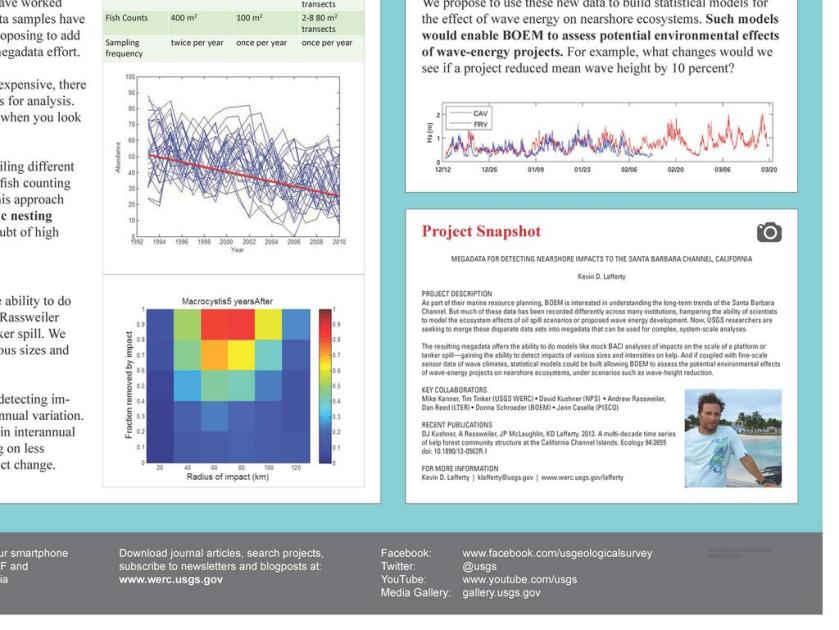
For many of us, working a research conference using smartphones has become second-nature…It was the poster aspect that had me thinking for a while. How can we make a better poster layout that will be more friendly to smartphone users…and…will stand out from the crowd?
You can see the beginnings of my experiment with this design I created for Kevin Lafferty, a P.I. with the U.S. Geological Survey and UC Santa Barbara. A key innovation is the “Project Snapshot” — this is actually where I’ve tucked all the technical language, the citation, the coauthors, the email addresses, and all the “usual” poster elements. Essentially, I’ve written up your notes for you in this 9×12 inch space, and the camera icon is a reminder that you literally can just take a snapshot of this box, and not have to write all this down. – Ben Young Landis
 The Finch and Pea