Canadian Museum of Nature

If I remember correctly, the Canadian Museum of Nature in Ottawa was partly under construction when I visited in 2008, but I’m not sure which part I missed. I do recall the dinosaur exhibit, where I took this picture of an Archeopteryx.

Feathered dino

I think it was in this room, which was awesome:

floating skeletons Continue reading “Canadian Museum of Nature”

Platypus viewing in Queensland

IMG_8561There are only five species in the order of monotremes – mammals that lay eggs – and they all live in Australia. Four of the monotreme species are echidnas, a sort of anteaters. The fifth is the single strangest mammal out there: the platypus.

The platypus is so unique, and so unmistakably different from any other animal, that I get really annoyed when people want to be super-specific and call it “duck-billed platypus”. As if we were at risk of confusing it with any of the many other different types of platypus. Oh, that’s right. There are no different types. There is just platypus.

I first saw a platypus at Healesville sanctuary, when I was 13. I most recently saw one at the British Museum. That one was dead. But my favourite platypus encounter was at Eungella National Park in Queensland.

Continue reading “Platypus viewing in Queensland”

The Wadden Sea and Ecomare

The Netherlands gets a new king today. As a large part of his land is reclaimed sea or lakes, you will not be surprised to hear that one of his interests is water management. I previously wrote about the Cruquius Museum, set in a pumping station that emptied a lake in the west of the Netherlands. Centuries of fighting against the sea have made the Netherlands a world leader in land reclamation. Dutch engineers were responsible for draining the fens north of Cambridge in the UK, and improved the levee system in New Orleans after Hurricane Katrina.

WaddeneilandenBut even in the Netherlands, the sea sometimes wins. While the West coast is a neat line of dunes and dikes holding back the water, the North coast is a fringe of islands. These islands are part of the Frisian Islands archipelago that extends along the entire North coast of the Netherlands, the North East coast of Germany, and the South East of Denmark.

They weren’t always islands. At the end of the last ice age, they were the coast line. Continue reading “The Wadden Sea and Ecomare”

Have Science Will Travel

Eva has been trotting the North-Western Hemisphere visiting science museums, parks, and other science-themed tourist traps. You can follow her travels on our custom Have Science Will Travel Google Map:

Eva cannot visit everywhere. If you are interested in writing a guest post, especially focusing on a science tourism destination in the Eastern or Southern Hemispheres (ie, the continents other than North America and Europe), contact The Finch & Pea here.

Exploratorium opens in a new location

Tomorrow, the Exploratorium in San Francisco opens its doors in a new location at Pier 15.

Look how incredibly awesome the new building is going to be.

Because it isn’t yet open, no science tourists have been there yet, but it’s a good time to look back at both the old venue and some of the Exploratorium’s online ventures.

I visited the old location, at the Palace of the Fine Arts, in 2008, but I had virtually met the museum before that.

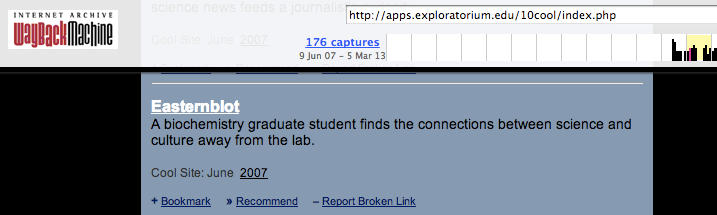
For a few years, the Exploratorium website listed a selection of interesting science websites. They put up a new list once every while, and yours truly once made the list! Easternblot.net was one of the “ten cool sites” on the Exploratorium website in June 2007! (That was when I updated it much more often…)

Proof from the WayBackMachine!
Screen shot 2013-04-14 at 23.06.10

So when I visited in 2008, I knew I would like the museum, because the museum liked me! And indeed, I saw some cool stuff there:

Lessons from the lab
Continue reading “Exploratorium opens in a new location”