Apocalypse 1952: Bernard Wolfe’s Limbo

Rage against the machine
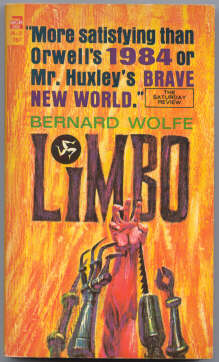
It’s the post-apocalyptic 1990’s, thanks to a late 70’s nuclear third world war brought on by the giant computers that had been delegated by humans to handle geopolitics. (They sound a little like the micro-trading computers that now handle the much of high finance.) It turns out that the computers weren’t any better at keeping the peace than humans were.

Neurosurgeon and former Mormon Dr. Martine has spent the last 18 post-war years hiding out on an uncharted island somewhere in the Indian Ocean, integrated with the natives, but events draw him back home to what’s left of the United States. What he finds, built upon the slag heaps of both the former United States and Soviet Union, is a cyborg civilization filled with men who’ve renounced war, cut off their limbs, and replaced them with nuclear-powered prostheses. To his shock, Martine find out that he unwittingly had something to do with this bizarre state of affairs.

Bernard Wolfe’s 1952 Limbo is a disturbing but weirdly compelling proto-cyberpunk behemoth that combines an edgy, in-your-face language that compares with the best of Alfred Bester, with long, Heinlein-style philosophical digressions that are about as subtle as a kick to the head, to create one long, entertaining rant against… well, something, but I couldn’t quite figure out what. Continue reading “Apocalypse 1952: Bernard Wolfe’s Limbo

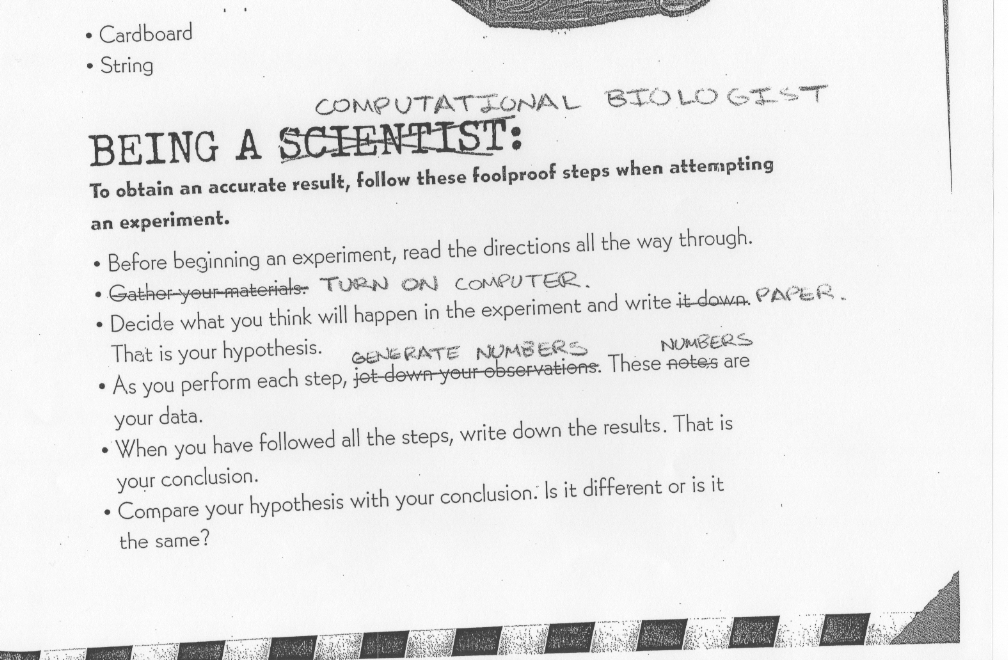
Being a Scientist: Computational Biologist

When your field publishes papers with sections entitled “Simulated Data”, something like this is bound to happen. I’m pretty sure we had to rescue this one from the break room trash. Being sensitive or living up to the computer nerd limited sense of humor stereotype?

You can get your own “Being a Scientist” template here and create your own, you crafty bastards you.


Favorite ultra-weird sci-fi

io9 has two posts on ultra-weird sci-fi, which is just my kind of thing. Why? Well, first, it’s not boring, and second, weird sci-fi is where you find authors discovering new means of expression, which makes the reading the book a more powerful, or at least trippy experience. Below are my 10 choices for best ultra-weird sci-fi, and I’m always looking for new book recommendations, so what are your picks?

In no particular order:

1. Blueprints of the Afterlife, Ryan Boudinot:By the end of this book, you still won’t know what’s going on, but it’s a time-beinding, post-apocalyptic trip. Boudinot’s world is Philip Dick meets Snow Crash meets The Simpsons. Some time after a catastrophic, corporate-sponsored civil war, Manhattan is now being recreated in the Pacific Northwest, down to the last detail. Just who is doing this recreating isn’t clear, nor is it clear why or how a pre-war architect was able to draw up the blueprints out of the, uh, blue. That the narrative is non-linear is putting it mildly, and the book has an appropriately weird cast including a world-champion dishwasher, government-sponsored, genetically engineered humans who are farmed for tissues, a celebrity whose legal name is Neeman Fucking Jordan, and of course, a Last Dude. Continue reading “Favorite ultra-weird sci-fi”

Mining industry takes on peer-review

It’s really not a new storyline: A big science study is examining whether some industry product or practice is harmful, and industry lawyers and scientists pull out all the stops to block the results. In this case, the question is whether miners’ exposure to diesel exhaust increases their risk of lung cancer. (Really, is there anything about being a miner that does not increase your risk of lung cancer?)

A post over at the Natural Resources Defense Council lays out the details (h/t Climate Progress). Several scientific journals received threatening letters from a mining industry lobby, warning these journals not to publish, or even peer-review papers from the diesel/mining/lung cancer study. The mining industry is trying to block publication of scientific studies they did not pay for, and whose results they did not like. A society in which any scientific study can be blocked by third party that possesses enough legal firepower is not the kind of society we should be.

According to Science, several journal editors received legal threats from a mining industry lobbyist:
Continue reading “Mining industry takes on peer-review”

Is science powerless to confront the supernatural?

Larry Moran praises a recent philosophical paper knocking the idea that science, by definition, cannot consider the supernatural:

Maarten Boudry, Stefaan Blancke, and Johan Braeckman have an article coming out in Science & Education on “Grist to the Mill of Anti-evolutionism: The Failed Strategy of Ruling the Supernatural out of Science by Philosophical Fiat.”

It relates to the idea that science is limited by its insistence on adhering to methodological naturalism. According to this view, science cannot investigate the supernatural. The view is popular among some who oppose creationism since it means that creationism can’t be scientific, by fiat. It’s also important for accommodationists because it allows science and religion to co-exist in separate magisteria.

Continue reading “Is science powerless to confront the supernatural?”