In his interview with Ian McKellen on the WTF Podcast, Marc Maron said one the smartest things I’ve heard about modern niche marketing:
I don’t have a demographic. I have a disposition.
You should listen to the rest of the interview too.

In his interview with Ian McKellen on the WTF Podcast, Marc Maron said one the smartest things I’ve heard about modern niche marketing:
I don’t have a demographic. I have a disposition.
You should listen to the rest of the interview too.

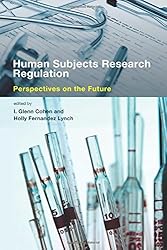 This week Science for the People is learning about the regulatory frameworks that try to balance scientific progress with the safety of research subjects. We’ll speak to Holly Fernandez Lynch and I. Glenn Cohen of the Petrie-Flom Center for Health Law Policy, Biotechnology, and Bioethics at Harvard Law School about their book Human Subjects Research Regulation: Perspectives on the Future. We also speak to health journalist and editor Hilda Bastian about research, journalism, ethics and “The Chocolate Hoax“.
*Josh provides research & social media help to Science for the People and is, therefore, completely biased.
No one, not even his closest friends, would deny that Charles Babbage was a first rate pedant. In 1842, Alfred, Lord Tennyson wrote a poem entitled “The Vision of Sin”, which included the following verse:
Fill the cup, and fill the can:
Have a rouse before the morn:
Every moment dies a man,
Every moment one is born.
Good stuff that. I feel all inspired to fill life up with joy, because it is fleeting and meaningless. The “carpe-est” of “diems”, if you will*. I am so moved that the editor in me is not even bothered in the slightest** about the unorthodox punctuation choices.
Charles Babbage is a better pedant than I. He wrote a letter to the poet:
In your otherwise beautiful poem, one verse reads, “Every minute dies a man, Every minute one is born”; I need hardly point out to you that this calculation would tend ot keep the sum total of the world’s population in a state of perpetual equipoise, whereas it is a well-known fact that the said sum totatl is constantly on the increase. I would therefore take the liberty of suggesting that in the next edition of your excellent poem the erroneous calculation to which I refer should be corrected as follows: “Every moment*** dies a man, And one and a sixteenth is born.”
Babbage trolled Tennyson. Babbage trolled Tennyson hard.
*Please don’t.
**Botheration is stastically indistinguishable from “not bothered in the slightest”, primarily due to large sample variance.
***Apparently, the original version used “minute” which Tennyson later changed to “moment”.
SOURCE: The Thrilling Adventures of Lovelace & Babbage by Sydney Padua , which you go and buy now. In fact, I ‘ve already judged you more than a little if you have already bought the book, read it, and been completely familiar with this story, because you read the end notes like a true scholar.
From the introduction to Randall Munroe’s What If?:
They say there are no stupid questions. That’s obviously wrong; I think my question about hard and soft things, for example, is pretty stupid. But it turns out that trying to thoroughly answer a stupid question can take you to some pretty interesting places.
What If? is the book I would have written if I was better at math and had free time*. Much like The Thrilling Adventures of Lovelace & Babbage is the book I would have written if I could draw and had free time*.
*This does not imply that either Randall Munroe or Sydney Padua have any free time. It merely implies that my priorities are misaligned.
El Dorado, the city of gold, was a popular legend in the 16th century. At that time, large parts of South America remained undiscovered, so who knew what secrets the continent held?
According to legend, El Dorado was located at Lake Parime. Sir Walter Raleigh was the first explorer to try to find the lake, in 1595. He didn’t find it, but that was no reason to believe it wasn’t there. Maybe they just hadn’t looked closely enough?
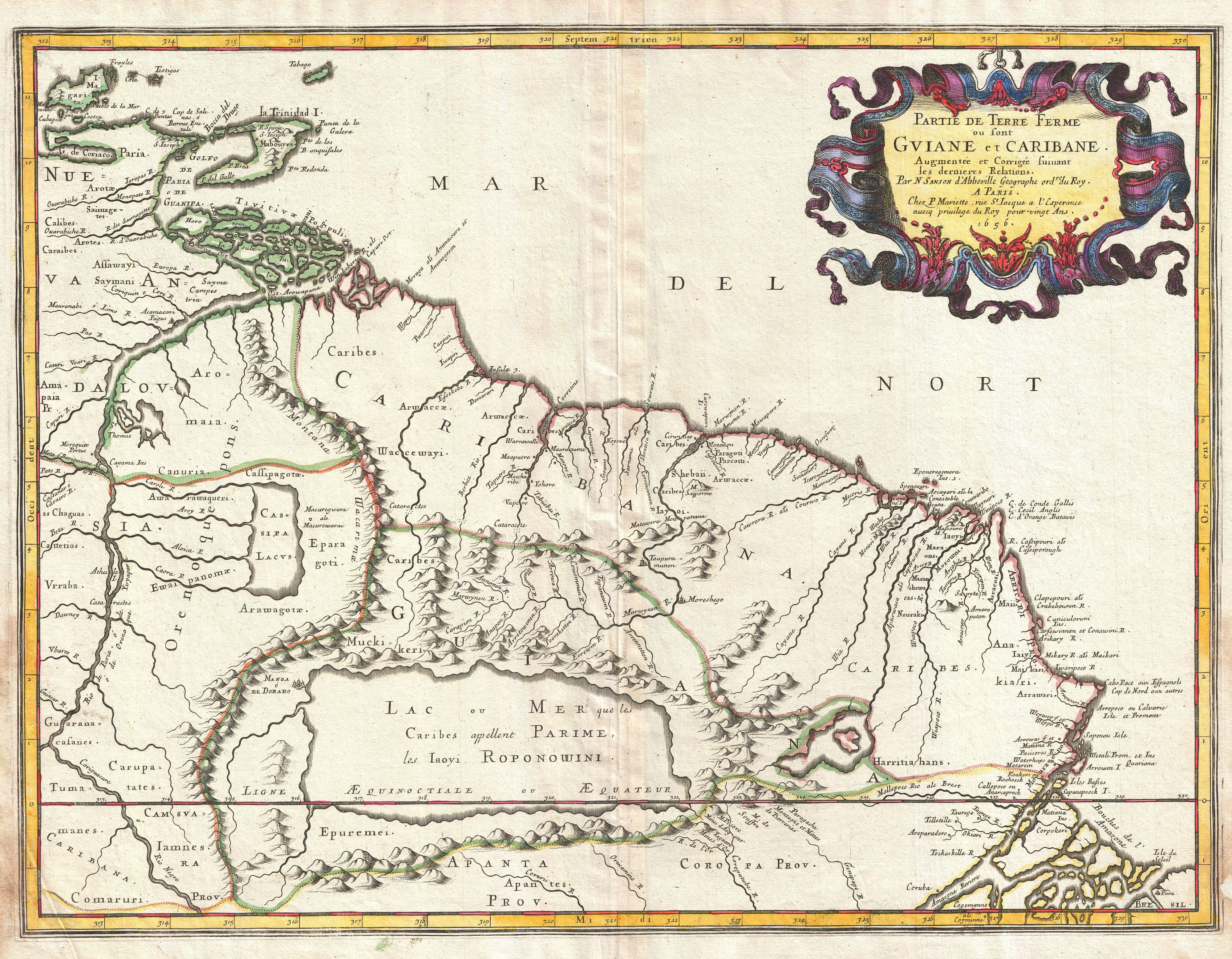
Several other expeditions set out in the direction of the supposed lake, but nobody was successful. Of course not. The lake, like the city of El Dorado itself, was just a myth.
Or was it?
According to our modern day oracle of Wikipedia, there is some geological evidence that suggests that there were indeed lakes in the past in the area where Lake Parime was thought to be, and that some those lakes could have carried gold that came from mountains upstream, leading to myths of an entire city of gold. Some researchers believe that the painted rock of Pedra Pintada was alongside an ancient lake. Others have found evidence that a 17th century earthquake drained an entire lake that could have been Lake Parime. But the one research paper cited on Wikipedia as reference to suggest that Lake Parime might have been the lake drained in a 1690 earthquake does not make this assumption at all.
Was there really a city of gold, or even a mysteriously vanished lake?
Citation needed.
Map: 1656 Sanson Map of Guiana, Venezuela, and El Dorado . Public domain. Via Wikimedia.
 The Finch and Pea
