
John Brunner’s mediocre Productions of Time

I’ve been drowning in job proposal/manuscript writing this month. I did manage to finish one of the growing stack of vintage science fiction weighing down my shelves: John Brunner’s The Productions of Time (1966), which sounded fun, but ended up disappointing.

Murray Douglas is a famous but washed-up actor, just out of rehab for alcoholism and trying to get back into theater. He gets recruited for an odd play project designed by an enigmatic Latin American playwright Manuel Delgado, whose past works have led to suicides and institutionalizations of the actors involved. Murray and the cast are kept in a lavish country club to work out the play, but Murray soon realizes that the theater project may be secondary. Delgado and his staff have rigged the place up with mysterious electronic devices that may be for eavesdropping, and and Delgado seems to be deliberately stoking to the sexual and narcotic vices of the oddly passive cast. Continue reading “John Brunner’s mediocre Productions of Time”
Living in South Carolina

Now that I live in South Carolina, I get asked “how do I like it there?” a lot. This usually code for “how do I like living in a rural, cultural backwater?” This is somewhat fair, as the Civil War did start here, but not exactly accurate. Like all things involving interactions between people, it is complicated. I could try to convince them that South Carolina is not what you expect with personal stories and character references.

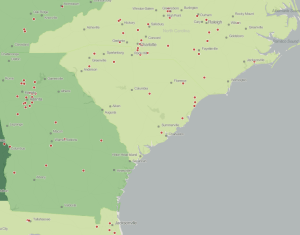
Instead, I’m just going to point to the data from FloatingSheep.org documenting the spate of racist tweets surrounding Obama’s reelection that showed that South Carolina only ranked 24th (of 51 – DC was included) in tweeted racism. Not ideal, but better than many would expect. For comparison, my home state (Ohio) ranked 23rd*, the state where I went to college (North Carolina) ranked 19th, the state where I went to graduate school (Missouri) ranked 8th, and the nation where I did my post-doc (UK) isn’t exactly sure if they have ever seen a black man before (92.1% white).

So, yeah, its OK living here.

I also like NASCAR (Tony Stewart, thanks for asking). So, that helps too.

Note that the results are based on a pretty small set of racist tweets <400. So, they should be taken with a big grain of salt.

*From looking at the data tables, I think Ohio and South Carolina are technically tied.

Math always wins

In the wake of Obama‘s re-election, people are going to spend a lot of time first crowing over the success of Nate Silver‘s election forecasting at FiveThirtyEight.com, then telling us all why he didn’t do that good of a job. The point is not that Nate Silver is a genius. The point is that these methodologies can be tested. We can see how they perform. Then we can tweak them and see if they perform better. As a whole, they are not going to get worse. And, these statistical methodologies are slowly creeping into the public view.

The pundits don’t want this to happen. They make a killing saying things that can’t get checked. They don’t have to update their methods. Accountability is anathema to pundits. One’s “gut” is not amenable to validation.

We can see this in baseball. We all know (among the set of people who care about baseball) that the “Moneyball” or sabermetrics approach is more effective than traditional methods of evaluating talent, which is more effective than the random citing of statistics used by play-by-play analysts.

Nate Silver’s forecasting was not the only coherent system for analyzing the election, nor was it the most accurate. The publicity afforded by his association with The New York Times made his predictions the test case for legitimate math and reason. Math won. It always wins.

*Paul Raeburn says essentially the same thing first, here.

Your glass of sweet tea is half full

Photo by nealpage (CC BY-NC 2.0)

Expectations are funny things. They can take the exact same experience and give it entirely different interpretations.

Why is having your half-empty glass of unsweet tea refilled with sweet tea so much worse than having a half-empty glass of sweet tea topped off with unsweet tea? Same drink. Different expectations.

The experience of half-sweet tea entirely depends on your expectations. In both situations, the quantitative experience is exactly the same. The qualitative experience is entirely different. Both are totally different.

Bees been struggling

In my random Netflix perusal, I came across a documentary about the striking loss of bee populations, The Vanishing of the Bees. I hadn’t realized this, but in industrial scale farming a large amount of pollinators are needed to pollinate fields of crops, many more pollinators than live in the area normally. Bee farmers fill this role by cultivating large colonies of bees. They move these bees around the country in semi-trucks to farms where they are needed. These bees are experiencing “colony collapse disorder” where entire colonies of bees are wiped out. Without pollinators, many crops will be drastically affected. Fellow blogger Michele has posted artwork that tries to draw attention to the plight of the bees.

While the research into colony collapse disorder is very complex and implicates multiple factors including diseases and pesticides, the documentary focuses on the potential contribution of  pesticide exposure to this disorder. Continue reading “Bees been struggling”