
Teach a child to think

LMU students taking a class at the LA zoo. Photo by Adan Garcia.

For the last month, the science policy group I belong to has been discussing K-12 STEM education. The United States’ scoring on international achievement tests has been falling since the 70s. You can look over the data for the most recent evaluation by PISA (Program for International Student Assessment) here. For all of our posturing as the most powerful country in the world, we are failing to give our children a competitive education. How do we turn the ship around and teach our children to think critically and help them prepare for a life in a rapidly advancing society?

Continue reading “Teach a child to think”

So I take it you aren’t happy with ENCODE…

Mike is very busy being an awesome scientist. So, I have the duty of reacting to the latest “ENCODE takedown” published by Graur et al in Genome Biology and Evolution: “On the immortality of television sets: ‘function’ in the human genome according to the evolution-free gospel of ENCODE”. The title kind of tells you that the ENCODE consortium has a snowball’s chance in Hell of coming out of this one looking good – not that the paper was written by unbiased critics. Continue reading “So I take it you aren’t happy with ENCODE…”

Rock Out!?

What is science-y about stories of my kids being adorable. Well, on the one hand, they are statistically significantly more adorable than average*. If it helps, I also refer to them as our human genetics experiment (n=2)**.

Punkface MacGruder (2yo) to The Frogger (4yo): Sister, you want ROCK OUT!?

Me: Frogger, when someone asks you if you want to ROCK OUT!, you say “YES!”

* Which, I suppose, would be an example of unconscious bias influencing a study’s results – if it weren’t also true.

** Also, evolutionary theory dictates that my fitness is determined by children.

Lucretius: Lightning is not a means of divine communication

ThetriumphofdeathThe Nature of Things is an unfinished poem, but the sudden ending gives the finale an ironic twist: although a major purpose of the poem is to alleviate our fear of death, it ends in a fearsome, apocalyptic description of the plague that ravaged Athens during the Peloponnesian war.

Before that, Lucretius devotes much of the final book of his poem to a natural explanation for that perennial favorite signifier of the divine mood: the weather. Having spent the last few years in the U.S. Midwest, I’ve developed a fresh, first-hand appreciation for the destructive power of storms. (Given recent meteorological trends, it’s hard not to gain a first-hand appreciation of such destruction no matter where you live.) Before weather.com, radar images, and other tools that give us some predictive power, the violent and capricious nature of bad weather was perhaps easiest to understand as a means of communication between gods and humans.

Lucretius says that ascribing weather to gods is nonsense: Continue reading “Lucretius: Lightning is not a means of divine communication”

Words someone who does art wrote about why they make art

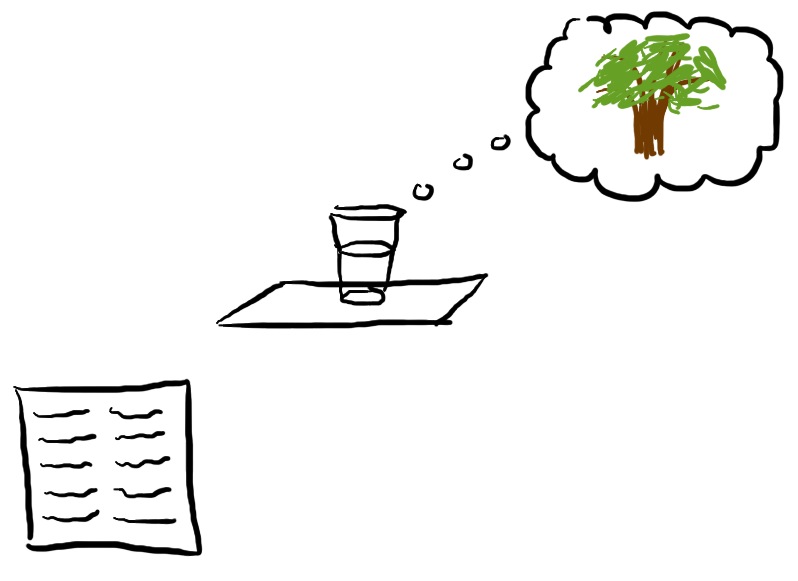
Author's impression of Michael Craig-Martin's "An Oak Tree"Our favorite coffee shop in Hartsville is The Midnight Rooster. It is home to “the crocodile table”, lattes made with a Southern sense of urgency, and delicious chocolate chip cookies. Today, my daughter, The Frogger, and I were passing some time between one errand and the next. The Midnight Rooster also has lots of art books from exhibitions. So, I got to read artist statements. Just back from ScienceOnline, my scientist soul is feeling properly chastised about the use of jargon.

Talk about jargon. We science nerds have nothing on these artists. Continue reading “Words someone who does art wrote about why they make art”