Sunday Science Poem: Abstraction is crucial in science and poetry

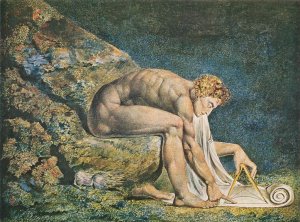
Newton-WilliamBlakeI recently heard a presentation by the Caltech biophysicist Rob Phillips, in which he issued a challenge to those who claim biology, in contrast to physics, is too complex and messy to be understood with mathematical theories: take a look at Tycho Brahe’s 16th century astronomical data, and see if you can make sense of it without math. Take a look at the data, and see if you can demonstrate, without a mathematical theory, that the orbit of Mars is an ellipse.*

In order to understand the messy real world, scientists use abstractions that can be quite distant from our everyday experiences. The historians of science Stephen Toulmin and June Goodfield explain how this was crucial to Newton’s method:

[W]here Aristotle’s theory of motion was based on familiar, everyday principles, Newton’s was stated in terms of abstract mathematical ideals. The circling heavens, a falling stone, smoke rising from a fire, the steady progress of a horse and cart: these were the objects by comparison with which Aristotle explained other kinds of motions. For Newton, on the other hand, the explanatory paradigm was a kind of motion we never encounter in real life. Nothing ever actually moves uniformly and free of all forces, at a steady speed and in a constant Euclidian direction. Yet Newton was able to bring together the threads left loose by his predecessors by systematically applying just this abstract idea of ‘natural’ motion. So far from being guided by experience alone, he could not afford to be too much tied down to the evidence of his senses, or to the results of experiments: it was, rather Aristotle who stuck too closely to the facts. Newton was ready to imagine something which was practically impossible and treat that as his theoretical ideal.

Musicians, artists, and poets have also found that abstraction is crucial. The abstract features make it tough for most of us to grasp modern works. Jacques Barzun explained it this way:

Like the would-be purist in art, the scientist takes a concrete experience and by an act of abstraction brings out a principle that may have no resemblance to the visible world… Poets and prosaists, whether Abolitionist, Decadent, or Symbolist, found that to create works adequate to their vision the language must be recreated.

If we recognize the common role of abstraction in art and in science, the baffling poetry of someone like Arthur Rimbaud begins to make much more sense.

Continue reading “Sunday Science Poem: Abstraction is crucial in science and poetry”

This is not a Prisoner’s Dilemma, or is it?

A little bit ago, Cory Doctorow posted a story from Inside Higher Ed about students organizing to beat the curve in a Johns Hopkins computer science class. The professor, Peter Fröhlich, scales grades based on the highest grade1. The students all refused to take the test, making the highest grade a 0. Thus, a 0 was an A, meaning they all got As.

…students in Fröhlich’s…classes decided to test the limits of the policy, and collectively planned to boycott the final. Because they all did, a zero was the highest score in each of the three classes, which, by the rules of Fröhlich’s curve, meant every student received an A…The students waited outside the rooms to make sure that others honored the boycott, and were poised to go in if someone had. – Zack Burdyk, “Dangerous Curves” from Inside Higher Ed

Doctorow labeled this as a solution to the Prisoner’s Dilemma. A brief perusal of the 113 comments on his post will convince you that the internet thinks that this is NOT an example of the Prisoner’s Dilemma. Continue reading “This is not a Prisoner’s Dilemma, or is it?”

’80s Creep – Mother Goose Rock ‘n’ Rhyme

Everyone identifies the 1980s as the decade before the discovery of irony. I grew up in the ’80s and will testify that they were frighteningly sincere. What is forgotten when we look at the ’80s is that social trends do not care for arbitrary time units. There was a lot of “’80s” in the ’90s* – a point proven by the release in 1990 of Mother Goose Rock ‘n’ Rhyme. In Mother Goose Rock ‘n’ Rhyme, Mother Goose goes missing and her son must embark on a musical adventure to find her before bad things happen. What makes Mother Goose Rock ‘n’ Rhyme ’80s sincere is the star level at the time of the singing nursery rhyme characters he encounters on his way. Harry Anderson (Night Court) is Peter Piper. Cyndi Lauper is the Mary who had a little lamb. Little Richard (co-inventor of rock ‘n’ roll) is a very merry Old King Cole. ZZ Top are the Three Men in a Tub. The list goes on.

Today, only Sesame Street has that kind of pull.

*Nirvana wasn’t even a thing until 1991 when “Smells Like Teen Spirit” from Nevermind broke big for them.

**This came up because my daughter’s dance class appears to be using one of the songs from Mother Goose Rock ‘n’ Rhyme, which, to my undying shame, I recognized and may have sung along too.


Home field intimidation

According to a paper from Marshall Jones of Penn State in Psychology of Sport and Exercise (you can read it for only $31.50), home field advantage is far more prevalent in subjectively judged, independent sports, like diving and gymnastics, than in objectively judged sports, like sprinting and the biathlon.

Subjectively evaluated sports such as diving, gymnastics, or figure skating usually show sizable and significant home advantages. Otherwise, occasional findings have been reported but they are not consistent within a sport, are generally weak, and often statistically unreliable. – Marshall Jones

This dovetails nicely with the home field advantage phenomena reported by L Jon Wertheim and Tobias Moskowitz in Scorecasting for team sports like baseball, basketball, and association football (aka, soccer) on points of subjective judgments (eg, strike zone, certain fouls, and extra time, respectively).

Taking together, this suggests that home field advantage is a result of the crowd intimidating the officials, not the crowd boosting the morale of the home team.

Some light reading for fellow science fiction junkies

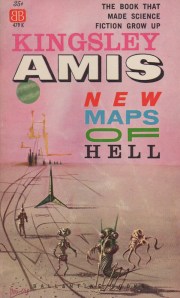
amisnewmapsofhellAt last: I’ve got an author index of my science fiction reviews here at The Finch and Pea. If you compulsively read vintage science fiction like me (my interests mostly fall in the ~1945 to 1986 range), then you may just find something to your liking here.

Why vintage science fiction? It is a literature that has a lot to say about our culture’s relationship with science and technology, one that has developed some striking metaphors for science and nature.

Over the last few years I’ve managed roughly 30 reviews, fewer than I’d hoped, but not too shabby. Up next is a series on Big Dumb Object science fiction, already begun with Rendezvous with Rama. Coming up soon will be a discussion of Niven’s Ringworld, Varley’s Titan, Bob Shaw’s Orbitsville, Greg Bear’s Eon, and finally, once I finish working my way through the Polish original, Lem’s Solaris. Continue reading “Some light reading for fellow science fiction junkies”