
…but my business cards are “cool”

20130808-000424.jpg
One Version of My Business Cards (Art by Jill Powell; Used With Permission)

It’s true. They are. They are those trendy small ones. They have a QR code. And, most importantly, they have original, The Finch & Pea inspired artwork by Jill Powell. At the 2013 Santa Fe Science Writing Workshop, I gave one of those cards to Karen McLeod of COMPASS. That lead to a thoroughly enjoyable conversation with COMPASS’s MBA intern, Ben Hamm.

Ben has been investigating how COMPASS might help improve interactions between the business and scientific communities. I, apparently, was one of 40+ “thinkers” he talked to about this topic. Fortunately, the other 39+ thinkers were able to make up for my ramblings. Ben summarized some of what he learned from these interviews in a very thoughtful blog post “Looking Beyond the Business Card”:

But over the course of more than 40 interviews with thinkers in nonprofits, government, journalism, and the private sector, I discovered a cultural divide among scientists themselves – between academics and their counterparts in industry. . .While there’s plenty of cross-pollination between university and commercial scientists on topics like chemistry, geology, and medicine, it seems that communication grows thinner in more interdisciplinary and holistic fields like ecology and climate. If this is true, it points to many missed opportunities for both groups to learn from one another.

Sunday Science Poem: Lord Byron’s Post-Apocalyptic Vision

‘Darkness’, Lord Byron (1816)

HubertLouvreRuinsDarwin’s argument for evolution by natural selection gets a lot of attention as the science bombshell of the 19th century that shocked the sensibilities of Victorian society, but there was an equally consequential, if less dramatic, scientific development that took place much earlier in the century, a development that left a deep impression on the generation before Darwin: William Herschel’s discovery that the universe is much bigger and much older than nearly anyone had imagined.
William Herschel’s scientific findings, made with his ever larger telescopes, were a frequent target of Romantic poets’ imaginations, and towards the end of his career, Herschel’s speculations about the past and future of the cosmos fed Romantic angst over the role of God and humanity in what now seemed to be a jaw-droppingly vast cosmic stage.

Among Herschel’s more disturbing ideas is the notion of a natural end to the Milky Way. As Richard Holmes notes in The Age of Wonder, Herschel jarred the poet Thomas Campbell by explaining that the night sky was filled with “many distant stars [that] had probably ‘ceased to exist’ millions of years ago, and that looking up into the night sky we were seeing a stellar landscape that was not really there at all. The sky was full of ghosts.”1 Continue reading “Sunday Science Poem: Lord Byron’s Post-Apocalyptic Vision”

The paradox of more science funding, less research… we’ve seen this before

Does this sound familiar?

Since 19XX, overall federal research funding in all fields has shown a steady increase, resulting in greater than 40 percent growth (adjusted for inflation) from 19XX to 19XX. University-based researchers have been the primary beneficiaries of this growth. Although the data are harder to come by, relevant Figures from [Agency X] and several universities indicate that the growth in funding for XXX research has been comparable to these overall trends.

However, these figures lump together many different kinds of projects and funders. For example, one element of xxx funding is the base-funded (or core) program, which is the primary source of support for small science endeavors. This report looks at base-funded programs at both NSF and [Agency X] and finds, contrary to the trends described above, that they have not even kept up with inflation and have certainly not been able to keep pace with the explosion in grant requests. As a result, grant sizes have decreased, and the percentage of proposals accepted has dropped. A rough calculation shows that researchers must now write two to four proposals per year to remain funded, up from one or two in 19XX. Of course, increasing the time spent searching for support means that less time is spent on productive research. Rising university overhead and fringe benefit costs, that consume more and more of each grant dollar exacerbate this problem. Clearly, the base-funded program has not participated proportionately in the overall XXX research funding increase. Although we do not attempt to quantify the effect this has had on the quality of science produced, we do find that the core program has become much less efficient during the past decade. We also infer that the lion’s share of new funding has gone into project-specific funding, most of which involves big science efforts.

I’ve blanked out a few things… can you guess what area of research and what time period this refers to? The answer is below the fold. Continue reading “The paradox of more science funding, less research… we’ve seen this before”

Academics on the Internets

Via Scott Esposito, I read David Parry on why academics should write more for the general public:

Meanwhile, the general public perceives faculty members as isolated from reality, holding cushy jobs, and uninterested in open communication. The public has little access to the broad diversity of knowledge, experience, and background inside higher education, because those academics who do achieve broader platforms generally come from only the most elite universities. Although many of those public intellectuals are brilliant writers and speakers, they represent only a tiny percentage of the expertise available in the academic world.

This raises the question of what academics have to offer large online media outlets that is different from what excellent professional journalists offer. My first thought is sheer number: there aren’t enough excellent professional journalists who can write competently on certain specialized topics (e.g., we have a lot of great political and sports journalists writing even for smaller outlets, but fewer great science journalists); academics can help fight the good fight and take good opportunities that come their way. Continue reading “Academics on the Internets”

Sunday Science Poem: Emily Dickinson and the Experiment of Consciousness

Emily Dickinson’s # 822

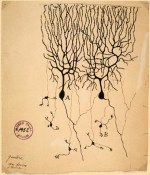
PurkinjeCellHow much consciousness is necessary for experience? Does a lobster or E. coli have experience, or does experience exist only with more awareness, awareness not just of the environment, the direction of a food source or a competitor for a mate, but awareness of self, of the passage of time, of the past, and of the alternative possibilities of the future?

In # 822, Emily Dickinson describes experience as an experiment in consciousness. Each of us, as a consciousness, is aware of environment (‘the Sun’), our fellow species members (‘Neighbors’). We share this basic level of awareness with much of the living world. A much rarer awareness, probably existing only in some vertebrates, is self-awareness (‘itself’ is used five times in this poem of 67 words), and awareness of death.

Beyond self-awareness, we have a capability for mental experimentation that is only possible with language, and is thus probably unique among organisms. Here is how Daniel Dennett illustrates this capacity: Continue reading “Sunday Science Poem: Emily Dickinson and the Experiment of Consciousness”