Mythology is Gross

Genealogy of the Olympians in Greek Mythology (Wikipedia)
The authors of this encyclopedia do a good job of illustrating that myths have many variant versions.

Samuel Arbesman has a fun, if creepy, post over at Wired on calculating how inbred the Greek gods were. Previously, here at The Finch & Pea, we’ve taken on the inevitable inbreeding that must have occurred in Adam and Eve’s family, which provides some additional explanation of what exactly geneticists mean by “inbreeding coefficient” and what the consequences of inbreeding can be.

I’ve thought about taking on the genetics of the Greek gods before on these grounds, but have always gotten overly hung up on the many variants of the origin stories that often exist for each god. For the gods’ sake, Aphrodite has an origin story that has her arising as a female clone from Uranus’ castrated testicles (most likely due to the SRY gene never being expressed during development).

A Network of the People’s Comments on Net Neutrality

The FCC received over one million comments on Net Neutrality. You might remember their website crashing and deadlines being extended. NPR reports the results of an analysis of a subset of the comments by data-analysis firm Quid. Their state by state analysis shows that I’m one of the few people in South Carolina that cares about Net Neutrality.

They have produced an even more interesting visual that maps out the diversity of reasons given to support Net Neutrality and how those reasons were linked in the comments.
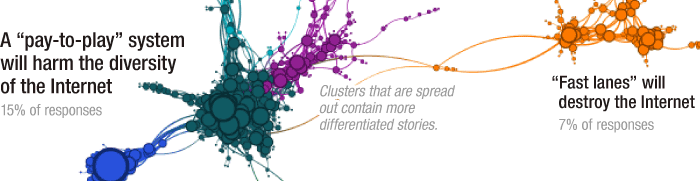
gr-neutrality-comments-624

Apparently, the few anti-Net Neutrality comments were from form letters and didn’t register on the map.

Although sites like the Electronic Frontier Foundation’s (EFF) web tool provided a template for letters, those were used to generate only about half of the comments (apparently, 80% is more typical for other regulatory issues).

Templates are not unusual. As we’ve reported previously, when the public is asked to comment on policy, citizens often engage by sending in a templated or form letter that advocates for a certain position help them create. The Quid analysis shows about half the comments received by the FCC were “derived from templates.” That’s actually low compared to analyses of other rule-making — upwards of 80 percent of comments on financial regulation were templates. – Elise Hu at NPR


My comment to the FCC, for example, was derived from EFF’s template.

Will this work? Hard to know giving the obstacles faced; but the FCC will clearly be on the record for killing Net Neutrality against the will of the people.

HT: Rob Beschizza at BoingBoing

The First Modern Post-Apocalypse Novel: After London

Richard Jefferies’ After London (1885)

bankofenglandruinsGothic and Romantic writers — like Cousin de Grainville, Lord Byron, Edgar Allen Poe, and most significantly, Mary Shelley — wrote the first important End of the World fiction early in the 19th century. But as Romanticism waned, the nascent genre languished for half a century, until it came roaring back with a new wave of future fiction that occurred during the last few decades of the century. Alongside various utopias (Looking Backward: 2000 to 1887), dystopias (Caesar’s Column), and future war stories (Battle of Dorking), post-apocalyptic fiction became popular among writers in Britain, France, and America. The familiar genre images of the primitive society, the wasted city, the ruined Statue of Liberty, the cataclysmic new ice age, and the barren, Dying Earth, was all there in the best-selling, futuristic fiction at the end of the 19th century. The genre has been popular ever since.

The first post-apocalyptic novel of this new wave of future fiction was Richard Jefferies’ 1885 After London. As we all know, End of the World fiction is most often about the end of the world as we know it and its aftermath — not about the utter extinction of humans or the complete destruction of life on earth. Earlier Romantic writers were an exception; they really did deal with the utter end of the world. But After London is about the survivors and the transformed world they’ve inherited. Continue reading “The First Modern Post-Apocalypse Novel: After London”

Limited Returns on Shark Week

Apparently, Shark Week did not help the stock price of Discovery Channel’s parent company (Discovery Communications, DISCA), according to this article from CNN Money.

Despite that success, investors aren’t biting. Shares of Discovery Communications(DISCA), which owns the Discovery Channel and networks like Animal Planet, have flatlined this week.- Matt Egan at CNN Money

This might sound like good news for those of us who find that Shark Week has increasingly become a week of inaccurate, fear mongering programs. Many shark scientists and conservationists have taken every opportunity available to register their problems with the program contents. Continue reading “Limited Returns on Shark Week”

Happy Phi Day! Take 3

Note: What follows is pretty much fluff, like a great deal of my writing. I want the world to be a “funner” place. Over the past several days, however, events in the area (St. Louis) I used to call home have been anything but fun. I started this post last week and decided to finish it this morning as a break from staring impotently at the news in my Twitter feed.

Today marks the third anniversary of my quixotic quest to get 14 August recognized as Phi Day.

I am all for cheesy, sciencey holidays like Pi Day and Mole Day. Holidays are fun. When they are at their best, they also teach us something. Religious and civic holidays are meant to transmit lessons – think of Martin Luther King, Jr. Day, Passover, Memorial Day, and Christmas. Some do a better job than others (I’m looking at you Columbus Day). Why shouldn’t our sciencey holidays also convey meaning about the thing they are representing?

Think about this exchange:

Me: Happy Phi Day!

You: What is “Phi Day”?

How we respond depends on which day we choose for Phi Day. Continue reading “Happy Phi Day! Take 3”