
ENCODE Media FAIL (or, Where’s the Null Hypothesis?)

I’m ready to drink myself into a stupor, and not because it’s my birthday. This week we’re seeing a massive science reporting fail on a large scale. And just to be clear, I’m not only (or even mostly) blaming reporters.

We’ve known for a long time that protein-coding genes are regulated by non-coding DNA sequences, ‘gene switches’, if you will. We’ve known for decades that the genome contains many ‘gene switches’. (See the references in this review.) That’s uncontested.

ENCODE is significant because they’ve provided a very useful data set, and not because they’ve a) shown that non-coding DNA is important (we knew that), or b) most of the genome has phenotypically important regulatory function (it does not), or c) that most of the genome is evolutionarily conserved (not true either). What they have shown is that much of the genome is covered by introns, and it is hard to find biochemically inert DNA, which those of us who’ve tried to generate random, ‘neutral’ DNA sequences (for say, spacers in synthetic promoter experiments) will agree with.

Now, let’s see how major media stories are handling the significance of ENCODE (h/t to Ryan Gregory for compiling the list of stories): Continue reading “ENCODE Media FAIL (or, Where’s the Null Hypothesis?)”
ENCODE Decodes the genome… but how much is functional?

The latest round of ENCODE papers are out, accessible via a handy ENCODE explorer gateway at Nature. I know what I’ll be doing for the next week. Stay tuned for more Finch & Pea coverage of what all this means, but I can’t resist a few brief comments about function.

First, you can immediately dismiss the NY Times’s misleading headline that suggests much, much more of the genome is functional than we previously thought. Being an intron counts as ‘function’ here, which is a pretty low bar to meet. The ENCODE results indicate that much of the genome is represented within introns, which I find fascinating, but that’s not something that forces us to dramatically revise our ideas about function in the genome.

Second, I’m going to claim (without any proof whatsoever) the title of the world’s record holder for “the largest number of randomly generated DNA sequences tested for function in an enhancer assay.” Hopefully in the not too distant future you can read in print about the 1000+ random sequences (plus several thousand genomic sequences) we tested in our new, smokin’ hot, high-throughput enhancer assay, but here’s the punch line: it’s not that difficult to randomly generate a DNA sequence that will drive substantial tissue-specific transcription.

In other words, whether it’s been selected for function or not, DNA is generally not biochemically inert.

P.S. This seems to be consistent with Ewan Birney’s comment, “It’s clear that 80% of the genome has a specific biochemical activity – whatever that might be.”

P.P.S. Brief methods: We took sequences under ChIP-seq peaks, thoroughly scrambled them while preserving the original di-nucleotide frequencies, and dropped them upstream of a basal promoter to test for enhancer activity.

If you want a paradigm shift, don’t go looking for it

“In science… novelty emerges only with difficulty, manifested by resistance, against a background provided by expectation.” – Thomas Kuhn, The Structure of Scientific Revolutions

Organizations that fund scientific research love to call for paradigm-shifting proposals. And scientists love to think that their latest work is smashing down staid, old paradigms. But this focus on paradigm shifting gets Thomas Kuhn exactly backwards. If you want a paradigm shift, don’t go looking for it.

That’s Kuhn’s major point in this week’s The Structure of Scientific Revolutions reading. Last week, we had a broad discussion of Kuhn’s ideas about pre-paradigm science, what a paradigm is, and why normal science is like solving puzzles. This week we’re going to be a little more focused: we’re going to talk about four pages – p. 62-65 – instead of four chapters.

Read these four pages, and you’ll understand more about Kuhn’s view of science than just about anyone who talks about paradigm-shifting. Continue reading “If you want a paradigm shift, don’t go looking for it”

Hitting the bottle

After listening to Chris Hardwick, Jonah Rey, and Matt Mira interview Thomas Jane and his cat on The Nerdist Podcast, I felt like checking out the short Punisher red band fan flick made by Jane, who played the Punisher in 2004.

DO NOT WATCH if you are squeamish, at work, in the company of impressionable children, or have a wide variety of medical conditions.

Continue reading “Hitting the bottle”

Even Bugs are Going Green

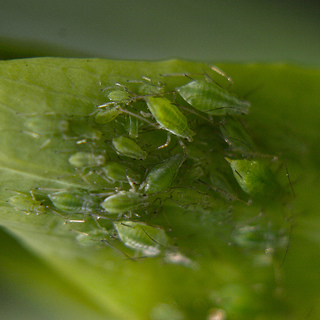
Aphids on the underside of a leaf

Aphids, the scourge of many a gardener, may be the first insect found to use photosynthesis (in addition to wrecking your lettuce). It seems a bit greedy to eat up all of my tomato plants if you can still make energy just basking on the shriveled remains of my plants. Photosynthesis is the process of generating chemical energy from light energy derived from the sun. This puts aphids in the category of the most advanced organisms using photosynthesis including sea slugs and salamanders. In addition, plants, algae and some bacteria have been known to use this process to fuel their energy needs.

Aphids are small insects that feed on a great number of plant species. They have been shown to make their own carotenoids, molecules necessary for oxidation control or light detection. This is the first animal known to make it’s own carotenoids and not require them from their diet.

A new article in Nature shows very early evidence that aphids are using these carotenoids to generate chemical energy from the sun’s light energy. While the evidence is still preliminary, aphids could turn out to be much more than just plant sap suckers. It still doesn’t make me feel any better about my garden.