Breaking in order to Build: Part 2

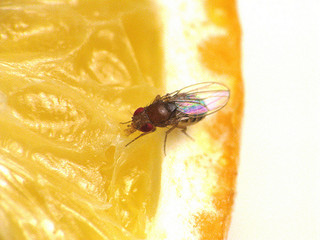
Image Courtesy of Michael Schmidt

I recently wrote about how breaks in neural DNA may be part of the process our neurons use to generate new memories. About the same time, I found a new study in Science that addressed the role of the genome in neurons from a different angle. It turns out that Drosophila (fruit flies) have particularly heterogeneous genomes in the neurons associated with learning and memory. Now let me back up and explain exactly what I mean by heterogeneous genomes and how that can affect learning and memory. Continue reading “Breaking in order to Build: Part 2”

Francois Jacob, 1920-2013

François Jacob, a pioneer in our understanding of the regulation of gene expression, passed away on Friday. His work with Jacques Monod was foundational to much of the work in my PhD thesis lab and inspired our approach to understanding splicing regulation in my post-doctoral lab. Like many true insights, his realization about a basic mechanism of biology was so basic and fundamental that seemed like the kind of thing we must have known all along. Maybe we did, but until François Jacob we didn’t know we knew it.

Carl Zimmer tells the story of Jacob’s moment of insight:

In the darkness of the Paris movie theater, Jacob hit on an answer. The repressor is a protein that clamps on to E. coli’s DNA, blocking the production of proteins from the genes for beta-galactosidase and the other genes involved in feeding on lactose. A signal, like a switch on a circuit, causes the repressor to stop shutting down the genes…Perhaps these circuits are common in all living things…But when François tried to sketch out his ideas for his wife, he was disappointed.

“You’ve already told me that,” Lise said. “It’s been known for a long time, hasn’t it?” – Carl Zimmer

*Hat tip to Heidi Smith via PZ Myers.

Clear brains you say??

Karl Deisseroth
Karl Deisseroth

The interwebs have been abuzz this week about a new technique published in Nature coming from the Deisseroth Lab at Stanford (formerly of optogenetics fame). Now he’s the optogenetics guy AND the CLARITY guy, come on Karl leave something for the rest of us! Anyway, the new method allows entire brains, that have been removed from their respective skulls, to be processed into hydrogel hybrids that are optically clear and able to be labeled and observed all the way to their very center. This video is an example of a CLARITY processed mouse brain that is labeled with Thy1-GFP (green fluorescent protein expressed in ~10% of neurons). You can see individual neural cell bodies (the small round dots) and the projections from individual neurons (long thin fibers). Continue reading “Clear brains you say??”

“Take a Chance on Me”, only for suckers that can’t do a Punnett Square

Physicist Sara Callori uses Punnett squares to try to figure out who Sophie’s father really is in Abba’s Mamma Mia?.

One of the interesting implications of her approach is that our expectations would changes with each new casting of the musical.


Analyzing splicing via RNAseq

from Eduardo EyrasDuring my postdoc in Jernej Ule’s lab at the Laboratory of Molecular Biology in Cambridge (UK), we studied the genome-wide regulation of splicing (aka, alternative splicing, but these days all splicing is “alternative”). This involved integrating information on protein-RNA interactions with information on splicing isoforms (mRNA transcript variants from the same gene) from next generation sequencing. I could spend hours talking to you about how complicated this type of thing can get. Or, I can show you this figure from Eduardo Eyras.