Linkonomicon: Science, Democracy, and Plato’s Revenge

Some decisions clearly require expert knowledge, but democracy is a commitment to letting consequential decisions be resolved by a group of people who are clearly not experts on every important issue, i.e. all of us. And so we have a problem.

My favorite philosopher of science, Philip Kitcher, says Plato would think we’re crazy:

If the public does not think a particular issue should be addressed, then it is entirely right that nothing should be done about it. Plato saw this as a fundamental commitment of democracy, and, because he understood that people may be massively deceived – or misled – about what is in their interests, he drew the conclusion that democracy is a political disaster.

But Kitcher doesn’t think Plato should have the last word. Go check out his ideas about the role of experts in democracy in “Plato’s Revenge: An Undemocratic Report from an Overheated Planet”, via the journal Logos

MOOCs verus a science education

Are massively open online courses (MOOCs) going to revolutionize high education? Over at Pacific Standard, I argue that they won’t – at least not science education, and I suspect that’s true of most other areas as well.

The punch line:

Far from overturning the staid and overpriced traditional lecture model of education, MOOCs reinforce that model and conflict with recent research on how to teach technical subjects like science.

Continue reading “MOOCs verus a science education”

Daniel Dennett: I talk therefore I am

What makes us human? In the New Statesman, philosopher Daniel Dennett argues it’s language:

I think it is quite obvious that language is what sets us apart from all other animals. But what is less often recognised is how language enables all the other distinctly human phenomena, transforming inherited “animal” dispositions, instincts, desires and tastes into forms that bear scant resemblance to their ancestral forms…

So utterly does language transform our minds that it is almost impossible to launder its influence from our imagination when we think of the “minds” of other species.

Language utterly and irrevocably changes our relationship with the world.

Sunday Poem outsourced to The New York Review of Books

I’m traveling with limited internet access, but it’s National Poetry Month. That means it’s not hard to find good poetry on the internet. For this week, let me direct you to The New York Review of Books’ feature on John Ashbury.

To whet your appetite, here are some technological metaphors for Ashbury’s process of creating poetry:

[S]omething irrevocably and personally fastidious does emerge from the industrial process which digests his love of art deco and old B movies, and—to quote Webster’s dictionary on the term—shows “the progress of materials through various stages by means of a manufacturing process.” That “schematic diagram,” claims the jacket copy, is “nothing less than the entire poem itself.”

Industry is now old hat in poetry, but perhaps not quite in this sense. Ashbery’s total and seemingly effortless absorption in the dense technology of modern living is a million years away from the days of the Thirties, when poets self-consciously made pylons stride across the uplands like nude giant girls. And yet Ashbery begins with “an emptiness / so sudden it leaves the girders whanging in the absence of wind.” His “newness” has a long history behind it, a history of poetic properties broken down for recycling but suddenly reconstituted in unexpected and effective ways, to lie around like the stranded monster rotting in the reeds of Rimbaud’s Bateau Ivre.

Sunday Science Poem: Abstraction is crucial in science and poetry

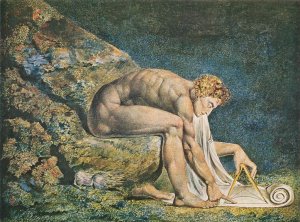
Newton-WilliamBlakeI recently heard a presentation by the Caltech biophysicist Rob Phillips, in which he issued a challenge to those who claim biology, in contrast to physics, is too complex and messy to be understood with mathematical theories: take a look at Tycho Brahe’s 16th century astronomical data, and see if you can make sense of it without math. Take a look at the data, and see if you can demonstrate, without a mathematical theory, that the orbit of Mars is an ellipse.*

In order to understand the messy real world, scientists use abstractions that can be quite distant from our everyday experiences. The historians of science Stephen Toulmin and June Goodfield explain how this was crucial to Newton’s method:

[W]here Aristotle’s theory of motion was based on familiar, everyday principles, Newton’s was stated in terms of abstract mathematical ideals. The circling heavens, a falling stone, smoke rising from a fire, the steady progress of a horse and cart: these were the objects by comparison with which Aristotle explained other kinds of motions. For Newton, on the other hand, the explanatory paradigm was a kind of motion we never encounter in real life. Nothing ever actually moves uniformly and free of all forces, at a steady speed and in a constant Euclidian direction. Yet Newton was able to bring together the threads left loose by his predecessors by systematically applying just this abstract idea of ‘natural’ motion. So far from being guided by experience alone, he could not afford to be too much tied down to the evidence of his senses, or to the results of experiments: it was, rather Aristotle who stuck too closely to the facts. Newton was ready to imagine something which was practically impossible and treat that as his theoretical ideal.

Musicians, artists, and poets have also found that abstraction is crucial. The abstract features make it tough for most of us to grasp modern works. Jacques Barzun explained it this way:

Like the would-be purist in art, the scientist takes a concrete experience and by an act of abstraction brings out a principle that may have no resemblance to the visible world… Poets and prosaists, whether Abolitionist, Decadent, or Symbolist, found that to create works adequate to their vision the language must be recreated.

If we recognize the common role of abstraction in art and in science, the baffling poetry of someone like Arthur Rimbaud begins to make much more sense.

Continue reading “Sunday Science Poem: Abstraction is crucial in science and poetry”
