
Finding function in the genome with a null hypothesis

Last September, there was a wee bit of a media frenzy over the Phase 2 ENCODE publications. The big story was supposed to be that ‘junk DNA is debunked’ – ENCODE had allegedly shown that instead of being filled with genetic garbage, our genomes are stuffed to the rafters with functional DNA. In the backlash against this storyline, many of us pointed out that the problem with this claim is that it conflates biochemical and organismal definitions of function: ENCODE measured biochemical activities across the human genome, but those biochemical activities are not by themselves strong proof that any particular piece of DNA actually does something useful for us.

The claim that ENCODE results disprove junk DNA is wrong because, as I argued back in the fall, something crucial is missing: a null hypothesis. Without a null hypothesis, how do you know whether to be surprised that ENCODE found biochemical activities over most of the genome? What do you really expect non-functional DNA to look like?

In our paper in this week’s PNAS, we take a stab at answering this question with one of the largest sets of randomly generated DNA sequences ever included in an experimental test of function. Continue reading “Finding function in the genome with a null hypothesis”
Sunday Science Poem: We live in the casts of our imaginations

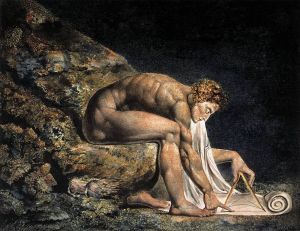
Wallace Stevens’ ‘Description Without Place’

779px-William_Blake_-_Isaac_Newton_-_WGA02217Science works by making models of the world. We need models, because the data rarely speak for themselves.

As individuals, we also work by making mental models of of the world, both at the automatic, neurobiological level where the brain assembles representations of the world from the neural impulses transmitted by our sensory organs, and at the conscious, conceptual level, the level where we consciously try, with limited information, to decide what’s going on in the world around us. Models mediate between us and reality.

Continue reading “Sunday Science Poem: We live in the casts of our imaginations”

Sunday Science Poem: Science and doubt on the naked shingles of the world

Matthew Arnold’s ‘Dover Beach’

Dover BeachFor at least a millennium in the West, Christianity was the dominant public perspective on how the world operates. That is no longer true. In our culture, science now explains the world.

Despite widespread private expressions of piety, in our public culture science is what we believe. Intelligent design, fad diets, ESP, or any other ideas that make a go at competing on science’s materialistic home turf all end up measured by science’s standard. This is why pseudo-science exists: you have to dress your ideas in a lab coat and protective eyewear if you want other people to believe your ideas about the physical world. That was not true when Victoria inherited the British throne in 1838, but it was largely true when she died in 1901. This was the result of a tectonic shift in the psychology of an entire society, and Matthew Arnold’s poem ‘Dover Beach’ captures the mental anguish of that shift. Continue reading “Sunday Science Poem: Science and doubt on the naked shingles of the world”

Sunday Science Poem: Cloning and other ways of taking adaptive matters into our own hands

Sally Van Doren’s ‘Adaptive’

VanDorenPOSSESSIVE_covfront_sized-300x450With the latest improvements in the technology for creating cloned human embryos, the science fiction idea of human clones is no longer quite so speculative. (Cloning livestock is not only not speculative, it’s almost routine.) In the near future we will have the ability to create, with the technologies of genome editing and cloning, upgraded versions of ourselves – in other words, taking our adaptation to our environment into our own hands, rather than simply accepting what we’ve been handed by evolution.1

Changing the meaning of our DNA to make a new version of ourselves parallels the much less ethically dubious process of reading a poem by deliberately adapting its meaning to our needs and interests as readers. Continue reading “Sunday Science Poem: Cloning and other ways of taking adaptive matters into our own hands”

Better stem cell tech, more controversy

Over at Pacific Standard, I offer brief layman’s guide to the latest pluripotent stem cell technologies, and I argue that better stem cell technology will not make the ethical controversy go away. (In last week’s Nature, Martin Pera & Alan Trounson make a similar point.)

To understand where I’m coming from, let’s take a step back a few years, in the aftermath of the Bush Administration’s controversial decision to limit NIH-funded research on human embryonic stem cell (ESC) lines. Back then, much of the debate was over the merits and ethics of ESC’s versus lineage-restricted adult stem cells: ESCs were for the most part derived from leftover IVF embryos or aborted fetuses (and thus didn’t carry the genome of a patient). Adult stem cells could be taken from patients, but were much more restricted in their potential applications. Dolly the sheep was old news at that point, but the technology to create Dolly (and thus also create embryonic stem cells with the genome of a living adult) did not actually work with human cells. Continue reading “Better stem cell tech, more controversy”