The Art of Science: Culture and Monoculture

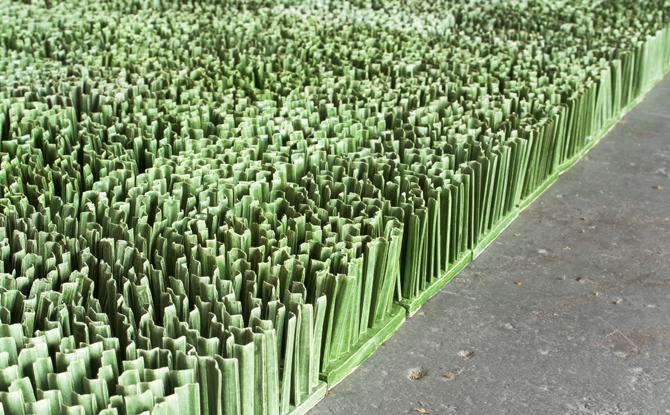
Dawn Holder, Monoculture, porcelain, 2013

Dawn Holder’s Monoculture is a porcelain replica of that American ideal, the perfect green lawn. Holder explains that she focused on the lawn because of its “multivalent nature.”

“It is a “natural space” in that it is comprised of plants and landforms, yet the lawn is a wholly artificial construct, a highly controlled space requiring labor, chemicals, and specialized equipment to maintain. I am fascinated by suburban America’s desire to construct this hybrid artificial-natural landscape and what it signifies in terms of time and resources. I think the lawn is our culture’s fantasy version of the natural world.” (source)

Holder’s piece, made from individually formed, glazed and fired pieces of porcelain, is also, of course, a “highly controlled space” that requires a lot of labor to create and maintain.

“The toil involved in the manufacture of these repetitive pieces mirrors the tedium of shaping and cultivating the landscape…Breakage and repair have become part of the labor of maintaining much of the work.” (source)

Holder’s piece is on exhibit at the National Museum of Women in the Arts, in Washington, DC, as part of a show called Organic Matters—Women to Watch 2015. The work seems especially timely as drought and climate change call into question whether humans can – or should – continue to exert this kind of control over the natural environment.

Perhaps one day, maybe sooner than we imagine, a museum will be the only place to see a perfectly tended green lawn.

Organic Matters continues at the National Museum of Women in the Arts through September 13.
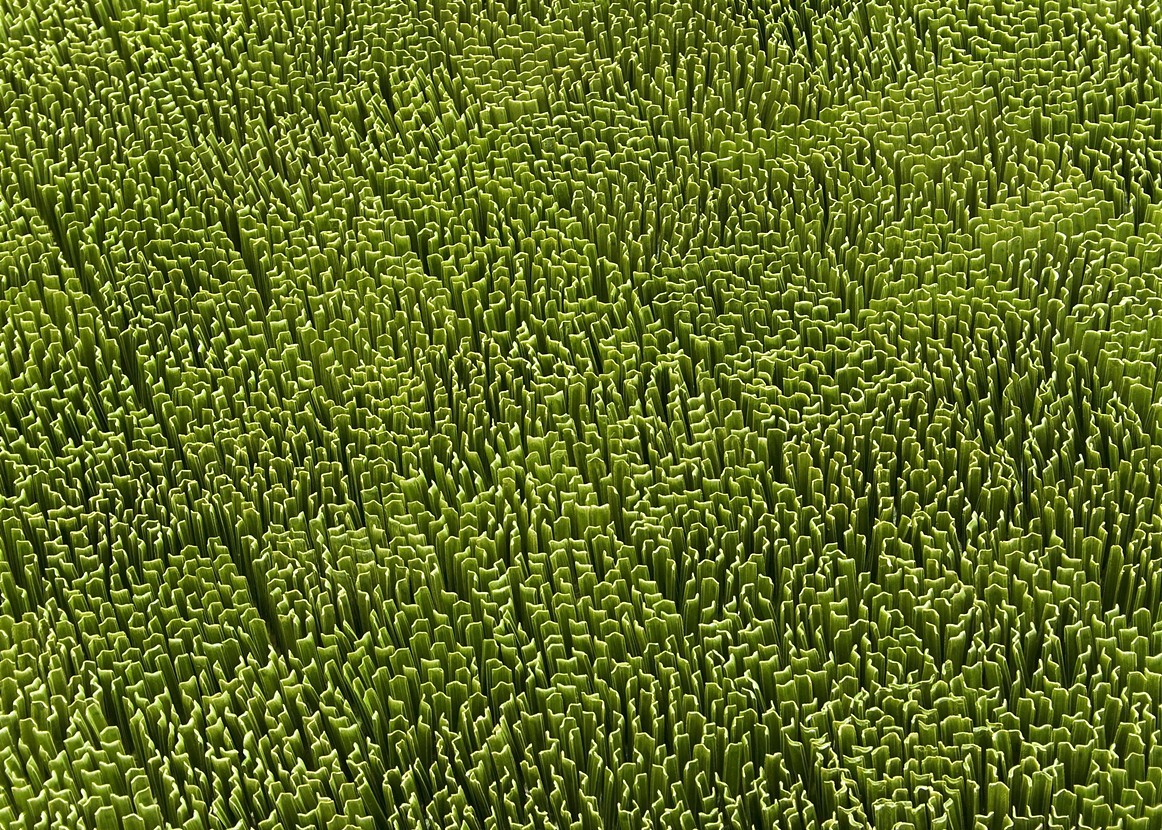
detail from Monoculture


Science Caturday: Pluto-monium!

pluto-lolcat

Among casual sky-watchers, Pluto is  best known for having its status downgraded from planet to dwarf planet in 2006. That has changed over the past few weeks, as NASA’s New Horizons Probe prepares to fly within 8,000 miles of Pluto on Tuesday, July 14.

New Horizons is already sending back loads of fascinating images of Pluto and more are sure to come. You can get all the latest updates by following @NASANewHorizons on twitter.

For more background about the discovery of Pluto and what scientists know so far about the “contentious little planet,” I recommend Nadia Drake’s excellent “Pluto At Last” at National Geographic.

It may no longer be called a planet, but this week, Pluto is the star.


The Art of Science: Decay All The Way

Artists have explored the beauty of decay  for hundreds of years. Images of dying flowers and falling-down buildings are potent reminders that life is fleeting and that nothing we build will last forever.  But of all the painters and poets that have pointed out this bittersweet fact, few get down to the nitty-gritty of decay quite like Sam Taylor-Johnson.

In her 2001 video piece Still Life, Taylor-Johnson (Formerly Sam Taylor-Wood, and yes, the same one who directed 50 Shades of Grey), presents a classic Renaissance tableau of a bowl of fruit on a table, sets up a camera and lets nature take its course. As the bacteria build up, the fruit begin to shrink and collapse upon themselves.

Unlike a traditional painter, who would typically suggest decay by showing fruit or flowers just past their prime, but still beautiful, Taylor-Johnson keeps the camera rolling until the all that’s left is a rotting black pile topped with angelic white mold, buzzed about by fruit flies.

One of the things that’s fascinating about watching the process is how the fruit keeps moving, at first shrinking and then seeming to regrow as the bacteria multiply furiously. It’s a truly visceral display of the circle of life. If you like this piece, and you have a really strong stomach, watch Taylor-Johnson’s video A Little Death of a dead rabbit (another classic art image) being devoured by insects.

If you’re in the DC area, you can see Still Life as part of the Super Natural exhibition at the National Museum of Women in the Arts until September 13.


Science Caturday: Happy 4th of July!

boomy

Cats and dogs may not be fans, but for most Americans, the defining feature of any 4th of July celebration is fireworks. Behind the spectacular explosions, of course, is science – physics and chemistry. Julia Greenberg gives a brief explanation of what’s inside fireworks at Wired (gunpowder, glitter and starch, basically), while Scientific American’s Science Buddies blog offers a kid-friendly tutorial on making sparklers in various colors.  But keep in mind, fireworks can be dangerous! Drew Magary at Deadspin rounds up readers’ best fireworks horror stories for your horrified holiday lolz.


Introducing Banks’ Second Theorem

A neighbor recently opened an etsy shop to sell her paintings. She asked me a bunch of questions about the process, which I was happy to answer. Then she asked me the essential question: “How do you get people to find you on the internet?”

Getting people to find me on the internet (ohai!) is the central struggle of my career. It’s a constant battle that I’ve been fighting every single day, with some success, for the past five years. But of course I didn’t tell my neighbor this, because I didn’t want to scare her off. So I suggested she start by posting her new shop on her Facebook page. “Well, that’s the thing, I don’t do Facebook.” Twitter? Nope. Instagram? What? We didn’t even get to the idea of submitting work to blogs.

I had a sudden flashback to a conversation with another artist a few years earlier, who complained that twitter wasn’t working well for promoting her work. “I tweet a lot,” she explained, “But I don’t actually READ tweets.” Dear fellow artist,

cheese-wrong

This is not to say that twitter is the only way to go, or that artists have to spend as many hours a day on the internet as I do. They probably shouldn’t!

procrastinate

But really, selling online has a lot in common with selling offline. You need to put in some time. You have to get out there and forge relationships. You need to know who the players are. I’m going to call this Banks’ second theorem:*

If you want to sell on the internet, you have to be on the internet.

If you had a brick-and-mortar shop, you would know the other shopkeepers in your neighborhood, wouldn’t you? Well, if you have an online shop, the internet is your neighborhood. Get out there, take a walk every day, and say hello. Read some blogs. Read some tweets. Make some intelligent comments. Show other people the cool things you find on your walks. Then say, “here, have a look at what I’m working on.” Repeat.

*I’ll get to the first theorem later. My blog, my rules.

(originally posted on Artoblogica)