The Art of Science – Giant Squid

Canadian painter Helen Gregory is serving as artist-in-residence at the Canadian Museum of Nature as part of her Ph.D program in at the University of Western Ontario. Since May, she has been exploring the museum’s collections, finding inspiration among the natural history specimens that inspire her work. A show of her work, dramatically titled Unrequited Death, is on exhibit at the museum in Ottawa, Ontario, until September 3.

Unrequited Death features eleven paintings that juxtapose biological specimens with ornate, romantic backgrounds reminiscent of the Victorian era.  Among the pinned butterflies and dead birds, one stands out: the giant squid.  It’s based on an actual specimen in the collection of The Rooms Provincial Art Gallery in St. John’s, where it was first shown in 2009. Let’s face it, it’s just not every day you see a 12-foot-long painting of a gigantic deceased cephalopod, so if you’re in Ottawa in the next few months, don’t miss this one.

Gregory uses painting to explore biological specimens both in relation to our knowledge of the natural world and our understanding of cultural meaning. “Objects are imbued with layers of meaning that shift with their context.  For example when a dead bird is picked up, preserved, labeled, catalogued, and held in a museum collection, it becomes more than a biological specimen: it makes the transition from natural to cultural artifact,” she notes.

Gregory will be speaking about her work on June 21 at the museum – details are here.  For more of her work, visit her website.
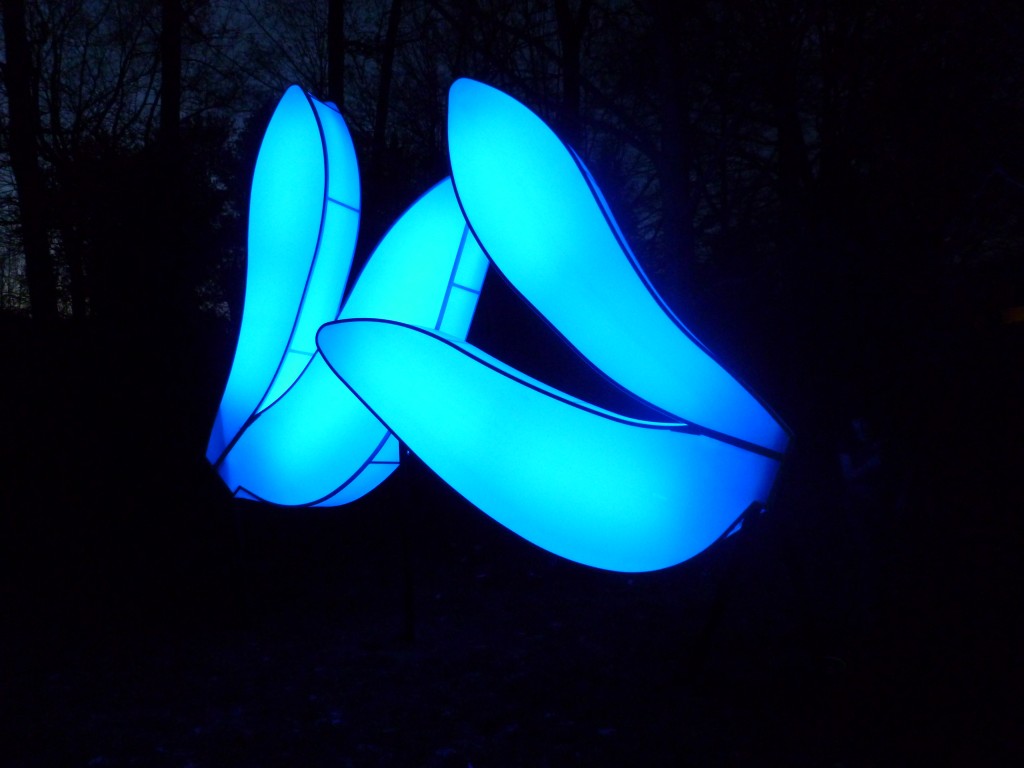
The Art of Science – Love Motel for Insects

Love Motel for Insects - DC

Love Motel For Insects is an outdoor light installation by Brandon Ballengée in the shape of giant dragonfly wings. The piece, which uses ultra-violet lights on blank fabric to attract insects, creates an opportunity for public interactions with nocturnal arthropods.  Ballengée, an American artist who has been working with environmental themes for years, began creating pieces to attract insects in Central America in 2001.

The dragonfly-wing sculpture seen here, which was on display at the Smithsonian’s National Zoo in Washington DC from March 24- June 10, 2012, is one of many such “love motels” that Ballengée has built.  According to the artist, ” Love Motel for Insects is an ongoing series of outdoor installations intended to construct situations between humans and arthropods. The works use ultra-violet lights on enormous blank canvases to attract insects and create an opportunity for public interactions with rarely seen nocturnal arthropods.  At each location, the Love Motels for Insects become the backdrop for community events such as picnics, biodiversity festivals, graffiti jams, scientific investigations, musical events and even local film screenings relating to local insect species.”

Currently, a piece in the shape of a luna moth is on display in New York City at the  sculpture court of  Jim Kempner Fine Art, at 501 West 23rd Street from June 9 through August 4 2012. Click here for more information. You can find out more about Ballengée’s other environmental artwork at this website.

The Art of Science – Crochet Caffeine Molecule

Crocheted Caffeine Molecule by Javelin Chi

Javelin Chi was trained as a chemist and now works as a research technologist at Agilent technologies in California . She first started crocheting in graduate school to relieve the stress of lab work. She eventually turned her hobby  into a professional sideline, selling her crocheted molecules on her Etsy shop, Prim and Plush,  and at craft shows. Continue reading “The Art of Science – Crochet Caffeine Molecule”

The Art of Science: Solar Burns

Charles Ross, Year of Solar Burns, 1992

The work of American artist Charles Ross uses natural light sources to create intriguing and stunning effects.  After working for many years with using prisms to create dynamic color and light effects in architectural spaces, Ross decided to change his focus.   Rather than dispersing sunlight through a prism he decided to focus it into a single point of raw power to create a solar burn. Each day for one year he burned the path of the sun through a large lens into a wooden plank. The burns were exhibited side-by-side  in an exhibition titled Sunlight Convergence/Solar Burn (1971-72). Continue reading “The Art of Science: Solar Burns”

The Art of Science – The Great Demise of the Pollinators

This week’s science art piece, The Great Demise of the Pollinators , an etching  by Nils Henrik Sundqvist, highlights a widely-known but poorly-understood environmental emergency – the huge, world-wide decrease in the numbers of pollinators. Continue reading “The Art of Science – The Great Demise of the Pollinators”