The Art of Science: Fujiko Nakaya Creates an Atmosphere

showa_5
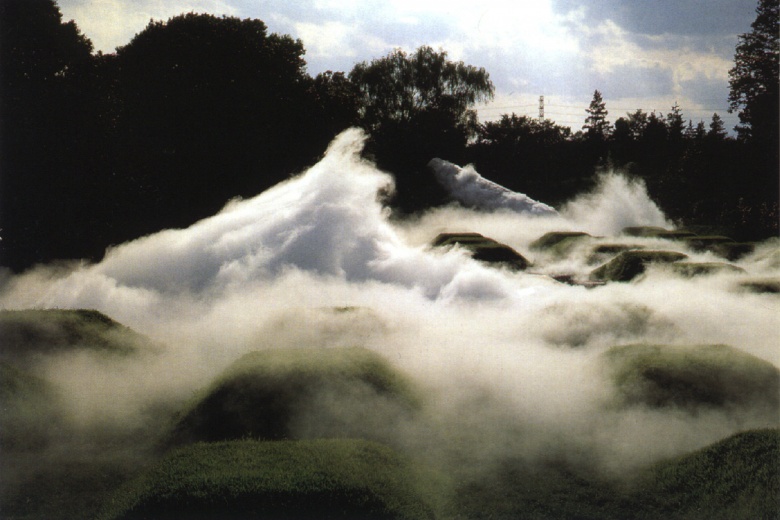
Foggy Forest, Tokyo, 1992
photo : Shigeo Ogawa

Fujiko Nakaya is the world’s foremost sculptor of fog. And in the sense that it is not really possible to sculpt fog, you could say she has been doing the impossible for over 40 years.

Nakaya began her career in Japan as a painter. But, frustrated with the limitations of painting and inspired by her father, a scientist who is credited with making the first artificial snowflakes, she essentially invented her own medium.  Working with engineers, she developed a system to create and disperse water vapor through pipes to create fog. For her first fog sculpture, she covered the entire Pepsi pavilion at Osaka’s Expo ’70 in fog. Since then, using the same technology, she has created more than 50 fog sculptures in environments ranging from art galleries to bridges to forests.

Using water vapor as a sculptural element is at once simple and profound.  It transfigures the environment, making the familiar seem strange and dreamlike, and then disappears without a trace, absorbed back into the air. The artist says that in ancient Japan, fog was seen as “the breathing of the atmosphere.”

Intriguingly, Nakaya’s latest fog sculpture is set to debut at the Exploratorium in San Francisco, a city famous for fog. Her work will be installed along a pedestrian bridge in the sure-to-be-spectacular new Exploratorium space which will open on April 15 on the Embarcadero waterfront.   As Nakaya explained to ArtNews, “On calm days, fog will bundle on the bridge and gently flow along the canal onto the ocean,” she says. “With a strong wind, it will hoist upward into the sky like a dragon. On humid days, it floats over the water and lingers in tufts. Its ever-changing form is the probe, in real time, of its immediate environment.”

If you can’t make it to San Francisco, here’s a video of Nakaya’s installation Cloud Forest, from 2010.
Science Bunday: Easter Special

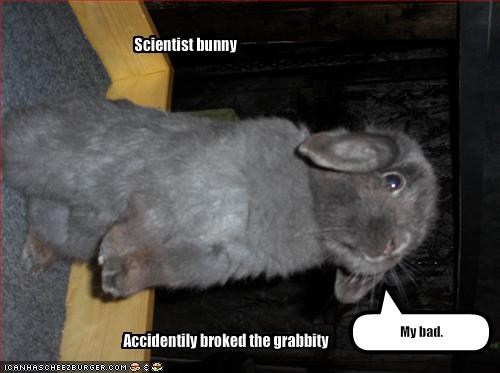
Oh, Science Bunny. Maybe stick to delivering eggs : (

bunneh

Science Caturday: Nootrishun Edishun

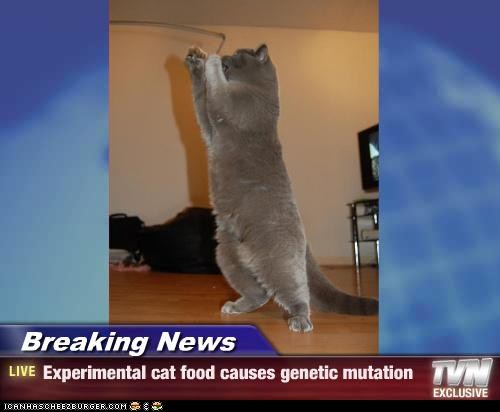
Looks like some naughty scientists allowed their kitties to test some highly experimental cat food, with regrettable results:

catfud1

Another tragic case:

catfud2

Some experiments, while not actually harmful, were also unsuccessful:

catfud3

Careful what you feed your cats, people.

all photos from Cheezburger.com

The Art of Science: Mark Dion’s Marine Invertebrates

markdion

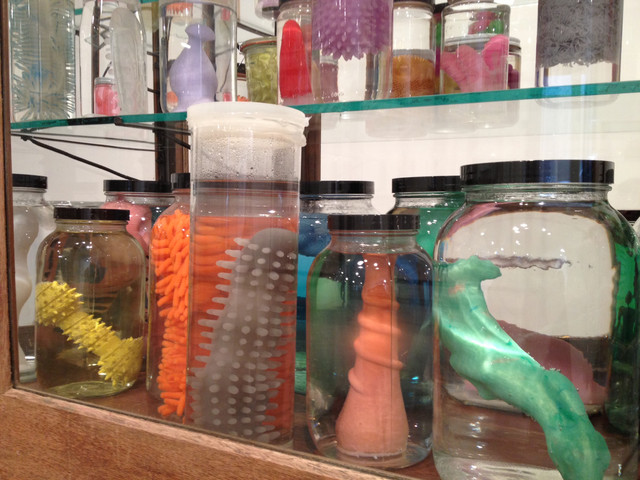
Andy Warhol famously said that “Art is what you can get away with.” It seems a good definition for this sculpture by renowned American artist Mark Dion.  The piece, Marine Invertebrates, is made up of dog toys and sex toys displayed in specimen bottles, as if in an old-fashioned natural history museum.

The toys, which bear an uncanny resemblance to real marine invertebrates,  continue Dion’s exploration of the ways that museums and other institutions shape our views of nature.   A show of his work, including this piece, is on exhibit at the Tonya Bonakdar gallery in New York city through April 13.

According to the gallery website, “Appropriating archaeological and other scientific methods of collecting, ordering, and exhibiting objects, Dion creates works that question the distinctions between objective (rational) scientific methods and subjective (irrational) influences. The artist’s spectacular and often fantastical curiosity cabinets, modeled on Wunderkabinetts of the 16th Century, exalt atypical orderings of objects and specimens….Mark Dion questions the authoritative role of the scientific voice in contemporary society.” (source)

On a less philosophical plane, my personal responses to this artwork were (in objective, rational, scientific order): 1. Hahahahahaha! 2. OMG that is amazing. 3. Damn, I wish I had thought of that.

More information on the Dion exhibit and his other works are at the Tonya Bonakdar Gallery website.

Science Caturday: Adventures of Schrodinger’s Cat

electron

What’s better than a science lolcat? (OK, besides two science lolcats)  A blog filled with adorable and informative physics kitty cartoons, that’s what. I recently stumbled upon The Adventures of Schrodinger’s Cat, a webcomic blog by an anonymous physics student from Madrid. Besides the classic dead-or-alive thought experiment, the charming cartoon cats explore a wide range of topics in physics, including quantum mechanics, relativity, optics, and string theory.

running

Learning stuff with cute kitties is what Science Caturday is all about. You can also get updates at The Adventures of Schrodinger’s Cat Facebook page.