The Art of Science: Symbols of Universal (Wireless) Connection

Technological Mandala 05, 2012

The mandala is an important symbol in both Hindu and Buddhist religious traditions, both as art form and as spiritual practice. In extremely simple terms, a mandala is a geometrically–based representation of an interconnected universe or cosmos. They are usually painted or drawn, although some are made painstakingly of sand and then swept away after their completion, as a symbol of the impermanence of all things. Italian artist Leonardo Ulian makes mandalas out of a more contemporary material – electronic components, including resistors, capacitors and microchips. Beautiful, intricate and delicate, they hint at a new interpretation of the idea of interconnectedness – the wireless kind.  Although he’s using an ancient religious style, Ulian refers to his artworks as “ephemeral gizmos”, which, like sand or new technology, can be quickly swept away.

See more of Leonardo Ulian’s work at his website.

Science Caturday: Space Cat comes down to Earth

Everyone’s favorite real-life spaceman, Commander Chris Hadfield, recently returned to earth after 5 months aboard the International Space Station. Interestingly, the press paid little attention to the fact that an alien kitty stowed away on the ISS and grew so attached to Hadfield that he accompanied him back to Canada. As these recent photos show, the cat (unimaginatively dubbed Space Cat) is experiencing a few difficulties adjusting to life on Earth.

spacecat1

He may have trouble eating one with that space helmet on. Dealing with grabbity is also a challenge. Continue reading “Science Caturday: Space Cat comes down to Earth”

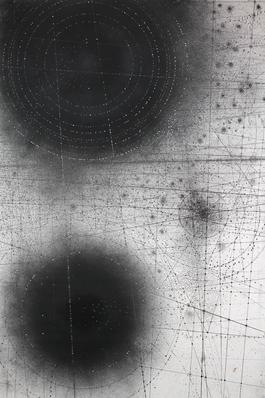
The Art of Science: Emma McNally’s Cunning Plots

Carbon Sound Field, 2010

Emma McNally makes pencil drawings on paper that remind everyone of something – star maps, city grids, network diagrams, physics experiments. In fact, they are none of these things. Inspired by visualizations of complex systems but not based on actual data, they spring entirely from her imagination. And that’s cool too. Her page at the Trinity Contemporary Gallery site has more.

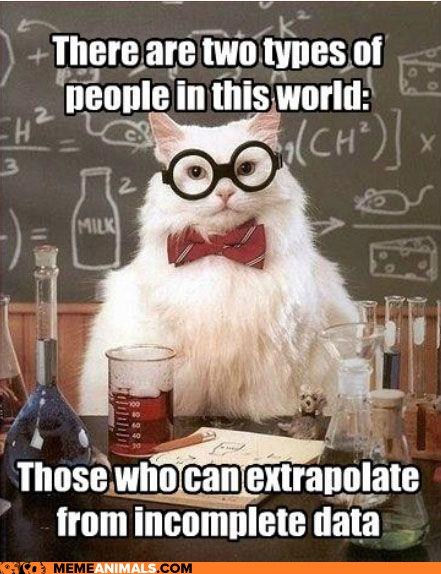
Science Caturday: I don’t get it, Chemistry Cat

extrapolate

I guess that makes me one of the other kind.

The Art of Science: Build Your Own Species

from Cephalopodoptera, 2012

One way around the difficulties of traditional scientific illustration?  Invent your own species, then nobody can argue with your rendering of the details. Vladimir Stankovic, a Serbian-born illustrator who now lives in Finland, regularly dreams up new species, and even a whole new order, Cephalopodoptera, “a link between molluscs and insects” that live in underwater caves.

Stankovic says he’s inspired by Klimt and Dali, but his work shows the clear influence of Haeckel as well – if Haeckel had used photoshop to turn his paintings into animated gifs. You can see an online gallery of Stankovic’s work here and buy one for your wall at his etsy shop.