Science kitteh illustrates two things at once: one of the basic laws of physics, and one of the guiding principles of Caturday.

Photo via Cheezburger.com

Science kitteh illustrates two things at once: one of the basic laws of physics, and one of the guiding principles of Caturday.
Photo via Cheezburger.com

Ceramic artist Tamsin van Essen uses a combination of novel and traditional techniques to produce thought-provoking pieces, including many drawn from science and medicine. For example, her Medical Heirlooms series comprised a series of vessels that seemed to have skin diseases, while the cups in her Contamination series appeared to have been colonized by various nasty bacteria.
I was particularly drawn to her Collection of Curious Objects, a series of less traditionally shaped objects inspired by theoretical physics. On her website, Van Essen explains:
Physicists are busy developing sophisticated theories around the existence of things that are impossible for us to see, perfecting mathematical models of the ‘beyond-visible’ worlds of the very large and distant (using Einstein’s theory of relativity) and the very small (using quantum mechanics).
Focusing on this realm of the intangible, I wanted to explore how abstract theoretical ideas can be visually represented. I also wanted to play with the notion that today’s cutting-edge theories may one day be seen as quaint and curious museum pieces: theoretical antiques or abstract junk.
The objects might be found in someone’s dusty attic or perhaps turn up on Antiques Roadshow in the future: “Oh my! Look what they thought in 2008!”
I love their simultaneous seriousness and playfulness – ceramic quarks and wormholes! – demonstrating van Essen’s willingness to engage with difficult and abstract ideas in an accessible but not dumbed-down way. And while I can admire the thought and craft that goes into a vase that appears to have syphilis, I’d much rather have a shiny quark.
If you’re in the UK, you can see some of van Essen’s work in the Subversive Design show at the Brighton Museum through March 2014.
This week, lots of smart peeps (about 30,000 of them) are in San Diego for Neuroscience 2013, The annual meeting of the Society for Neuroscience. Our science kitty decided to be very naughty and break the embargo on one of this year’s hottest developments in neuroscience.

Sorry, Dr. Muffins. No tuna for embargo-busting kitties!
photo via Cheezburger.com
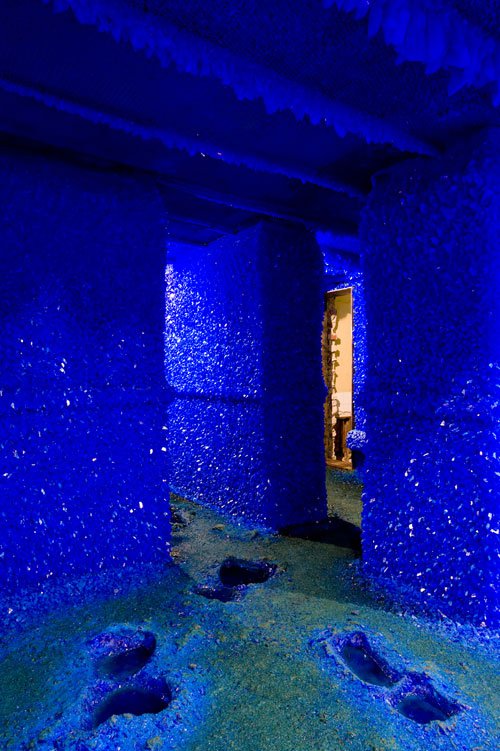
In 2008, British artist Roger Hiorns turned a derelict London flat into a major modern artwork. He created the piece, Seizure, by reinforcing and waterproofing a small, condemned apartment and then pumping in 75,000 liters of copper sulfate solution. After a few weeks, Hiorns pumped the liquid back out, and what remained was a glittering gem – the walls, floors and ceilings all covered with bright-blue crystals. Hiorns had previously created other crystal encrusted sculptures, so he knew how to work with copper sulfate. But he admits that the crystals in Seizure grew larger and quicker than expected – which was part of the art, allowing the natural process to happen in a way that was only partially controllable by the artist.
The finished work brings to mind the underground lair of some mythical creature, or perhaps the inside of a geode. Earlier this year, Seizure was moved to the Yorkshire Sculpture Park, where a special building was erected to house it. Because of the delicate chemistry of the piece, it cannot get wet or too hot. The new structure will allow many more people to visit the work, a good thing because Hiorns has said he has no interest in repeating himself by creating more crystallized pieces.
Want to make one yourself? Here’s a simple tutorial on how to grow copper sulfate crystals. Be sure to check with your parents, landlord, or spouse before coating entire rooms.
Hat tip to @Orthelious, whose Bearpope tumblr is fully of arty goodness
A bad pun (and really, is there any other kind?) is built right into Science Caturday. You might say it’s in its DNA…..

And since two bad puns are better than one….

photos via Cheezburger.com
 The Finch and Pea