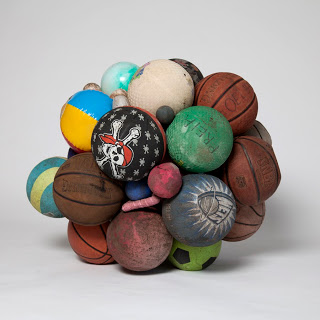
I want to thank you for tuning in on Wednesdays for a little dose of art and science. I really appreciate it. But I also want to ask you, have you blogged? Have you blogged weekly? Because if so, you’re probably familiar with the feeling that I’m feeling right now. I got nothing. I’ve been searching the recesses of the internet for, well, maybe not hours, but a good long time, and all I came up with was this molecule made out of discarded playground balls. Like it? I think it’s kind of cool. I could try to spin some deep meaning out of it, like that it’s a molecule made of things that are themselves made of molecules. But really, dear readers, I respect you too much for that. I’ll try to find something great next week.
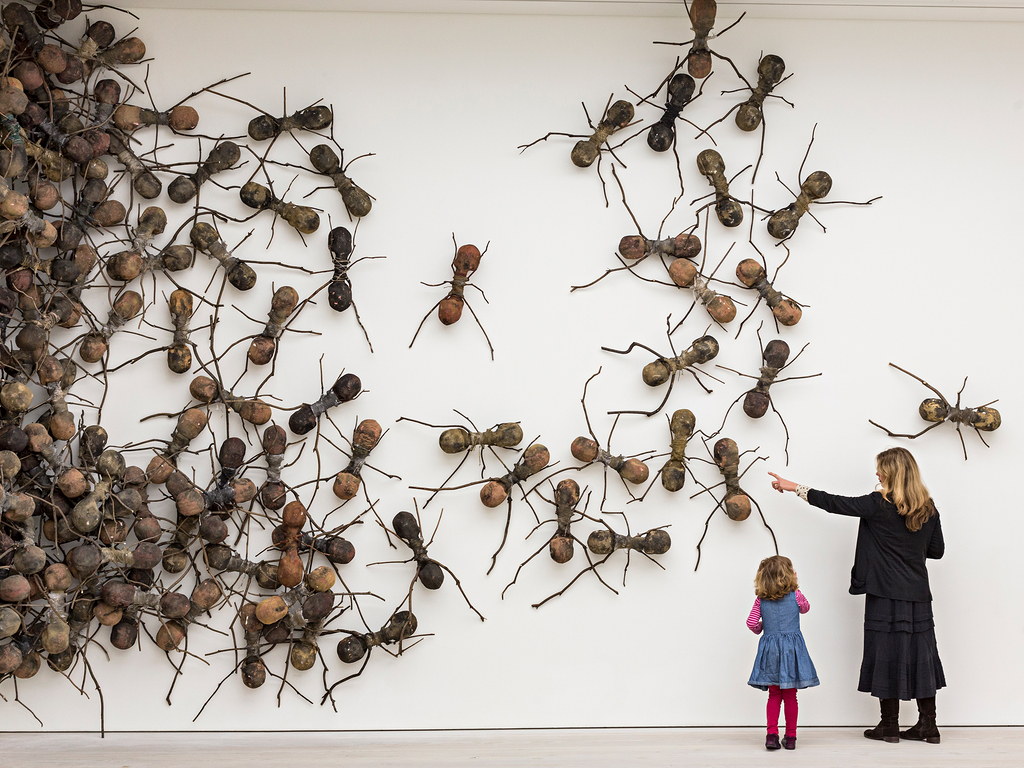
Rafael Gomezbarros, Casa Tomada, 2014 Photo by David Levene
Ants are crawling over the walls of London’s Saatchi Gallery. No, the cleaners aren’t on strike; the ants are an installation by Colombian artist Rafael Gómezbarros, part of a group exhibition called Pangaea: New Art from Africa and Latin America.
If you look closely, you will see that the bodies of the ants, each of which is 50 CM (about 19 inches) long, are made up of casts of human skulls in fiberglass and resin. For the artist, the ants represent the millions of immigrants traveling the earth in search of a home. In particular, Gómezbarros pays tribute to thousands of Colombians who suffered internal displacement and violent deaths in the armed conflicts that have convulsed his country over the past five decades. His ants have taken over the facades of several important buildings in Colombia, including the National Congress building in Bogotá.
Why ants? It’s easy to see why they work well as a stand-in for the teeming masses of immigrants. Humble, hardworking and capable of building complex social organizations, ants are also unfortunately easy for larger animals to snack on or crush underfoot. But ants are resilient, too. They are able to “farm” their own foodstuffs, band together to kill much larger species, and create rafts of their own bodies to float in water. Ants are survivors.
This week’s mythbusting prize goes to researcher Claudia Fritz of the Sorbonne, who led two studies, both of which revealed that despite their mystique, antique “master” violins – even Stradivari – produce no better sound quality than modern instruments.
In a piece in National Geographic Phenomena, Ed Yong walks readers through the stages of Fritz’s research, involving a number of different testing protocols, and her findings, which ultimately indicated that professional violinists found no difference in sound quality between old instruments and new.
Of course, our classically-trained kitty will tell you that her particular invisible violin sounds much better than that screeching monstrosity next door.
The internet was all a-squeal this week over the revelation that Harvard University’s libraries house a number of books bound in human skin. (Actually, the news that launched a thousand blogposts was that a Harvard-owned volume alleged to be bound in “all that remains of my dear friende Jonas Wright, who was flayed alive by the Wavuma” was, in fact, bound in sheepskin. ) Horrified and delighted, journalists gleefully explained that “anthropodermic bibliopegy” was once a thing, way back in the 16th and 17th centuries.
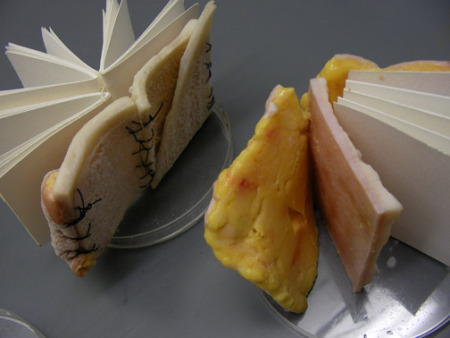
Well, it’s still a thing. Canadian artist Tagny Duff undertook a project from 2008-2011 called The Cryobook Archives, in which she used human and animal skin and modern biotechnology to grow “living” covers for handmade books. Duff even used a sort of ink made from a lentivirus to make designs on the book covers, which she displayed in a custom-built cryogenic freezer unit.
Duff explains that her cryobooks, which use skin cells donated by surgical patients and are stitched with surgical suture, are a way of reclaiming knowledge from its disembodied, electronic form. “We often overlook the fact that information is created from physical bodies” through the study of anatomy and biology.
I’m not sure Harvard’s libraries would be interested in these particular skin-covered tomes. For all the years of study and preparation that went into creating their covers, these books are blank.
Duff blogged extensively about The Cryobook Archives here. You can watch a video of her presenting the work at Dublin’s Science Gallery here.



 The Finch and Pea