Komodo Dragon at the St. Louis Zoo (Photo by Poppet Maulding; CC BY 2.0)
My soft spot for Varanus komodoensis is almost entirely due to the Matthew Broderick classic film, The Freshman. It was reinforced by a moment I had with a Komodo dragon at the St. Louis Zoo. Granted, the dragon was clearly making a threat display because it felt I was trying to encroach on its heat lamp territory. While the dragon was not correctly interpreting my intentions, there was something very compelling about having the attention, one-on-one with such a creature.
My affection for the lizards has not been dampened by Ed Yong revealing that the bite of the Komodo dragon is truly venomous (they essentially inject you with blood thinners and anti-coagulants, the bastards), not toxic from septic bacteria as has been assumed for the past 50 years or so.
In 2009, Fry discovered the true culprit behind the dragon’s lethal bite, by putting one of them in a medical scanner. The dragon has venom glands, which are loaded with toxins that lower blood pressure, cause massive bleeding, prevent clotting and induce shock. Rather than using bacteria as venom, the dragons use, well, venom as venom. -Ed Yong, “The Myth of the Komodo Dragon’s Dirty Mouth”, Not Exactly Rocket Science
Why do Komodo dragons still capture my imagination? Look, giant lizards with toxic bites are cool. Giant lizards with venomous bites are no less the stuff of really cool nightmares.
Today, my usual, totally biased praise of the most recent episode of Science for The People will be extra-biased. This week, host Desiree Schell interviews Christopher White about the effects of climate change in Glacier National Park. The discussion focuses on the clearly visible changes in the park, how those changes are monitored, and the cascade of effects resulting from those changes on the park’s ecology. Christopher White and I were both at the Santa Fe Science Writers Workshop earlier this year. He is one heck of a nice guy.
He did, however, miss a good reason to keep calling Glacier National Park “Glacier National Park”, even after all the glaciers are gone. The name begs the question, “Why do you call it Glacier National Park if there are no glaciers?” That question has a sobering and educational answer.
The show’s second interview, with Stephen Castles about human migration patterns, is equally interesting. Castles debunks some of the more grandiose claims about the effect of climate change on migration and refocuses the discussion on the true complexity of the issues.
Finally, how many podcasts do you know that provide links to supporting materials? Well, you know at least one now.
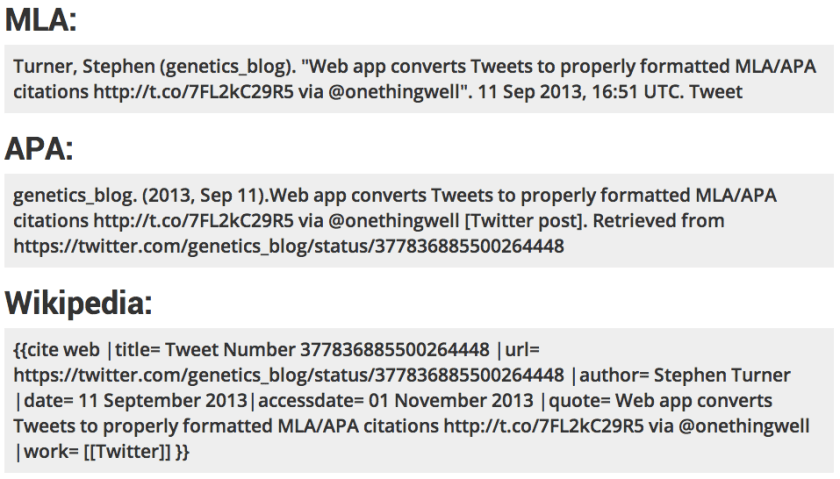
I’m not proud of that title; but I also lack shame. Ben Hedlund, however, should be very proud of his web app Tweet2Cite. Tweet2Cite takes the URL of a tweet and converts it into a properly formatted citation for MLA, APA, and Wikipedia styles. Here are the citations I generated using the tweet from Stephen Turner that brought Tweet2Cite to my attention*:
And, for those of you wondering, yes, you do need to provide a citation or attribution for information/quotes/images/links extracted from other people’s tweets.



 The Finch and Pea