What the Philae are you doing here?

UPDATE 12 NOV 2014 11:10AM (ET): Apollo 11 shit went down today. No matter what else we might be, we are a species that landed a robot on a comet about 500 million kilometers away for the purpose of scientific exploration. Not too shabby.

UPDATE 12 NOV 2014 11:54AM (ET): There is concern that Philae has not anchored to the comet properly. They are working on it.

Look, we appreciate you stopping by; but humanity is trying to land a robot on a comet for the first time ever. There is Apollo 11 level shit going down today. You can watch the ESA’s webcast live with us. The Philae lander is scheduled to touch down at about 11:00 AM (US Eastern).
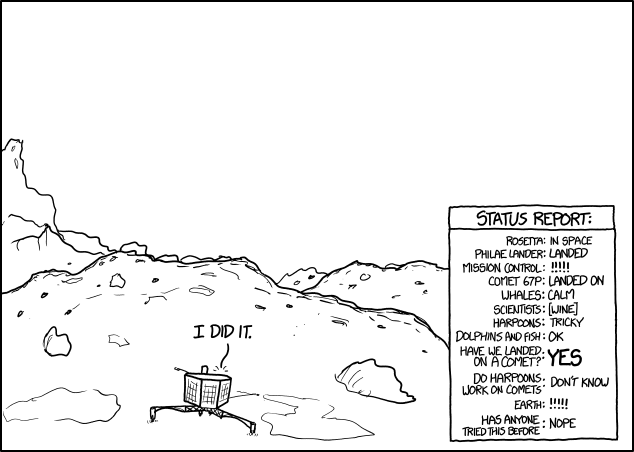
xkcd by Randall Munroe (CC BY-NC 2.5)

Over at xkcd, Randall Munroe is doing live updates of the Philae lander’s progress (and its internal monologue).

HT: Emily Lakdawalla (whom you should be reading today)

Philae: The Power of Positive Thinking?

UPDATE 12 NOV 2014 11:12AM (EST): THEY DID IT!

Philae by Stefan Schindler (All Rights Reserved; Used with Permission)

Tomorrow, the Philae lander detaches from the ESA Rosetta spacecraft and attempts to touch down on Comet 67P/Churyumov-Gerasimenko at Site J. A successful landing will be one of the great feats of human scientific exploration.

A webcast of the landing attempt will begin at 2PM (ET) today (ie, now).

Instead of waiting to post pictures, we are going to be optimistic and start with this LEGO build from Stefan Schindler showing the Philae lander resting comfortably on the comet’s surface. More to come…

Astronomy + Poetry from CosmoAcademy

As you know*, we like to mix our science and our poetry. Mike has generously loaned this Philistine the reins to the Sunday Science Poem franchise, which I promptly moved to Tuesday; but I had to move it to Tuesday because I don’t want you to miss out.

CosmoQuest is offering an online course (via Google+ Hangouts) looking at the intersection of astronomy and poetry:

Astronomy has played a role in human culture for thousands of years and appears in literature from every era.  We can see not only the influence of the heavens on our writings, but also the influence of language itself on our conception of astronomy. Heralding the dawn of the International Year of Light in 2015, join us now to explore how light from the stars has been important to humans for millennia.  We will begin with Gilgamesh and Homer, and continue through Shakespeare, Robert Frost, Maya Angelou, and into contemporary music and literature.  Along the way, we will also examine how the structure of language has influenced the perception of astronomical phenomena. – CosmoQuest Academy

The classes start on Monday, 17 November 2014 at 9PM (ET). Sign-ups (cost $99) are open until Monday, but there are only 8 spots left.

HT: Matthew Francis

*Frankly, I’m tired of coddling you newbies**.

**Have we decided on a sarcasm font***?

***I imagine all those exchanges are constantly derailed by people writing, “I think this one really works” in a proposed font, and then wondering, “Do they really like it or are they being sarcastic****?”

****…which may actually be a sign that it is working.

Science for the People: Understanding Neuroscience

sftp

Blue Pyramidal Neuron - original watercolor painting on clayboard by Michele Banks (All Rights Reserved - Used with Permission)
Blue Pyramidal Neuron – original watercolor painting on clayboard by Michele Banks (All Rights Reserved – Used with Permission)

This week, Science for the People is we’re looking at the ways we try to understand the inner workings of the brain. They talk to University College London researcher Cliodhna O’Connor about patterns in the way the public interprets neuroscience news. And they’ll ask Duncan Astle, Program Leader at the MRC Cognition and Brain Sciences Unit, about “neuromyths,” popular misconceptions about the way the brain functions.

*Josh provides research help to Science for the People and is, therefore, completely biased.

What a cute baby. . .solar system

The folks at Atacama Large Millimeter/Submillimeter Array (ALMA) just released an insanely detailed image of a developing star and the surrounding disc of material that may become its planetary system.

Credit: ALMA (NRAO/ESO/NAOJ); C. Brogan, B. Saxton (NRAO/AUI/NSF)

Phil Plait explains why this image is more than aesthetically interesting at Slate.

From what we understand of planet formation, a star and disk this young shouldn’t have a planetary system evolved enough to create these gaps. That’s a bit of a shock. Research published in 2008 also indicated the presence of a new planet, and I’ll be curious to see how this new observation fits in with that work as well. – Phil Plait

HT: Amy Shira Teitel