Reflections on “The Skeptical Boys Club”

It has been a few weeks since I originally published “The Skeptical Boys Club” on the significant under-representation of women in Skepticism[1]. It generated some serious response, criticism, and discussion. At the time, I tried to focus the article on the information I gathered, but tried to restrict the injection of my personal motivations for being interested, my thoughts on possible causes, and my thoughts on possible solutions. In the first case, those motivations were not immediately relevant. In the latter cases, I have no reason to believe that my thoughts on these matters have any value, and to put it next to “impressive” looking graphs might give those ruminations an inappropriate appearance of authority.

There has been some more recent interest in “The Skeptical Boys Club” by some individuals for whose thinking I have tremendous respect (but not always agreement, which is healthy) and whose thoughts on feminism, skepticism, and women in skepticism is infinitely more developed and considered than mine. After all, I can really date my intense interest in these types of issues quite accurately to precisely 28 months ago (more on how I know the date so precisely below). That is not much time to form a fully coherent philosophy of life.

So, I thought I would take this time to share some of my reflections from the experience of conceiving, researching, writing, and getting responses to the article.
Continue reading “Reflections on “The Skeptical Boys Club””

The Skeptical Boys Club

The Worldwide Skeptical MovementTM,1 has found itself in the unenviable position of one of Van Wilder‘s2 clients, namely asking, “How do we get ladies to come to our events?”3. Fortunately, The Worldwide Skeptical MovementTM seems to be asking for more serious reasons than the Lambda Omega Omegas. Unless you are the Augusta Country Club, you want your group demographics to mirror those of the society within which your group is embedded. Among many other benefits, this shows that your message is successfully reaching the entire society, not just a specific niche.

This is what is known in the business as “hard”. Continue reading “The Skeptical Boys Club”

Evolution is Intelligent Design: Neo-Functionalization

As is my wont, I like to highlight examples of art and design that either demonstrate or are inspired by evolutionary theory. While some of the elements of

by Stefano A (CC 2.0)
Nacho Carbonell Interpretative Portrait?

Nacho Carbonell‘s “Evolution” collection could be interpreted as an expression of abiogenesis, the emergence of biological entities from non-biological chemistry is NOT technically a part of evolutionary theory. Instead, I choose to view these works as an expression of neo-functionalization.

Neo-functionalization describes the process by which a gene stumbles upon a new function that is distinct from its original function. If that new function is beneficial, selection can very rapidly entrench that function in the genetic code.

In much the same way, Nacho Carbonell’s furniture starts as one “non-furniture” shape and discovers a new function, which finds discrete form rapidly.

'evolution' - the bench, 2010 paper mâché, iron structure 105 x 200 x 95 cm each piece is signed edition from galleria rossana orlandi, milan

Lovely. This bench would certainly look better in my garden than a few kilobases of coding DNA.

The Dubiosity Scale

Scientists like classification schemes and, especially, the jargon that comes along with them. Of course, this in part due to the fact that such schemes allow us to flex our intellectual vanity through the ritual abuse of dead languages. More legitimately, classification schemes and terms that are agreed upon within a particular field increase both the ease and precision of communication.

At the moment, I am writing at my patio table, peering with some concern (due to the threat to my ripening raspberries) at a bird hopping around the back garden. This bird is all black, with a relatively straight black beak; it is larger than a sparrow, but smaller than an eagle; and, as mentioned above, moves on the ground by hopping. Alternatively, I could communicate all that information, probably with even greater accuracy, by making use of our shared vocabulary for bird classification and tell you that I am looking at a carrion crow. Two words not only substitute for a tedious, run-on sentence of description, but also reduce confusion about the bird’s characteristics.

Good classification schemes summarize significant amounts of information by identifying many definitive characteristics through classification. Bad classification schemes convey no additional information other than the classification group.
Continue reading “The Dubiosity Scale”

Why is My Job Awesome?

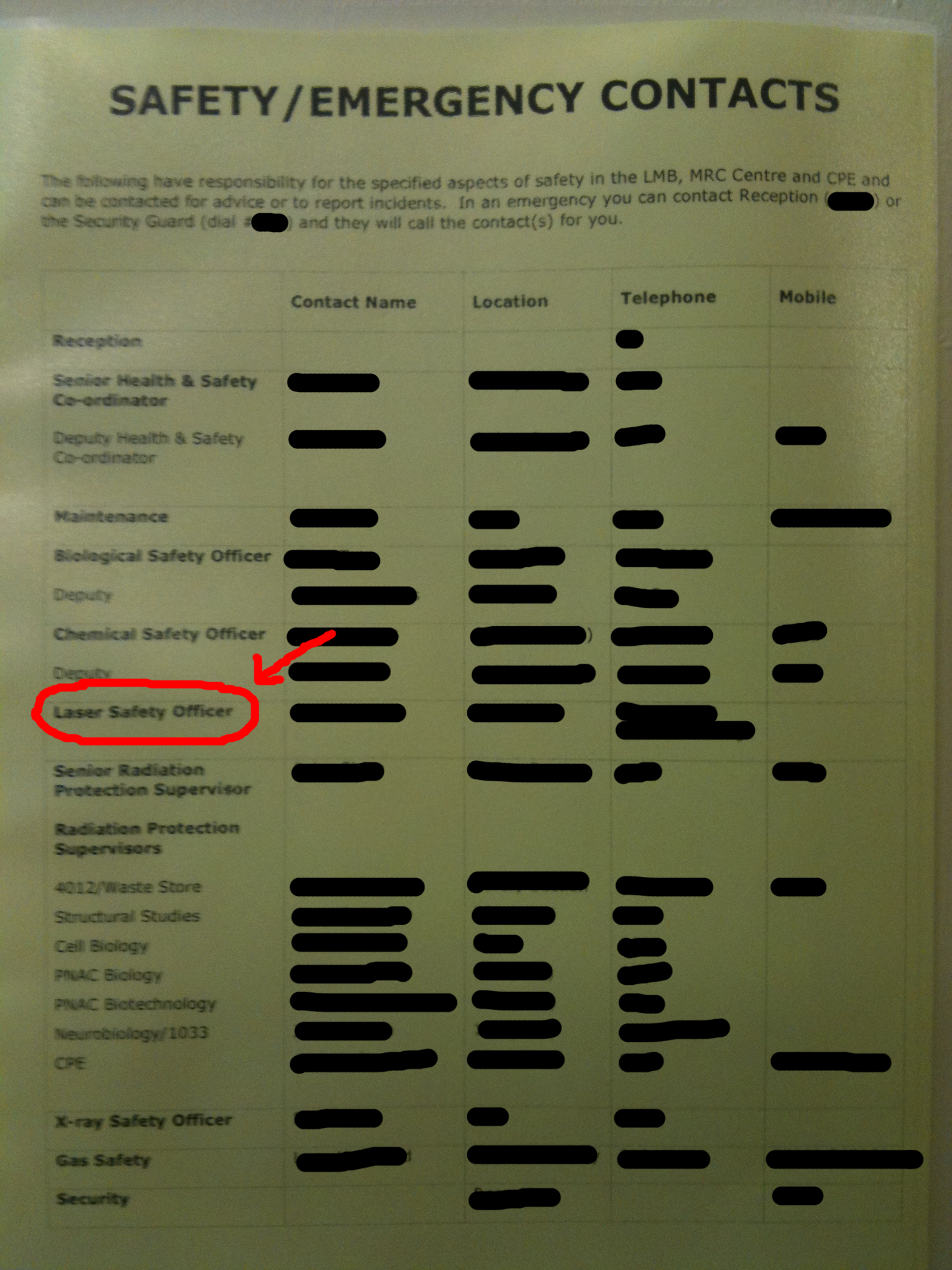
Because it requires a Laser Safety Officer. I bet the Death Star had one of those.

Photo by Josh Witten