
In honor of the great state of Missouri, birthplace of my doctorate and my eldest child (not in that order):
Author: Josh Witten
http://www.thefinchandpea.com
Math Madness #1: The Upset
It is conventional wisdom that every sensible bracket includes one and only one #12 seed upset over the #5 seed. Is getting the #12 seed the basketball equivalent of a +8 sword with double damage against the undead? If we look at the historical frequency of upsets in the round of 64 compared to the difference in seed[1], we see that the probability of upset decreases linearly as the difference in seed between the two teams increases (r2=0.96).
Being a Scientist: Computational Biologist
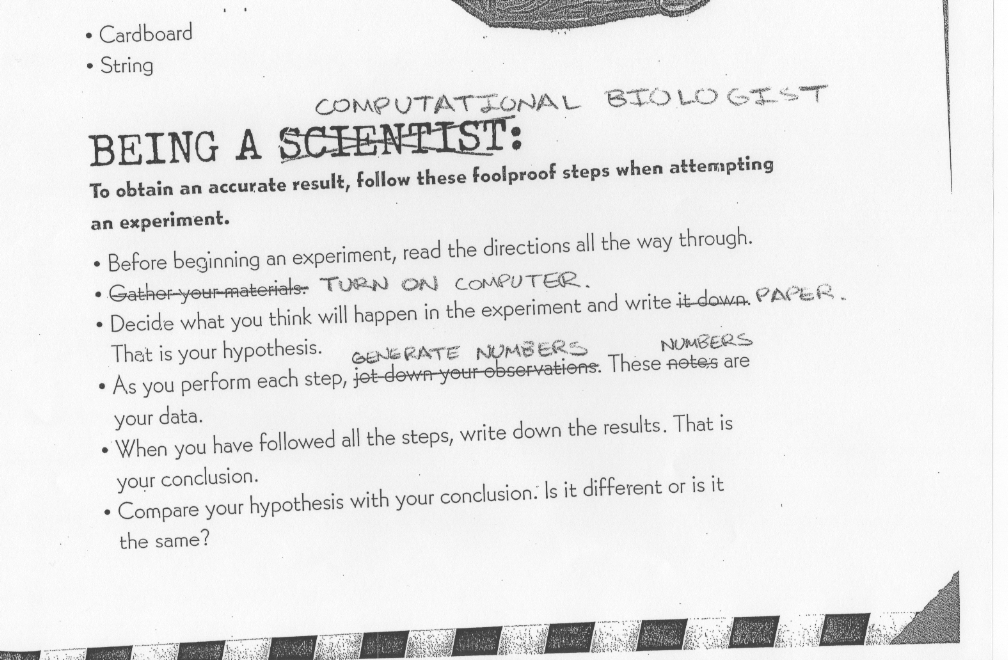 When your field publishes papers with sections entitled “Simulated Data”, something like this is bound to happen. I’m pretty sure we had to rescue this one from the break room trash. Being sensitive or living up to the computer nerd limited sense of humor stereotype?
You can get your own “Being a Scientist” template here and create your own, you crafty bastards you.
Pi Day?
In the irrational American way of denoting dates, today is 3-14-2012, which makes it Pi Day as the irrational, mathematical constant π=3.14… The suitability of 14 March as Pi Day is highly dependent on cultural context.
What π really represents is the ratio between the radius of an ideal circle and its circumference (C=2πr) or its area (A=πr2). We can determine the day of the year that best expresses this ratio if we treat the 365.25 days of the calendar year as either the circumference or area of the circle and calculating the day that would be the “radius”. In the case of the circumference, r~58 or 27 February. In the case of the area, r~11 or 11 January. Personally, I prefer to think of the year as the circumference, as it is linear and repeating, but you may pick your poison. I have both on my calendar and like to think of them in the same way as Catholic and Orthodox disagreements about the timing of Easter.
And, now is the point where I retract my earlier assertion that 16 February should be Phi Day. The more precise expression of the ratio gives us Day 226 (Φ~365/226) on the calendar, which is usually 14 August (except in the leap year). Please revise your calendar’s appropriately.
What’s the score?
 For Scorecasting (by L Jon Wertheim & Tobias Moskowitz), the question is not whether it is a swing or a miss, rather the question is whether it is a called strike on a 0-2 count. If you read the book, you will find out that the odds of a called third strike on an 0-2 count are different than on a 3-0 count. I’m not sure where this metaphor is going, but my short review is that Scorecasting was a very enjoyable read, even for a data nerd like myself.
It should come as a surprise to no one that I would be very interested in a book about the math, statistics, and incentives of sports. At the same time, I feared picking up yet another Freakonomics retread. Continue reading “What’s the score?”
 The Finch and Pea