Science Caturday: Kitty Cocktails

powdercat

Boozy drinks that you can mix like instant lemonade? The internet was abuzz this week with reports that a company called Lipsmark had received US government approval to sell a form of “powdered alcohol” called Palcohol. Shortly after the company’s announcement, however, the Treasury Department’s  Alcohol and Tobacco Tax and Trade Bureau said that it was withdrawing its approval.

So while we can’t immediately try out a powdered mojito, we can do as the internet folk do, and talk about it. Apparently, the idea of powdered booze has been around for decades, and versions of it are already for sale in parts of Europe and Asia.

Larry Greenemeier at Scientific American talks about the concept and the chemistry with chemist and blogger See Arr Oh, who notes that the alcohol isn’t so much powdered as encapsulated in a form of sugar. Paul Adams at Popular Science provides instructions on making your own “fluffy” powdered booze. And everybody everywhere warns you not to snort it.

The Finch & Pea is a fairly traditional pub, so we’re planning to stick with liquid alcohol for the forseeable future. We’re more interested in the product shown above, which could allow people to take lolcats on plane trips or bike rides, or even send them through the mail. This exciting development could bring a whole new meaning to Chemistry Cat.

Science Caturday: The Cat and the Fancy Fiddle

Invisible_Violin

This week’s mythbusting prize goes to researcher Claudia Fritz of the Sorbonne, who led two studies, both of which revealed that despite their mystique, antique “master” violins – even Stradivari – produce no better sound quality than modern instruments.

In a piece in National Geographic  Phenomena, Ed Yong walks readers through the stages of Fritz’s research, involving a number of different testing protocols, and her findings, which ultimately indicated that professional violinists found no difference in sound quality between old instruments and new.

Of course, our classically-trained kitty will tell you that her particular invisible violin sounds much better than that screeching monstrosity next door.

lolcat via Cheezburger.com


Science Caturday: Celestial Kittehs

uniberse

This week, astronomers made two exciting discoveries: the first is a ring system surrounding an asteroid named Chariklo, which orbits in a region between Saturn and Uranus.  This surprising finding makes Chariklo’s the fifth known ring system in our solar system , joining Jupiter, Uranus, Neptune and Saturn, and the first known to have formed around an asteroid.

happynao

The second major find is a distant, icy dwarf planet in the far reaches of the solar system, 7.5 billion miles from the sun. The object, officially known as 2012 VP113, measures about 280 miles across.  It’s extremely cold with a temperature of around minus 430 degrees Fahrenheit and is reported by astronomers to be faint and pink, making it hard to detect.

Our thanks to Kibbles kitteh and Mr. Boots for playing the roles of Chariklo and VP113 so graciously.

Science Caturday: Spring haz Sprung

nomoresnow

The vernal equinox on March 20 marked the official arrival of spring in the northern hemisphere. And after the harsh winter that many of us experienced this year, it arrived none too soon.

needtoshave

Only if you want to, kitty! Relax and enjoy the first Caturday of spring.

lolcats via Cheezburger.com

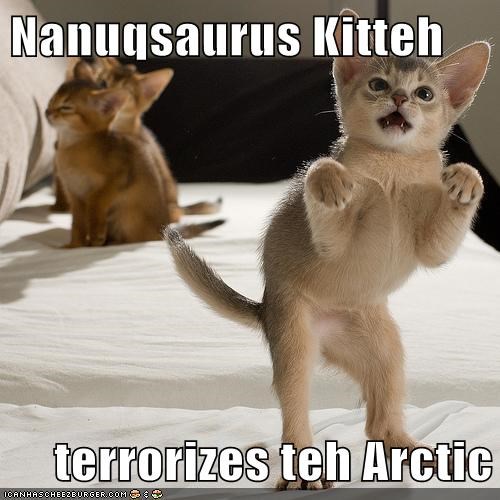
Science Caturday: Say Ohai to Nanuqsaurus

nanuq

It’s always exciting when scientists discover a new dinosaur, especially if it’s a cute little one.  As Brian Switek reported in National Geographic’s Phenomena this week, paleontologists Anthony Fiorillo and Ronald Tykoski have named a smallish tyrannosaur that once lived in the Arctic.

The scientists gave the dino the name Nanuqsaurus hoglundi –combining the Iñupiaq word for polar bear and a philanthropist named Forrest Hoglund.  The incomplete skeleton unearthed in northern Alaska indicates that, although Nanuqsaurus was likely fairly closely related to Tyrannosaurus rex, it was much smaller, around 25 feet in length compared to 40 for a T. rex.

Perhaps the most astonishing aspect of the recent discovery: photographic evidence (above) indicates that some traits of Nanuqsaurus may have somehow veered from their branch of the phylogenetic tree and taken up residence in cats, rather than birds. We await further study.

Photo: Cheezburger.com

Liek Dinos? Brian Switek’s ossim book, My Beloved Brontosaurus, is just out in paperback. You can haz.