The beaching – and threatened explosion – of a whale near a small town in Newfoundland last month was a reminder of just how huge, mysterious and fascinating these creatures are to humans.
Artist Tristin Lowe was so intrigued by the tale of a rogue albino sperm whale from the 19th century that he decided to recreate the whale at full scale in felt. Mocha Dick is a fifty-two-foot-long sculpture of a legendary whale that was said to have attacked numerous whaling vessels near Mocha Island in the South Pacific in the early 19th century.
Writing in the Knickerbocker Magazine in 1839, Jeremiah Reynolds described the original Mocha Dick as appearing “as white as wool . . . as white as a snow drift . . . white as the surf around him.” This was especially striking because sperm whales are usually dark gray, brown, or black. The unusually colored, highly aggressive creature provided the inspiration for literature’s most famous cetacean, Herman Melville’s Moby-Dick, published in 1851.
The “white as wool” description (and Melville’s novel) spurred the imagination of Lowe, who had previously made smaller pieces in felt. To work on this massive scale, he collaborated with the Fabric Workshop and Museum in Philadelphia to make the sculpture: a large-scale vinyl inflatable understructure covered in highly detailed white industrial felt.
Lowe was careful to give the sculpture a personality. He imagined the whale at over forty years old, covered with hand-stitched scars and barnacles. “All of his life is revealed on his skin,” says Lowe. “He wears that.” And like the real Mocha Dick, this 700-lb sculptural whale is well-traveled. Made in 2009, Mocha Dick has been exhibited in galleries and museums in Pennsylvania, Wisconsin, Virginia, Florida, Rhode Island and Massachusetts.
A video with more information about the artist and the piece is here.
Data are hard. Snow is cold. And yet artist Adrien Segal chose wood, a warm, yielding material, to visualize snowpack data, to stunning effect. This design of this remarkable, functional sculpture, Snow Water Equivalent Cabinet, is based on 31 years of snowpack measurements recorded by a SNOTEL sensor at Ebbetts Pass in California’s Sierra Nevada Mountains. The SNOTEL (snowpack telemetry) network, operated by the USDA’s National Water and Climate Center, calculates the amount of water contained in the snowpack of mountains in the western US. The data are used to forecast water supplies in the face of a changing climate.
Each drawer of the Snow Water Equivalent Cabinet represents one year of data. Segal explains:
“The sculpted plywood front is a three dimensional graph of the amount of water in the snow-pack at any given time during the water year, showing specifically the first snowfall, peak amount of water, and final snowmelt as changes occur from year to year. The size of each drawer is directly related to the amount of water in the snowpack, the smaller the drawer the less water stored, and the less storage space available in the drawer.”
The California-based artist says that her work integrates scientific research, data visualization, aesthetic interpretation, and materiality in an attempt to “to reconcile scientific conventions of reason and fact with an intuitive sensory experience.”
The work of Brandon Ballengée, an artist, biologist and environmental activist, often focuses on the damage that humans do to nature. For example, he has worked for years on both art and scholarship based on the rising occurrence of developmental deformities and the decline in populations of amphibians. A major 2013 installation, Prelude to the Collapse of the North Atlantic, looked at catastrophic declines in marine diversity.
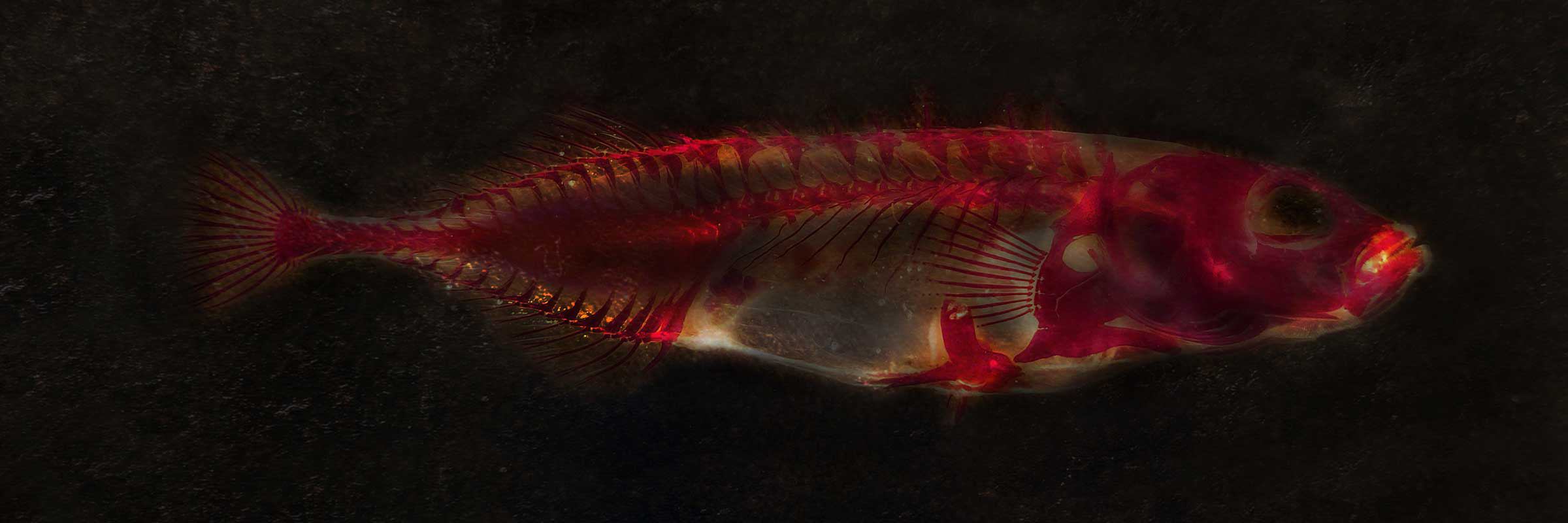
The photo-based installation Ti-tânes, however, takes a different view. Ballengée here was inspired by the Titans of Greek mythology, metaphorical representations of the forces of nature who were eventually overthrown by the more human-like gods, but nonetheless survived, banished to austere lands.
The artist explains:
With the Ti-tânes series, I aim to portray ancient animal species, which are able to survive (perhaps even thrive) in habitats environmentally impacted by human activity. Such organisms have endured millions of years and are now adapting to today’s ecological degradation.
For the works in this exhibition, three nine-spined stickleback (Pungitius pungitius) collected from the a polluted canal in Chamarande (France) were chosen as subjects and carefully stained using Alizarin red dye, which adhered to bone, then cleared using digestive enzymes to make surrounding tissues transparent. From the biological research side this was done to analyze specimens for any developmental abnormalities that in life we could not have seen. Secondly, this treatment was performed as an artistic choice – as clearing and staining is a way to change the way we are able look at such organisms, how we perceive them – they are abstracted yet made more clear. Next they were photographed on coal (literally fossilized carbon) meant to recall ancient life as well as changes to today’s climate made through the continued burning of such fossil fuels.
These artworks are meant as portraits of the individual fish, as each is unique as each of us. Through size (making them larger than life) they are scaled so the human viewer sees them at a magnitude beyond our ordinary bodily scale – grandiose and sublime like nature herself. Metaphorically they are meant to recall the ancient lingering nature deities surviving in banished now degraded environs. Viewed as skeletons they are not meant to represent death but instead life persisting in ecosystems made preternatural by human activity.
The Ti-tânes series is currently on exhibit at the Museum Het Domein in Sittard, The Netherlands, as part of Seasons in Hell, a retrospective exhibition of Ballengée’s artwork, through June 29, 2014. An online virtual tour of the exhibition is available here.
About 100 species of lemurs live on the island of Madagascar. The astonishing diversity of lemurs in this one location has allowed scientists to make important advances in evolution and island biogeography. Unfortunately, habitat loss and hunting are threatening their survival. According to the International Union for Conservation of Nature (IUCN) lemurs are the world’s most endangered mammals, with up to 90% of all lemur species face extinction within the next 20 to 25 years.
The Lemur Conservation Foundation (LCF), is a small, Florida-based non-profit dedicated to the preservation and conservation of the Madagascar primates, is hosting a show of art featuring lemurs.
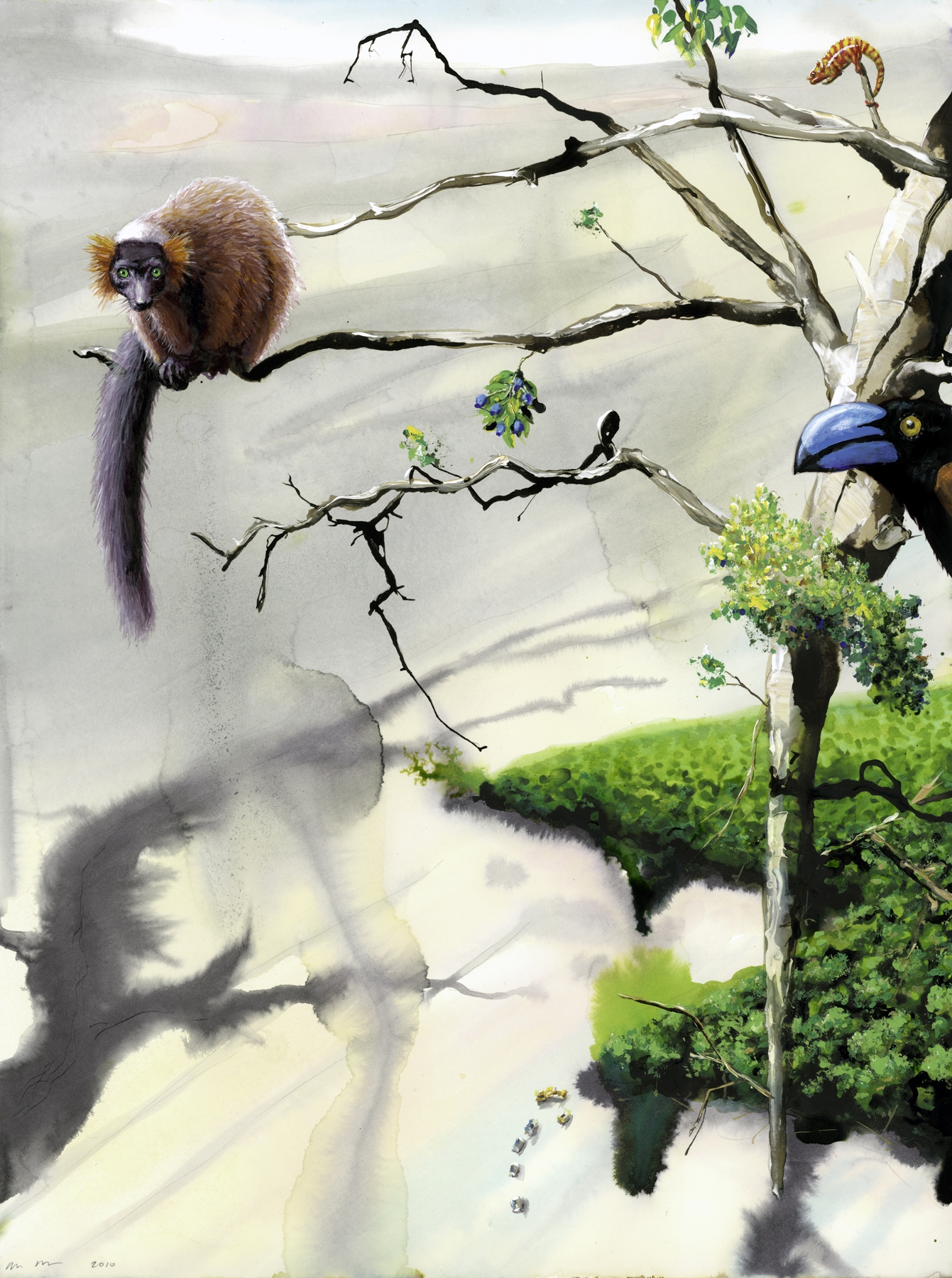
Vanishing, an exhibit featuring works from LCF’s permanent collection, includes works by 17 artists, including Alexis Rockman, who contributed Fragments, a painting depicting an imagined future of a devastated lemur habitat.
Rockman, well known for his dystopian visions of an earth ravaged by pollution and climate change, traveled to Madagascar in 2009 with LCF. He later painted Fragments, a lovely but unsettling image of a rare red ruffed lemur on a bare branch of a tree that offers little shelter or sustenance.
LCF founder Penelope Bodry-Sanders hopes the art exhibit will help people “understand the awfulness of extinction—without that, there is little hope for the future of lemurs and life itself in its magnificent diversity. “
Vanishing is on exhibit at Art Center Sarasota in Florida from May 22 – June 27. More information is here.



 The Finch and Pea
