Lydia Kasumi Shirreff can create most anything out of paper. The UK-based paper sculptor has turned flattened sheets of dead trees into eye-popping 3D models of plants, animals, building, and food, just to name a few. But my fave is the geology-inspired work she produced for a 2011 show called Animal, Vegetable, Mineral. Paper, scissors, meet rock.
Xavier Cortada, In search of the Higgs boson: H -> WW, digital art, 2013.
Xavier Cortada is an artist whose interests spread across many areas of science. His works have included projects at both the North and South Poles, and his subjects have ranged from DNA nucleotides to subatomic particles. This month, Cortada’s work is on display in two very different exhibitions.
The first, at Chcago’s Fermilab Art Gallery, focuses on art as a means of education and outreach, and features artists who have collaborated closely with scientists. Cortada is showing five large “digital tapestries” that he created as a fellow at CERN that portray the five search strategies which the CMS (compact muon solenoid) experiment used to discover a new Higgs-like particle. The exhibition, which also features work by Michael Hoch, Peter Markowitz, and Lindsay Olson, is open through April 22.
In a completely different vein, Cortada and a group of botanical illustrators have teamed up to create an exhibition called In Deep with Diatoms on display at the Frost Art Museum at Miami’s Florida International University, though February 22. The artists used traditional watercolor techniques to explore the unique and complex beauty of diatoms, single-celled aquatic microorganisms.
If you can’t make it to either show, you can see more of Cortada’s work on his website.
Artist Elsabé Dixon grew up raising silkworms in cardboard boxes as a child in South Africa. Now based in Virginia, Dixon has made her childhood hobby the source of her art, now on display in a unique residency and installation called LIVE/LIFE at Arlington’s Artisphere through February 22.
In the Artisphere studio, Dixon and helpers first constructed an environment for domesticated silkworms (Bombyx mori) to live out a life cycle – hatching from eggs to caterpillars, eating mulberry leaves, spinning cocoons, pupating, mating and dying – and then created sculpture using what was left behind, including twigs, empty cocoons, salt and even silkworm poop.
Detail from LIVE/LIFE, Elsabe Dixon, Mixed Media, 2014-15
Dixon sees the life cycle of the Bombyx mori – the only truly domesticated insect in the world – as a means of investigating many aspects of life. The first and most obvious is the ephemeral and ever-changing nature of life, but the work examines many other issues, including our relationships with society, nature and the built environment.
There are no barriers between the insects and the audience here. Visitors in the earlier months of the residency were free to touch the caterpillars and the moths. When I visited earlier in January, the moths were all dead, but I was able to touch the silk cocoons left behind.
The sculptural installation that Dixon has constructed, first for the silkworms to live in and then using their products and detritus, is based on microscopic photographs of silkworm particles. Made from materials including rubber, cut-up cardboard paper towel tubes, discarded silk cocoons, mulberry branches and, yes, piles of caterpillar poop, the installation looks organic, natural, and utterly at home in its modern-art setting.
LIVE/LIFE is open to the public Thursday and Friday evenings as well as Sunday afternoons, when the artist welcomes visitors to join in conversations with her and others in the field of art, medicine, engineering and food production.
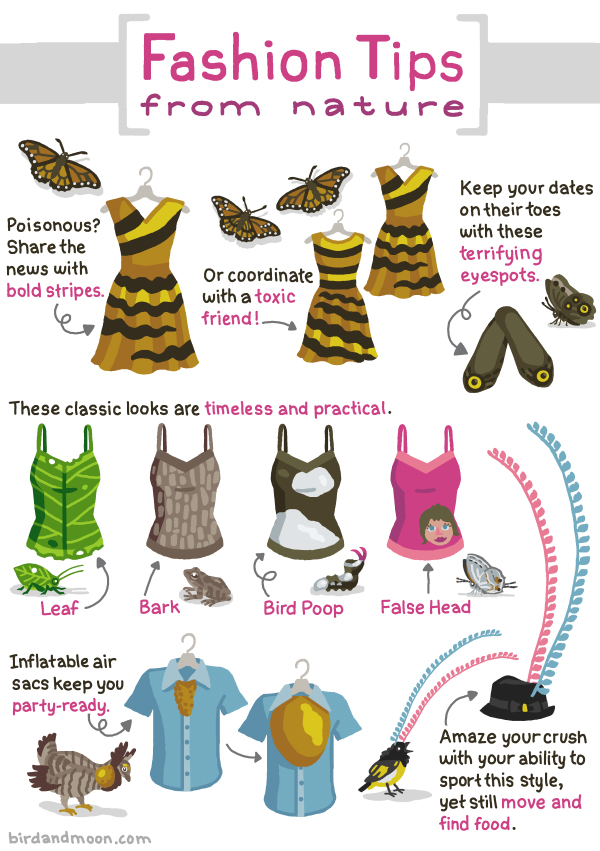
Rosemary Mosco is a naturalist, illustrator and science communicator who has seamlessly merged her scientific and artistic interests into a range of projects, most notably her Bird and Moon science comics.
Mosco’s academic background as a field naturalist, her obvious love of nature in all its forms, and her sunny sense of humor and cheerful style combine to create informative content that feels effortless.
Her work is featured in an exhibition called Quirks of Nature, running through June 8 at the Museum of the Earth in Ithaca, NY. The exhibition pairs her comics and illustrations with fossils, taxidermy, live animals, and more. Mosco provides commentary on her drawings and the inspiration behind them – from working at a bird rehabilitation center as a kid to suffering through an awkward first date – while experts explain the hard science behind each comic.
If you can’t make it to Ithaca, you can see more of Rosemary Mosco’s work at her website and support her work via Patreon.



 The Finch and Pea