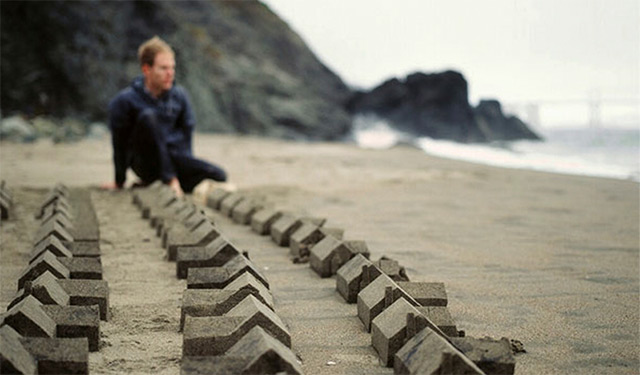
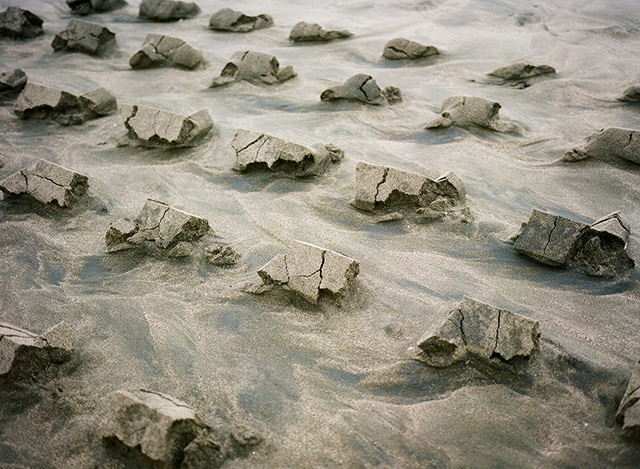
Masterplan, an installation by Chad Wright, is a subdivision of sandcastles based on typical American postwar houses, like the one he grew up in. By allowing his sand suburb to be washed away by the ocean, Wright comments on the death of the American dream, particularly the damage done by the real-estate bubble and bust. But the piece also brings to mind a consequence of climate change: rising oceans and eroding beaches that may force thousands, even millions, of coastal dwellers out of their homes in the years to come.
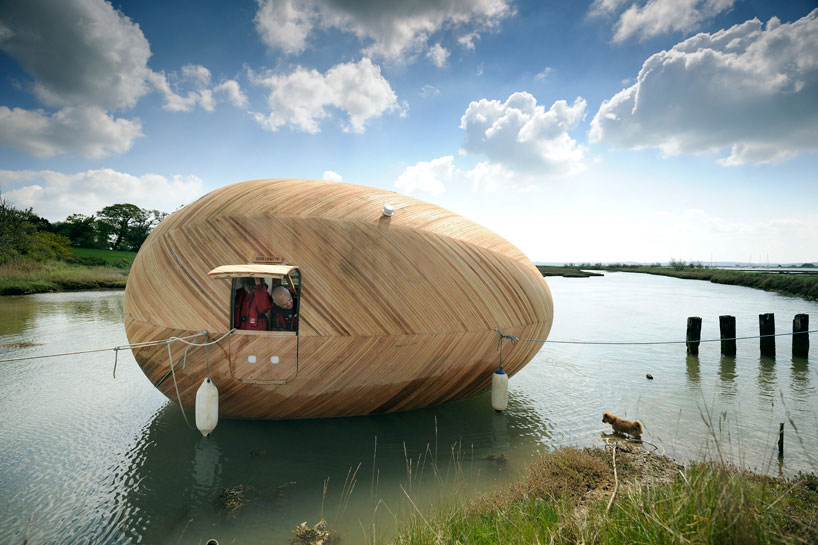
Living in a pineapple under the sea is so 2010. Artist Stephen Turner recently took up residence in a wooden egg on the River Beaulieu in England, where he will stay for about a year. The Exbury Egg, Turner’s new home, is a solar-powered wooden pod which is tethered like a boat in an estuary, rising and falling with the tide.
The main idea of the Egg is to explore “a more empathic relationship with nature” linked more closely with the rhythms of natural life. However, the project does not reject modern technologies but rather seeks to use them in the most effective possible way. For instance, Turner has a computer and phone powered by solar panels. Continue reading “The Art of Science: The Exbury Egg”
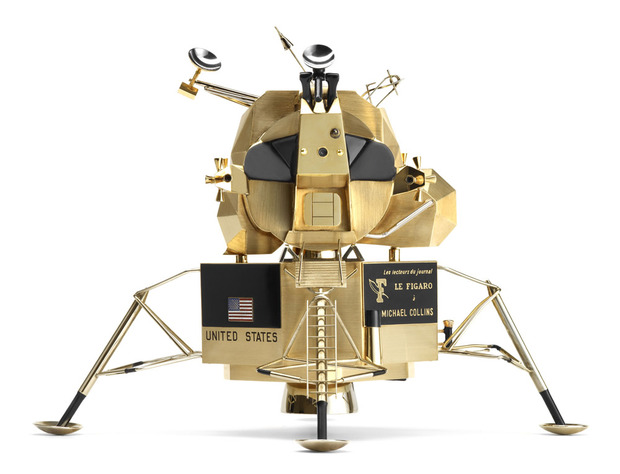
Surely a strong contender for best trip souvenir ever, this solid gold Lunar Excursion Module is one of three made by Cartier and presented to Apollo 11 astronauts Michael Collins, Neil Armstrong and Buzz Aldrin. This stunning piece is now on display at the Forbes Galleries in New York through September 7 as part of an exhibit entitled “Out of This World: Jewelry in the Space Age”.
According to exhibit curator Elyse Zorn Carlin, “Space has always been in our consciousness and often expressed in jewelry. The ancients wore amulets depicting the moon; in Georgian and Victorian jewelry we see numerous depictions of the moon, stars, and Halley’s Comet. The mid-20th century saw an explosion of “space age jewelry” and corresponding couture, and today the “futuristic” look in fashion is “in” thanks to Lady Gaga and other entertainers.” (source)
The exhibit contains many stunning pieces inspired both by the mysteries of the cosmos and by the modern technology that allows us to see space and travel there. A gallery of images is here.
Aganetha Dyck gets a lot of help creating her artwork. But rather than employ studio assistants or take on interns, the artist collaborates with hundreds of bees. Dyck, who says her main focus is “how knowledge is transported and transcribed between humans and other species”, considers her work to be an equal collaboration with the insects. “My research has included the bee’s use of sound, sight, scent, vibration, and dance. I am studying the bee’s use of the earth’s magnetic fields as well as their use of the pheromones (chemicals) they produce to communicate with one another, with other species and possibly with the foliage they pollinate.” (source) Some of her most striking pieces are small figurines that she places inside hives, to allow the bees to adorn with honeycomb. She also sometimes places drawings or paintings inside hives and lets the bees add texture and color to them.
Dyck’s (and the bees’) small sculptures are particularly striking because of their uncanny effect of juxtaposing something highly refined but essentially useless (porcelain figurines of lords and ladies in fancy dress) with something raw, natural and made with a clear purpose (honeycomb). Both parts of the sculpture seem somehow alien, like something found in grandma’s attic on another planet. That quality may be especially appropriate for work made with bees, a crucially-important species whose numbers continue to drop dramatically. This unique artwork may one day be impossible to create if Dyck’s collaborators continue to die off.
Dyck’s work is featured in the exhibit “Nature’s Toolbox: Biodiversity, Art and Invention”, which opens at the Ulrich Museum of Art in Wichita, KS next month through December 2013.
You can see lots more art and information at Aganetha Dyck’s website
A pair of Parisian designers has one-upped Brandon Ballengée’s Love Motel for Insects (featured here last year) by building snazzy condos for some lucky French bugs. The Insectopia installation, by Quentin Vaulot and Goliath Dyèvre, consists of tightly-packed wooden “houses” for insects, mounted on poles in parks in the 13th arrondissement of Paris. From a distance, they resemble trees; closer up, they look a bit like Laputa, the flying island from Hayao Miyazaki’s Castle in the Sky. Vaulot and Dyèvre say that their intention was both to foster urban biodiversity and to “provoke an emotion” in people who interact with the art, by drawing attention to a world that is largely invisible but in constant motion. No word yet on which lucky insects have moved into Insectopia, or if the quiet, hardworking ants are complaining about the noisy cicadas upstairs. If any of our readers are in Paris, please go look and report back with photos.



 The Finch and Pea