I’m crazy about Olafur Eliasson’s Wirbelwerk, an installation of colored glass, metal rods and a light source that throws constantly changing patterns over every surface of the atrium at Munich’s Lenbachhaus. Wirbelwerk, which means vortex or whirlpool, looks like a glittering, light filled cross between a tornado and an icicle. The piece combines three longtime preoccupations of Eliasson’s work: weather, light and space. Not to mention packing in plenty of engineering and optical physics for us nerds. Lots more photos here.
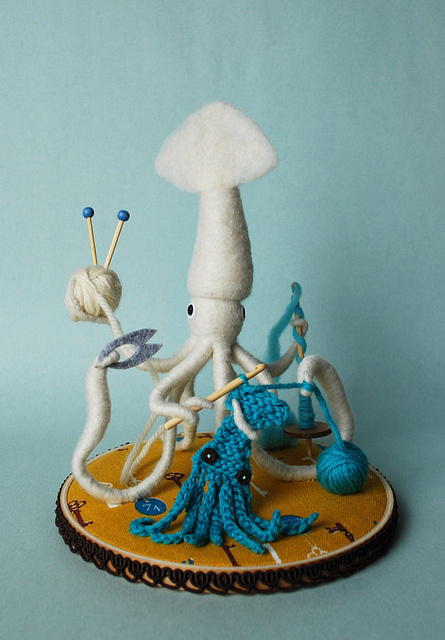
She describes herself as a “slow crafter”, but Hiné Mizushima has managed to pack a lot of projects into the last few years. A native of Japan, Mizushima started out there as a painter before moving first to Europe, then to the US, before settling in Vancouver and starting to create adorable needle-felted creatures. Not the usual bears and mice, though – she prefers offbeat creatures like squid, slugs, daphnia and even ectoplasm, which she shows in galleries and sells in her etsy shop. I love the combination of humor, smarts and beautiful craft in pieces like this needle-felted squid knitting a squid. If you’re not in the market for a gorgeous woolen cephalopod, this Unnatural History Museum postcard set should fulfill your needs for sweet, quirky science on a budget. (Note the detail: each little “ectoplasm” carefully sealed in its own labeled test tube)
Mizushima recently began creating stop-motion animations using her felted creations, and has been commissioned to make several music videos for the ultimate geeky band, They Might Be Giants. I especially love the “Insect Hospital” video, where sick and injured bugs get fixed up with various computer parts. She has also been making super-short animated gifs, including this amazing self-extinguishing firebug.
You can see lots more of Hiné Mizushima’s work on her website and follow her on twitter @hine_art
Birds poop all over everything. Or as Spanish artist Fabrizio Lamoncha puts it, “A common idiosyncratic habit in all birds is their inevitable punk nature to shit over our most precious belongings.”
He decided to transform what he calls this “countercultural attitude” into a “marketable artsy product”. Thus he created the Poo Printer, a slow, messy noisy machine which uses bird poop as pixels. He describes the printer:
“The Poo Printer consists of a wooden cage sized 170x120cm and 100cm high with a removable tray in the center. This tray has interchangeable parts looking like tree branches with integrated food dispensers. According to the order of placement of these pieces it creates the shape of each of the characters of the Latin alphabet. The birds will hang out there most of the day, eating, pooing and even eating and pooing simultaneously.” (source)
A large roll of paper covers the bottom of the cage, so as the birds poop from their letter-shaped perch, the “pixels” accumulate in roughly the same shape on the paper below.
Lamoncha’s first group of birds consisted of four male zebra finches, who apparently worked well as a team, pooping out a large letter “A” in about 2 days. (He chose all males to discourage the aggression that accompanies mating) He plans to make the printer available to art venues to use with their own teams of birds, and is currently working on an outdoor version. Click here for a time-lapse video of the Poo Printer in action.
Jacob Tonski’s Balance From Within looks like an illusionist’s trick, but it’s really a clever bit of engineering, applying space-age technology to an old-fashioned piece of furniture.
Tonski, an artist who teaches at the University of Miami, Ohio, found a broken-down sofa from the 1840s, took it apart and installed a reaction wheel, a rotating device often used to reorient satellites or telescopes. He then added a second axis to the reaction wheel, which allowed the sofa to balance, as if by magic, on one leg.
Tonski says the piece is a “meditation on the nature of human relations, and the things we build to support them.” He notes that a wide range of human interactions take place on sofas, and that they need to be solidly built to support our delicate relationships.
The sofa’s mechanism self-corrects when the piece is touched gently, but if it is pushed too far, like a relationship, it can break apart. Fortunately, the pieces of the sofa are held together with strong magnets, allowing it to be rebuilt quickly and easily, unlike a relationship. Oh, well. Metaphors are never perfect.
Balance From Within is currently on display at the FILE festival in Sao Paulo, Brazil until September 1. You can watch a video of the sofa in motion here.
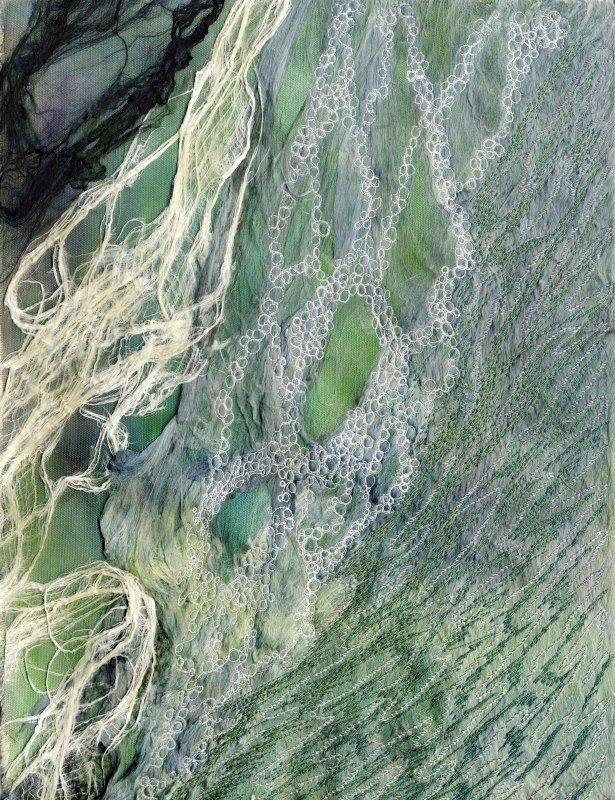
Julie Shackson, an artist living in Wales, takes nature in forms large and small as her inspiration. Working in a wide variety of media from photography to painting to textiles, often in combination, she produces artwork with depth and texture, whether her subject is a microscopic view of plant cells or a rugged shoreline. The piece shown above, Shoreline 3, joins paint on canvas with “dry” elements such as mulberry bark and silk embroidery to produce an effect which is decidedly watery, even bubbly. You can see more of her work at her website, or buy prints or originals from Saatchi Online.




 The Finch and Pea