Apocalypse 1954: Flying Saucers, Vulcanids, and Thorium Bombs

World in Eclipse, William Dexter (1954)
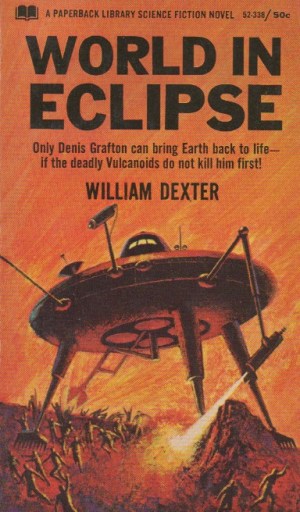
World in Eclipse is a mildly entertaining but second-rate cosy catastrophe story that leaves you with an itch to go read some Day of the Triffids or No Blade of Grass. It’s one of those ‘aliens save a small human remnant from armageddon and return them later to the devastated earth’ stories. (The worst book in this field has got to be A.J. Merak’s abysmal, 1959 The Dark Millennium.) Dexter’s plot could be mistaken for a parody of 50s sci-fi clichés, as you can see from the following brief plot summary (mild spoilers ahead):

The perennially dismissed reports of flying saucers turn out to be accurate accounts of visitors from planet Vulcan, which is undiscovered by humans because it is hidden in the asteroid belt. Continue reading “Apocalypse 1954: Flying Saucers, Vulcanids, and Thorium Bombs”
Best Sci-Fi of the 1950’s

Joachim Boaz has his excellent picks for the best 11 science fiction books of the 1960’s, and he’s looking for more opinions on favorite 60’s sci-fi.

Since I’ve spent the last six months focused almost exclusively on 50’s sci-fi, I’m not prepared to say much about the 60’s (but stay tuned). So here I present my picks for the best 11+ sci-fi novels of the 1950’s, with the caveat that I think most of the very best sci-fi of this decade came in the form of short stories, by Heinlein, C.M. Kornbluth, Robert Sheckley, Theodore Sturgeon, and a bunch of others. This means that when you’re browsing your favorite used book store for vintage sci-fi, don’t neglect the anthology section.

In chronological order: Continue reading “Best Sci-Fi of the 1950’s”

Apocalypse 1954: Hero’s Walk

Cold War Geopolitics in Space

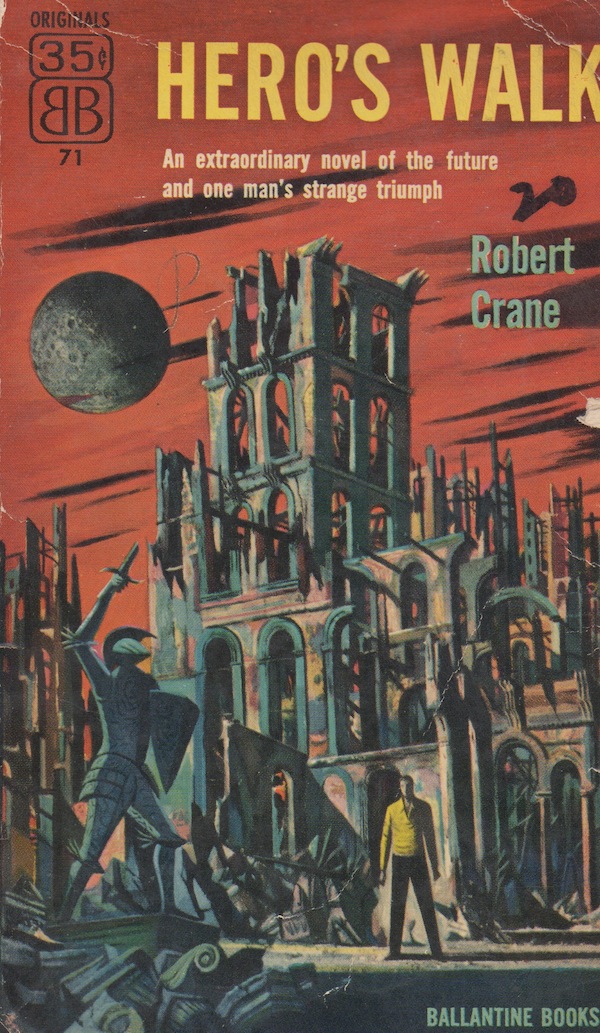
Hero’s Walk, Robert Crane, 1954

Humanity has united under a world government called InterCos, and has set out to boldly colonize the rest of the solar system. But strange, disturbing radio transmissions from space may be an alien warning against humanity’s imperialist ambitions. The politicians wrangle over the meaning of the transmissions, and use the issue to do what politicians always do – further their own power. Disregarding the frantic warnings of a desperate scientist who sees the alien threat, InterCos moves ahead with colonization, until the alien bombs start to fall. Hero’s Walk is basically a Cold War parable, published in the same year as the famous Oppenheimer security hearing, a critique of the reckless brinkmanship of the political leaders that threatened the world with the nuclear annihilation that scientists like Oppenheimer were warning about. Continue reading “Apocalypse 1954: Hero’s Walk”

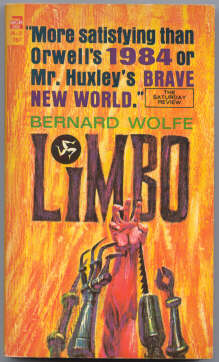
Apocalypse 1952: Bernard Wolfe’s Limbo

Rage against the machine

It’s the post-apocalyptic 1990’s, thanks to a late 70’s nuclear third world war brought on by the giant computers that had been delegated by humans to handle geopolitics. (They sound a little like the micro-trading computers that now handle the much of high finance.) It turns out that the computers weren’t any better at keeping the peace than humans were.

Neurosurgeon and former Mormon Dr. Martine has spent the last 18 post-war years hiding out on an uncharted island somewhere in the Indian Ocean, integrated with the natives, but events draw him back home to what’s left of the United States. What he finds, built upon the slag heaps of both the former United States and Soviet Union, is a cyborg civilization filled with men who’ve renounced war, cut off their limbs, and replaced them with nuclear-powered prostheses. To his shock, Martine find out that he unwittingly had something to do with this bizarre state of affairs.

Bernard Wolfe’s 1952 Limbo is a disturbing but weirdly compelling proto-cyberpunk behemoth that combines an edgy, in-your-face language that compares with the best of Alfred Bester, with long, Heinlein-style philosophical digressions that are about as subtle as a kick to the head, to create one long, entertaining rant against… well, something, but I couldn’t quite figure out what. Continue reading “Apocalypse 1952: Bernard Wolfe’s Limbo

Post-apocalyptic giant John Christopher passes away

Christopher Priest writes a brief obituary in the Guardian. Christopher (real name Samuel Youd) was one of the three giants of the excellent British school of post-apocalyptic fiction in the 50’s in 60’s, the others being John Wyndham and J.G. Ballard. Christopher, with his brutal The Death of Grass was somewhat of a transitional figure between the “cosier” Wyndham and Ballard’s dark novels.

h/t to io9.