
Cancer quote of the day

or maybe of the year:

More than half of the cancer occurring today is preventable by applying knowledge that we already have. Tobacco, obesity, and physical inactivity are the modifiable causes of cancer that generate the most disease. Cancer burden can be reduced by alterations in individual and population behaviors and by public health efforts as long as these changes are driven by sound scientific knowledge and social commitment to change. The obstacles to these efforts are societal and arise from the organization of institutions, including academia, and in the habits of daily life.

Applying What We Know to Accelerate Cancer Prevention
Graham A. Colditz, Kathleen Y. Wolin and Sarah Gehlert
Sci Transl Med 28 March 2012
No, we don’t assume that evolution must increase complexity

Ryan Gregory at Genomicron mocks an inane press release about a supposedly new evolutionary theory – the idea that endosymbionts will lose genes when their hosts or other microbes in their community can provide the functions of those genes. This is an old and widely established idea, so why anyone with any knowledge of recent evolutionary biology would play up this idea as novel is beyond me.

Sadly, the ignorance isn’t limited to whatever flack wrote the press release – at least one of the scientists involved is portrayed as the same misunderstanding of evolution that many creationists have:

“A common assumption about evolution is that it is directed toward increasing complexity,” said Erik Zinser, associate professor of microbiology. “But we know from analysis of microbial genomes that some lineages trend toward decreasing complexity, exhibiting a net loss of genes relative to their ancestor.”

Okay kids, repeat after me: evolution is not based on an assumption of increasing complexity. Increasing complexity (leaving aside the fact that the word complexity is terribly vague and non-quantitative) often happens in evolution, but we don’t assume that this is what should happen.

UPDATE: It could be that I’m being unfair to Dr. Zinser, that he’s being selectively quoted in a bad way by the same person who wrote the rest of the misguided press release. If that’s true, then all of my disdain is reserved for the anonymous press release writer.

‘May I be excused? My brain is full.’

Samuel Arbesman reports for Wired with excitement about a year-old article in PLoS ONE (“Variable Cultural Acquisition Costs Constrain Cumulative Cultural Evolution” by Alex Mesoudi) that presents a dire scenario for the continued progress of human civilization. Apparently, we are getting full. According to the study, human knowledge is becoming so complex that it will eventually take so much time and energy to learn what we already know that there will be no time to discover anything else. Graduate students know this feeling.

I will tell you not to worry. The study proceeds from a specific set of assumptions that we have no reason to accept. One of these assumptions is the knowledge equivalent of the falsified evolutionary development aphorism, “ontogeny recapitulates phylogeny”.

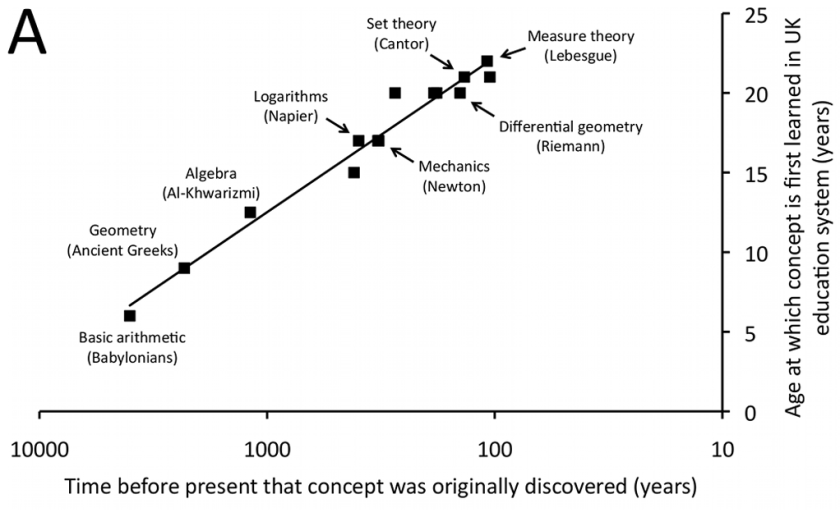
This assumption is presented in such a way that it could look like a finding to some readers using this figure:

This figure shows that UK students learn math concepts in the same order that they were discovered throughout history. It appears that individuals learn concepts in the same order that culture discovered those concepts. It is as if each individual’s learning experience is a microcosm of the entire experience of humanity. Continue reading “‘May I be excused? My brain is full.’”

Springer Press almost suckered by Intelligent Design

Springer’s editors in the field of engineering who aren’t familiar with the star figures of the intelligent design movement appeared ready to put the prestigious Springer stamp on a volume of pseudoscience:

As the National Center for Science Education reports, this one sounds like standard creationist pseudo-science-speak:

The volume in question, entitled Biological Information: New Perspectives, edited by R. J. Marks II, M. J. Behe, W. A. Dembski, B. L. Gordon, and J. C. Sanford, and slated to appear in a series of engineering books dubbed the Intelligent Systems Reference Library, was advertised by Springer as presenting “new perspectives regarding the nature and origin of biological information,” demonstrating “how our traditional ideas about biological information are collapsing under the weight of new evidence,” and written “by leading experts in the field” who had “gathered at Cornell University to discuss their research into the nature and origin of biological information.”

Continue reading “Springer Press almost suckered by Intelligent Design”

Prejudice is rational if you assume prejudice is rational

Yesterday, PLoS One published a study entitled “The Rationality of Prejudices” by Thomas Chadefaux and Dirk Helbing, which argues that being prejudiced can be an efficient strategy:

We model an -player repeated prisoner’s dilemma in which players are given traits (e.g., height, age, wealth) which, we assume, affect their behavior. The relationship between traits and behavior is unknown to other players. We then analyze the performance of “prejudiced” strategies. . .Such prejudiced strategies have the advantage of learning rapidly. . .they perform remarkably well. . .when the population changes rapidly.

The key assumption is right there in the abstract:

We model an -player repeated prisoner’s dilemma in which players are given traits (e.g., height, age, wealth) which, we assume, affect their behavior. (emphasis added)

In short, the researchers are starting with the assumption that the prejudices are true. Continue reading “Prejudice is rational if you assume prejudice is rational”