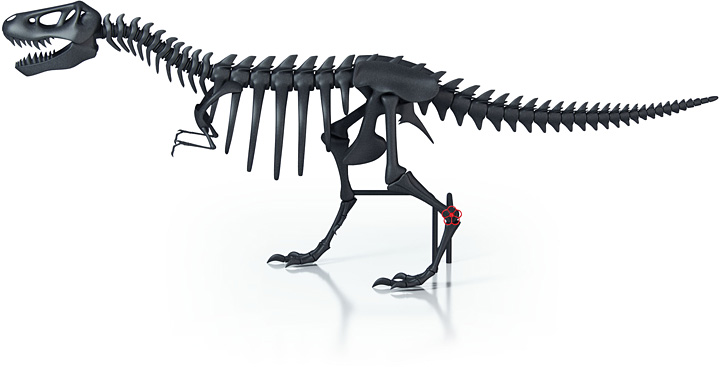
When I first heard about a radiator shaped like a Tyrannosaurus rex skeleton, I instantly thought “must have”1. After all, I am a fan of both making the functional inspiring and dinosaurs2. It is a great idea and at first I loved it.
Then something bothered me; and, being me, it has bothered me so much that I don’t think I could have one of these radiators in my house. Continue reading “Tyranniator”
The recently described small-bodied tyrannosaurid Raptorex kreigsteini is exceptional as its discovery proposes that many of the distinctive anatomical traits of derived tyrannosaurids were acquired in the Early Cretaceous, before the evolution of large body size. . .These findings are consistent with the original sale description of LH PV18 as a juvenile Tarbosaurus from the Upper Cretaceous of Mongolia. Consequently, we suggest that there is currently no evidence to support the conclusion that tyrannosaurid skeletal design first evolved in the Early Cretaceous at small body size.
Photo: Heather Haupt Enos, taken on North Campus at Cornell University
I don’t really understand how this “guerrilla” bike lane art promotes bicycle riding or bicycle friendly driving behavior.
But, it did get me thinking about velociraptors on bicycles. Which, naturally, led to me wondering what I would do if bicycle riding velociraptors were overrunning my city (the most likely scenario leading to such regulation of velociraptor velocipeding). In particular, what if one of said pedaling raptors decided it had a taste for Josh, on the bone.
Raptorex by Nobu Tomura (GNU Free Documentation License)
Normally, being wrong sucks. It’s all -10 points and you don’t get into Harvard. Sadness. But, not in science. One of the best things about scientific method is that it makes being wrong fun. That does not mean that scientists always like to hear they are wrong. We are after all sinful, prideful beasts like the rest of you – just smarter – just kidding.
A while ago, I discussed some relatively recent, amazing contributions of paleontology in order to illustrate that, while DNA may trump fossils for reconstructing evolutionary histories and the relationships between organisms, paleontology provides information on physiology and geographical location that can only be inferred by other disciplines. One of the discoveries discussed was of a 125 million year old, man-sized Tyrannosaurus rex ancestor, Raptorex, reported in Science on 17 September 2009. Continue reading “corREXion?”



 The Finch and Pea