
On Sunday, I participated in a panel discussion of the ENCODE project and issues related to it, with the folks from ScienceSunday via Google+ Hangouts. Ian Bosdet and I joined hosts Rajini Rao, Buddhini Samarasinghe, and Scott Lewis. to talk about ENCODE and make it accessible to those without a decade of post-graduate training in genomics If you have a spare 78 minutes, the discussion can be viewed on YouTube.
Tag: Genetics
Right Answer, Wrong Question
Author’s Note: Post was written without access only to the abstract, not the full text, of the journal article in question. Note that the argument is not with the methods or results of the research, but with how the research question has been presented.
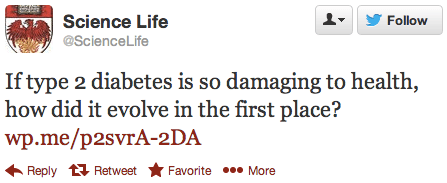
University of Chicago Medicine & Biological Sciences tweeted the following tweet on Twitter today highlighting the work of post-doc Laure Ségurel on genetic risks for Type 2 Diabetes:
The work itself is interesting in its own right. Investigating the population genetic history of genetic markers associated with Type 2 Diabetes risk could have multiple applications, beyond the high level of intellectual interest.
The question used to frame the research, however, troubles me, because it plays to general misconceptions about the evolutionary dominance and efficiency of natural selection in humans:
Why is this deleterious disease so common, while the associated genetic variants should be removed by natural selection? –Ségurel et al (Eur J Hum Genet. 2013 Jan 23. doi: 10.1038/ejhg.2012.295)
Science Caturday: Teh ENCAT Project
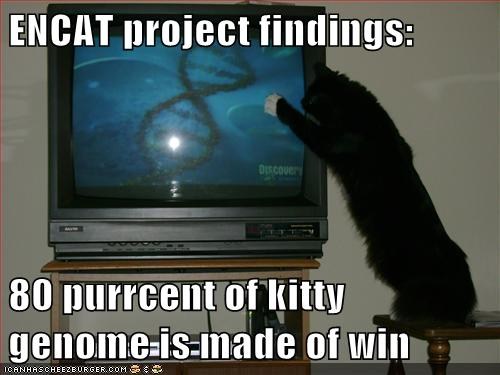
Ubber 20% = 5% snuggles, 5% noms, 5% ebil and 5% catnip. Moar interested in hoomin DNA? See Josh Witten’s latest post on the ENCODE project here.
LOL via Cheezburger.com
The Red Nose Gene
 Tis the season…for my 4 year old to ask me to sing Rudolph the Red-Nosed Reindeer repeatedly during any car trip longer than 30 seconds. My apologies to anyone who gets caught in the crossfire. My singing does not get better with repetition.
My kids also love the Rankin/Bass stop animation classic film Rudolph the Red-Nosed Reindeer. As you probably have come to expect, I have had a lot of time to wonder about how two seemingly normal reindeer could have a child with a glowing nose. Classic genetics is well-equipped to deal with this problem.
Both Santa and we should be very concerned about the genetics of red reindeer noses. According to Wikipedia, the Rudolph story dates back to 1939. There have probably been quite a few foggy Christmas Eves in the intervening years. According to the Pittsburgh Zoo, reindeer typically live for 10 years in the wild. While we can expect that Santa’s reindeer do a bit their those in the wild, it is clear that Rudolph alone would not be able to “guide Santa’s sleigh” today. Given their success breeding flying reindeer, it is not hard to imagine that Santa’s elves could generate a stable of red-nosed reindeer. How they would go about doing so would depend on how, genetically, Rudolph wound up with that first Red Nose. Continue reading “The Red Nose Gene”
CSHL Biology of Genomes Wrap-Up
After five grueling but interesting days, the Cold Spring Harbor Labs Biology of Genomes has wrapped up. So where is genomics heading?
A few lessons: Continue reading “CSHL Biology of Genomes Wrap-Up”
 The Finch and Pea