
Cutting the second slide & Dollo’s “Law”

A recent study on house dust mites has shown that the mighty mites have evolved “in reverse” from an obligate parasite into a free living organism. That is pretty cool. Yet, I find myself in the position once again of questioning the way the research is presented without questioning the quality of the research itself.

For permanent parasites and other symbionts, the most intriguing question is whether these organisms can return to a free-living lifestyle and, thus, escape an evolutionary “dead end.” This question is directly related to Dollo’s law, which stipulates that a complex trait (such as being free living vs. parasitic) cannot re-evolve again in the same form. Here, we present conclusive evidence that house dust mites, a group of medically important free-living organisms, evolved from permanent parasites of warm-blooded vertebrates. – Klimov & O’Connor 2013

The researchers present their result as a refutation of Dollo’s Law, which postulates that evolution is irreversible: Continue reading “Cutting the second slide & Dollo’s “Law””
Right Answer, Wrong Question

Author’s Note: Post was written without access only to the abstract, not the full text, of the journal article in question. Note that the argument is not with the methods or results of the research, but with how the research question has been presented.

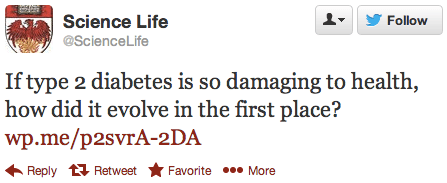
University of Chicago Medicine & Biological Sciences tweeted the following tweet on Twitter today highlighting the work of post-doc Laure Ségurel on genetic risks for Type 2 Diabetes:
Screen Shot 2013-03-08 at 8.33.27 AM
The work itself is interesting in its own right. Investigating the population genetic history of genetic markers associated with Type 2 Diabetes risk could have multiple applications, beyond the high level of intellectual interest.

The question used to frame the research, however, troubles me, because it plays to general misconceptions about the evolutionary dominance and efficiency of natural selection in humans:

Why is this deleterious disease so common, while the associated genetic variants should be removed by natural selection? –Ségurel et al (Eur J Hum Genet. 2013 Jan 23. doi: 10.1038/ejhg.2012.295)

Continue reading “Right Answer, Wrong Question”

The Birds of “The Unfeathered Bird”

Rebecca earned her master’s degree with a focus in avian ecology at Binghamton University, worked at Cornell’s Lab of Ornithology, has conducted international research on birds overseas, and completed her PhD in avian physiology the University of Memphis. She now teaches biology at the South Carolina Governor’s School for Science & Math.

After a certain high level of technical skill is achieved, science and art tend to coalesce in esthetics, plasticity, and form. The greatest scientists are always artists as well. – Albert Einstein

Birdsketch by Rebecca Heiss (All Rights Reserved)I became a biologist for a reason. It was not that I was particularly good at the sciences, but that I was terrible at art. My stick figures were never going to pay the rent. Perhaps lacking the drive to master any one trade, I’ve dabbled, becoming proficient in a smattering of largely scientific endeavors. It is little wonder then, that Katrina van Grouw’s mastery of multiple fields makes me feel a twinge of jealousy. Continue reading “The Birds of “The Unfeathered Bird””

So I take it you aren’t happy with ENCODE…

Mike is very busy being an awesome scientist. So, I have the duty of reacting to the latest “ENCODE takedown” published by Graur et al in Genome Biology and Evolution: “On the immortality of television sets: ‘function’ in the human genome according to the evolution-free gospel of ENCODE”. The title kind of tells you that the ENCODE consortium has a snowball’s chance in Hell of coming out of this one looking good – not that the paper was written by unbiased critics. Continue reading “So I take it you aren’t happy with ENCODE…”

Rock Out!?

What is science-y about stories of my kids being adorable. Well, on the one hand, they are statistically significantly more adorable than average*. If it helps, I also refer to them as our human genetics experiment (n=2)**.

Punkface MacGruder (2yo) to The Frogger (4yo): Sister, you want ROCK OUT!?

Me: Frogger, when someone asks you if you want to ROCK OUT!, you say “YES!”

* Which, I suppose, would be an example of unconscious bias influencing a study’s results – if it weren’t also true.

** Also, evolutionary theory dictates that my fitness is determined by children.