If you want a paradigm shift, don’t go looking for it

“In science… novelty emerges only with difficulty, manifested by resistance, against a background provided by expectation.” – Thomas Kuhn, The Structure of Scientific Revolutions

Organizations that fund scientific research love to call for paradigm-shifting proposals. And scientists love to think that their latest work is smashing down staid, old paradigms. But this focus on paradigm shifting gets Thomas Kuhn exactly backwards. If you want a paradigm shift, don’t go looking for it.

That’s Kuhn’s major point in this week’s The Structure of Scientific Revolutions reading. Last week, we had a broad discussion of Kuhn’s ideas about pre-paradigm science, what a paradigm is, and why normal science is like solving puzzles. This week we’re going to be a little more focused: we’re going to talk about four pages – p. 62-65 – instead of four chapters.

Read these four pages, and you’ll understand more about Kuhn’s view of science than just about anyone who talks about paradigm-shifting. Continue reading “If you want a paradigm shift, don’t go looking for it”

How science climbs out of the chaotic morass and into paradigms and puzzles

Welcome to the first meeting of The Finch and Pea’s The Structure of Scientific Revolutions 50th anniversary bull session book club. Grab a drink, pull up a chair, and let’s talk about the first four chapters of that book you always meant to read.

First, a brief word about the preface. Certain famous books are prefaced with apologetic comments by the author, warning us that what is to follow is just an outline or a sketch. We tend to smirk of over the fact that Darwin considered his 502-page behemoth just an abstract. Kuhn says similar things in his preface to Structure, but in this case I take Kuhn’s apologies more seriously. Historical examples are important in this book, but Kuhn tends to allude to episodes in the history of science, rather than discuss them – at least in the first four chapters. Perhaps this is fitting, because in Kuhn’s view, a successful paradigm necessarily leaves a lot left to be done. Continue reading “How science climbs out of the chaotic morass and into paradigms and puzzles”

Time to (re)read Thomas Kuhn

I will admit that I’m a sucker for book anniversaries of any sort, and since this month marks the 50th anniversary of the publication of The Structure of Scientific Revolutions, here’s your excuse to finally read it. I’ve been looking for an excuse to re-read it, since the first go around apparently made no impression on my brain – I will admit that I can’t say a single, intelligent thing about it.

To get yourself jazzed up, you can read the appreciation in The Guardian, and you can buy yourself the swanky new 50th anniversary edition. As for me, I’m sticking with my less glitzy second edition with the cool, somewhat minimalist cover.

Here’s our schedule, with discussions on Fridays: Continue reading “Time to (re)read Thomas Kuhn”

“The Failure of the Science Fiction Novel as Social Criticism”

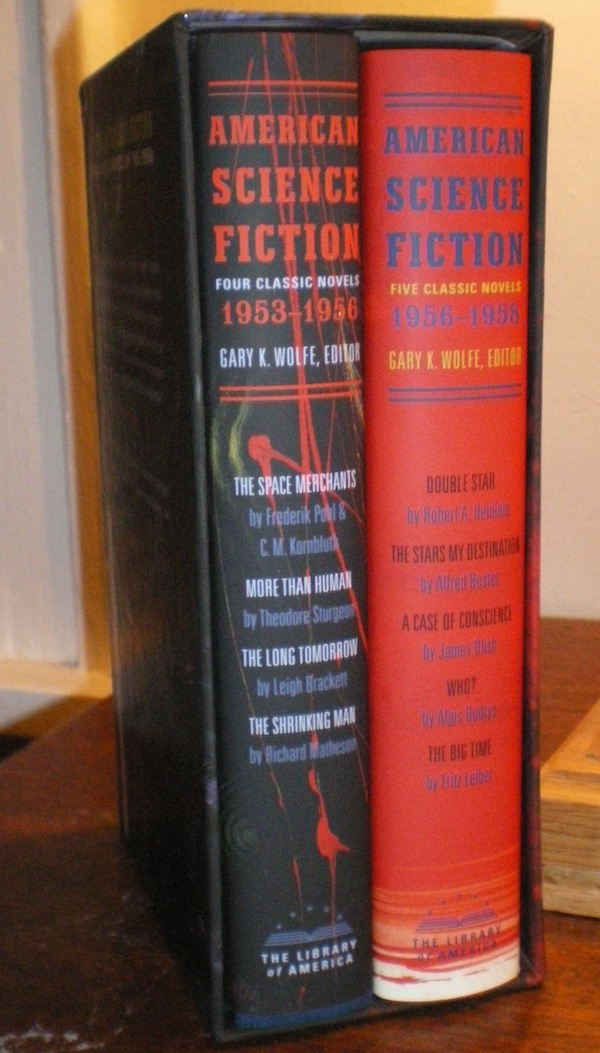
I’ve been digging into my new Library of America copy of The Space Merchants. The book is an outstanding example of science fiction as social criticism. And so it’s interesting to read C.M. Kornbluth’s thoughts on the failure of the science fiction novel as social criticism:

I suggest from this that there is very little fundamental material in the “Skylark” universe which is congruent with adulthood. I suggest that there is much fundamental material in that universe congruent with the attitudes and emotions of a boy seven or nine years old tearing off down an alley on his bike in search of adventure. The politics of this boy are vague, half-understood, overheard adult dogmatisms. His sex-life is a bashful, inhibited yearning for unspecific contact. His cultural level is low; he has not had time to learn to like anything seriously musical. Around the corner there lurks the impossibly malignant black-haired bully who may be all of twelve, and his smart little toady. But Dicky Seaton has a loyal pal, Marty Crane, and together they will whip the bully and toady in a fair, stand-up fight.

What are these wild adventures of Seaton and Crane, then? These mighty conquests, these vast explorations, these titanic battles? They are boyish daydreams, the power of fantasies which compensate for the inevitable frustrations of childhood in an adult world. They are the weakness of the Smith stories as rational pictures of the universe and society, and they are the strength of the stories as engrossing tales of Never-Never Land. We have all been children.

Continue reading ““The Failure of the Science Fiction Novel as Social Criticism””

Feast your eyes on Library of America Sci-Fi Cover Art

My Library of America volumes of classic 1950’s science fiction have arrived:

The first volume features a perfectly appropriate cover by Richard Powers. I can’t trace the date of this cover, but it seems more like Powers late 50’s, early 60’s style: Continue reading “Feast your eyes on Library of America Sci-Fi Cover Art”