The Infuriating and Essential Science Fiction of A.E. Van Vogt

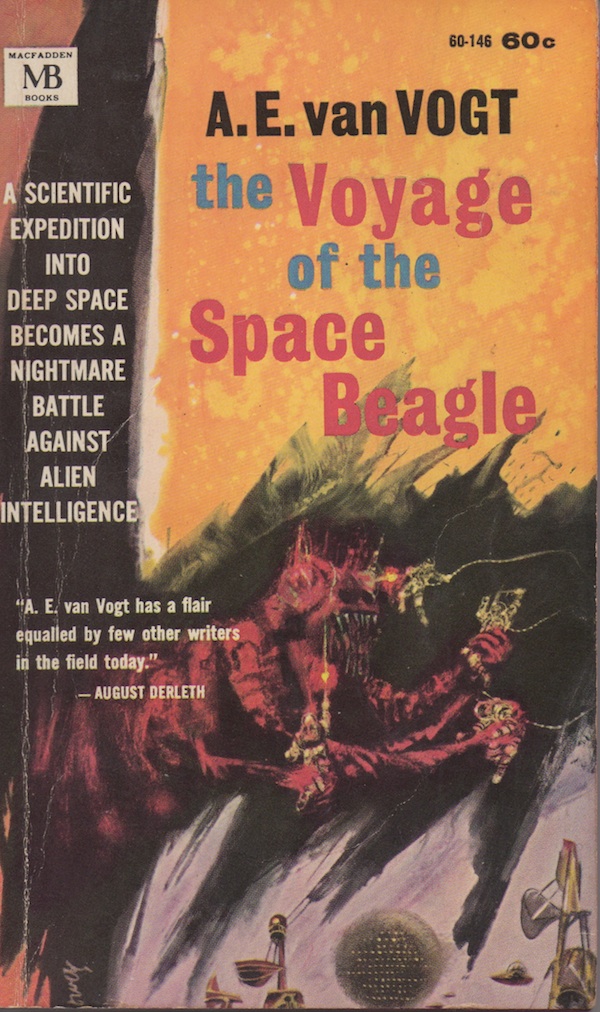
vanvogtvoyagespacebeagleIf you like the pulp science fiction of the Campbellian Golden Age from the late 1930’s to the early 1950’s, you’re bound to run across A.E. van Vogt’s name on nearly every must-read list. (Incidentally, not everyone, including me, considers this era to be the real Golden Age of science fiction). For fans of vintage science fiction, van Vogt is essential because his works were crucial in the canalization of many of the core ideas that we now consider essential to science fiction. At the same time, van Vogt is infuriating because his writing is annoyingly juvenile, even when compared against the other writers who shared pages in the same magazines aimed at juveniles.

When you read van Vogt today, it’s hard not to wonder what people saw in this guy when they ranked his works as some of the greatest ever in science fiction. Continue reading “The Infuriating and Essential Science Fiction of A.E. Van Vogt”
Apocalypse 1950: Science will save us from science

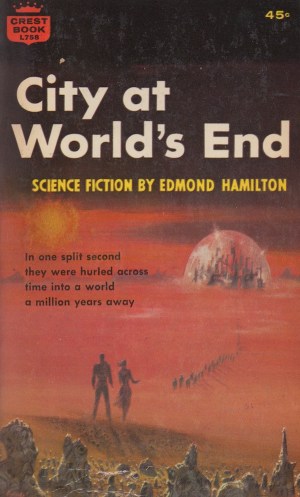
Edmond Hamilton’s City at World’s End (1950)

hamiltoncityatworldsendOn March 1st, 1954, on the Bikini atoll of the Marshall Islands, U.S. scientists detonated a thermonuclear hydrogen bomb called Castle Bravo. The expected yield of Bravo was five megatons TNT, but the scientists had missed a crucial fusion reaction that took place in this particular bomb design. As one scientist described it to the historian Richard Rhodes, “They really didn’t know that with lithium7 there was an n, 2n reaction [i.e., one neutron entering a lithium nucleus knocked two neutrons out]. They missed it entirely.” The actual yield of Bravo was three times the expected yield, measuring in at fifteen megatons. The blast blew a 6,500 ft diameter hole through the coral and trapped people in observation bunkers that were supposed to be situated far from the blast zone. Japanese fishermen aboard the vessel Lucky Dragon were exposed to high levels of radioactive fallout, leading to the death of one member of the crew and sparking an international incident between the US and the country that less than nine years before had been the world’s first nation to be attacked with nuclear weapons.

Recent popular fears that physicists would destroy the world through miniature black holes created in the Large Hadron Collider are just the latest manifestation of the difficulty people have long had in deciding whether to view scientists as the sorcerer or the apprentice. Continue reading “Apocalypse 1950: Science will save us from science”

Life versus the molecular storm

lifes-ratchetRichard Feynman put it best: “Things on a very small scale behave like nothing that you have any direct experience about. They do not behave like waves, they do not behave like particles, they do not behave like clouds, or billiard balls, or weights on springs, or like anything that you have ever seen… Because atomic behavior is so unlike ordinary experience, it is very difficult to get used to, and it appears peculiar and mysterious to everyone.”

The same could be said about things on a very large scale, such as planets and galaxies. It could also be said about extremes of time and temperature – we have no direct experience with microseconds and millions of years, or with what happens at thousands of degrees or near absolute zero. Scientific concepts that deal with such extremes defy our meso-scale common sense.

We respond to these assaults on our intuition sometimes with gee-whiz fascination, and at other times, when cherished beliefs are on the line, with resistance. Can our mundane actions really change the climate of something so large as the earth? How could we possibly have descended from small, furry dinosaur prey? And if a tornado whipping through a junkyard can’t spontaneously create a Boeing 747, can it really be true that complex, living, self-directing beings are formed out of molecules that merely follow the laws of physics and chemistry, without the guiding influence of vital spirits? Continue reading “Life versus the molecular storm”

2012 – Year of Classic Science Fiction Reprints

It’s been a little too busy to do the Sunday Science Poem or finish up the Thomas Kuhn book club (we’ll finish it soon, really). In the mean time, here are some quick sci-fi thoughts: with the recent arrival of an Amazon package at my home, I’ve realized that 2012 has been an awesome year for classic science fiction reprints. Here are my acquisitions:

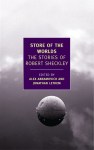
1) Store of the Worlds: The Stories of Robert Sheckley (NYRB classics): Nearly 400 pages, 26 stories, and a useful intro (PDF) by Alex Abramovich – this is essential reading for fans of the SF short story, especially those who like the vintage 50’s stuff. Continue reading “2012 – Year of Classic Science Fiction Reprints”

Kuhn book club rescheduled to Tuesday

For those of you who were missing the Structure of Scientific Revolutions book club yesterday, we’ll have to reschedule for Tuesday. Business intervened, including paper proofs and a Washington University Inaugural Symposium of the Center for Biological Systems Engineering at which I saw a video of a Pavlovian locust (yes, old grasshoppers learn new tricks – locusts can learn to associate new odors with food). And of course the ENCODE stuff came out.

So take the extra time to finish Kuhn’s book, and we’ll talk about chapters IX – XIII on Tuesday.