
M. P. Shiel’s The Purple Cloud (1901)
 The Book of Revelation isn’t the only part of the Bible that inspires post-apocalyptic fiction — Genesis plays a big part too. The Bible’s story about the beginning of the world has become a popular way to think about the world’s end. Adam and Eve, a paradisiacal Eden, and humanity’s fall get transformed into a last couple, a post-apocalyptic haven, and the forbidden fruit of some unexplored territory or lethal knowledge. What could be called the very first post-apocalyptic novel was explicitly written as a bookend to Genesis. Nathaniel Hawthorne later wrote a replay of Genesis that takes place within the empty remnants of civilization. M.P Shiel’s The Purple Cloud, an overwritten but under-read classic, is also a post-apocalyptic Adam and Eve story: the fall of civilization is brought about by a reach for the unexplored North Pole, and a last couple must consider the moral dilemma of repopulating an empty world.
The Purple Cloud is the first post-apocalyptic novel of the 20th century, but it starts with a throwback, by putting the whole thing within a mystic frame story of the sort employed much earlier by de Grainville and Mary Shelley. Most of the novel consists of the first-person record of the last man as he wrote it down in his notebooks; to get those notebooks in the hands of 20th century readers, Shiel has them dictated by a medium to her physician, who then passes the manuscript on to M.P. Shiel. Finding a plausible explanation for how a future story comes into the hands of present-day readers was a particular concern of 19th century SF writers, but would soon be largely abandoned. Continue reading “Apocalypse 1901: Adam and Eve in the Empty World Asylum”

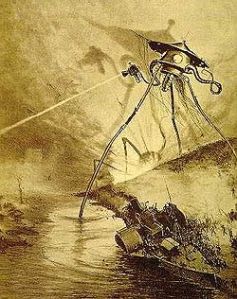 During the new wave of future fiction of the last decades of the 19th century, stories of catastrophic future wars were especially popular. The trend began in 1871 with George Chesney’s
 In the decades before the First World War, End of the World visions were influenced by major scientific discoveries of the 19th century. People became aware that the sun, the earth, and the human species itself were moving on a historical trajectory, one that would come to an end naturally, without any need for some divine entity to drop the curtain. The astronomer Camille Flammarion explored different natural scenarios for the End of the World in his
  The Finch and Pea