
Sunday Poem

From the greatest science poem ever written, Lucretius’ The Nature of Things. The first stanza sets up the second, Lucretius’ rationale for doing, if you’ll forgive me the anachronism, science.

Sooner of later, you will seek to break away from me,
Won over by doomsayer-prophets. They can, certainly
Conjure up for you enough of nightmares to capsize
Life’s order, and churn all your fortunes with anxieties.
No wonder. For if men saw that there was an end in sight
To trials and tribulations, they would find the power to fight
Against the superstitions and the threats of priests. But now
They have no power to resist, no way to reason how,
For after death there looms the dread of punishment for the whole
Of eternity, since we don’t know the nature of the soul:
Is the soul born? Or does it enter us at our first breath?
And does it die with us, and is it broken down at death? Continue reading “Sunday Poem”
Announcing the Finch and Pea book club

I know what you’re asking – is a book club appropriate at a pub? Certainly at this one, where we like books as much as we like beer. And hey, pubs have always been a place to have great conversations.

And so, on the second Tuesday of each month we’ll discuss a fantastic book that is at least tangentially related to science. Continue reading “Announcing the Finch and Pea book club”

Apocalypse 1954: Flying Saucers, Vulcanids, and Thorium Bombs

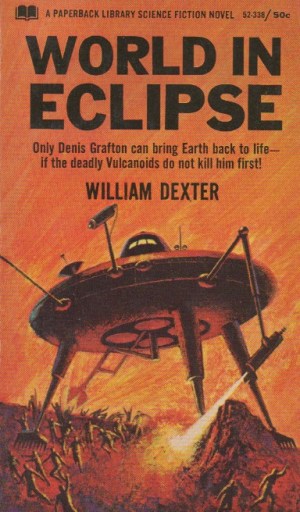
World in Eclipse, William Dexter (1954)

World in Eclipse is a mildly entertaining but second-rate cosy catastrophe story that leaves you with an itch to go read some Day of the Triffids or No Blade of Grass. It’s one of those ‘aliens save a small human remnant from armageddon and return them later to the devastated earth’ stories. (The worst book in this field has got to be A.J. Merak’s abysmal, 1959 The Dark Millennium.) Dexter’s plot could be mistaken for a parody of 50s sci-fi clichés, as you can see from the following brief plot summary (mild spoilers ahead):
The perennially dismissed reports of flying saucers turn out to be accurate accounts of visitors from planet Vulcan, which is undiscovered by humans because it is hidden in the asteroid belt. Continue reading “Apocalypse 1954: Flying Saucers, Vulcanids, and Thorium Bombs”

Best Sci-Fi of the 1950’s

Joachim Boaz has his excellent picks for the best 11 science fiction books of the 1960’s, and he’s looking for more opinions on favorite 60’s sci-fi.

Since I’ve spent the last six months focused almost exclusively on 50’s sci-fi, I’m not prepared to say much about the 60’s (but stay tuned). So here I present my picks for the best 11+ sci-fi novels of the 1950’s, with the caveat that I think most of the very best sci-fi of this decade came in the form of short stories, by Heinlein, C.M. Kornbluth, Robert Sheckley, Theodore Sturgeon, and a bunch of others. This means that when you’re browsing your favorite used book store for vintage sci-fi, don’t neglect the anthology section.

In chronological order: Continue reading “Best Sci-Fi of the 1950’s”

Library of America does vintage science fiction

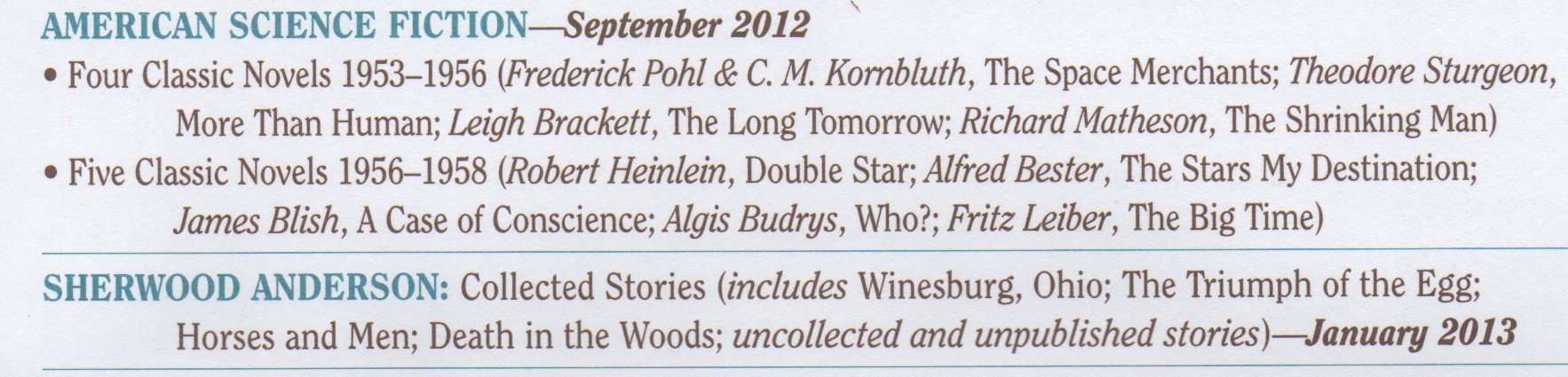
Hot damn! I can’t wait until September, even though I’ve got some of these:

Plus the collected Sherwood Anderson!