Aging of the scientific workforce

Another snippet from from Paula Stephan’s How Economics Shapes Science (Harvard University Press, 2012). Everyone interested in a science career should read this book.

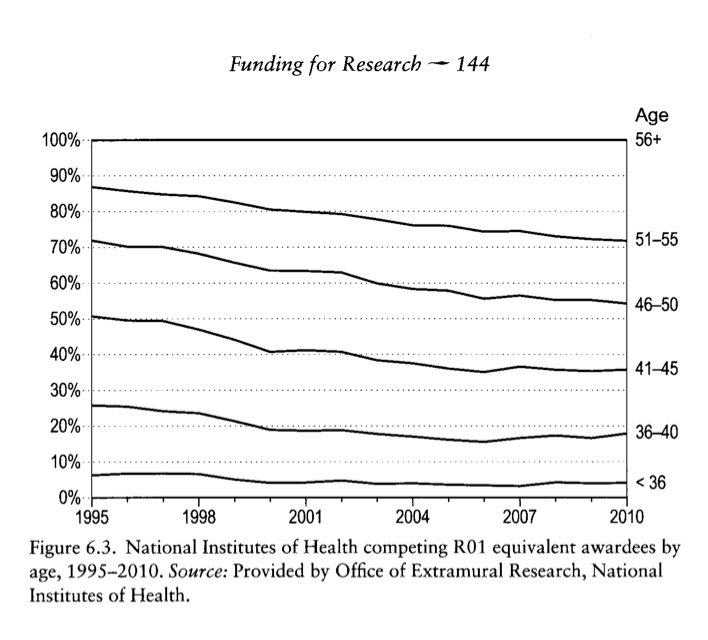
This figure shows how younger scientists have been squeezed out of funding, while the over 55 group has grown:

Science Summer Books

Science has it’s annual summer books issue out this week.

Be sure to check out the review Darwin’s Devices: What Evolving Robots Can Teach Us About the History of Life and the Future of Technology by yours truly: “Evolution and Robots.”

A teaser:

I am envious of those who when asked what they work on can respond, “I study the evolution of robots.” John Long (a vertebrate physiologist at Vassar College) is one such researcher, and reading Darwin’s Devices is like listening, over drinks, to a voluble, engaging, and funny scientist tell you about his work. On occasion, his jargon gets a little heavy, he will toss in an unexplained concept, or he will digress about his youthful dreams to join the Navy. But for the most part, Long draws you into a compelling and wide-ranging conversation. This includes discussions of the mechanics of fish backbones, how we practice science, the nature of evolution, what it means to be intelligent, our dystopian robot future, and, most important, the crucial role of good models in science.

Big SF award, big let-down

Jane Rogers’ The Testament of Jessie Lamb, shortlisted for the Booker, won a big SF award. This was a temptation I couldn’t resist so I checked it out of my library, and damn, this book was a let down.

It certainly qualifies as SF, in the great British, non-pulp tradition. It’s also one more book in the current fad of teenagers in dystopia, and like many teen-dystopias, this book, to its detriment, couldn’t decide whether it was YA or adult fiction.

There is nothing wrong being YA fiction. But if I don’t go in knowing that a book is aimed at young adults, I usually end up unsatisfied – it’s like picking up a cup of hot chocolate that you thought was coffee.

The idea behind this book has potential – a world-wide virus that kills all pregnant women is just one more catastrophe to add to our 21st century list of woes that includes global warming, terrorism, exploitation of animals and the environment, etc. Continue reading “Big SF award, big let-down”

Favorite Sci-Fi cover art

Vintage sci-fi cover art connoisseur Joachim Boaz has posted his favorite covers over at Science Fiction Ruminations. Go check it out.

This is fun, and I want to play too. Here are my five favorites from my paperback collection:

Continue reading “Favorite Sci-Fi cover art”

Classic Adventures in Deep Space

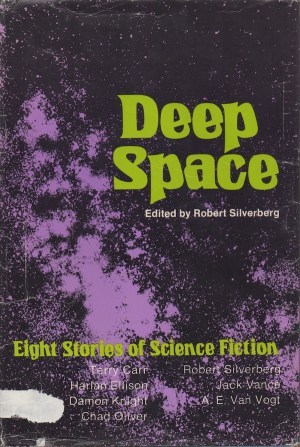
My local library system, to make room for never-ceasing influx of new sci-fi, frequently discards rarely read gems which I pick up for a quarter. I’ve managed to snag a half-dozen books from David Pringle’s famous mid-80’s list of the 100 best science fiction novels, and a volume of first-rate C.L. Moore stories, among others. Here’s another gem that might be easy to miss: Deep Space, a collection of mostly 1950’s stories about, you guessed it, deep space. Despite the lackluster cover, this collection has some first-rate stories, including early ones by Harlan Ellison and Gordon Dickson, and a psychedelic planet story from Jack Vance that is even better than the Dying Earth stories. Continue reading “Classic Adventures in Deep Space”