
Love art? Love science? Read The Age of Insight

Nobel Prize-winning neuroscientist Eric Kandel’s book about “The Quest to Understand the Unconscious in Art, Mind, and Brain, from Vienna 1900 to the Present” will keep you busy. It’s stuffed with history of Viennese Expressionism (Klimt, Kokoschka, and my new favorite, Schiele), Freud (what he got right and what he didn’t), cognitive psychology, and a fascinating discussion about how our minds, particularly our unconscious minds, respond to art.

There are a lot of neuroscience details, but the big point of the book is that Freud was right – most of our cognitive processes are unconscious. A key aspect of creativity is to facilitate the exchange between the unconscious and the conscious, and good artists take aesthetic moves that play on the unconscious responses of beholders, and to increase our awareness of the unconscious that operates in us. Kandel gives a neuroscientific justification of James Watson’s famous claim that “it’s necessary to be slightly underemployed if you are to do something significant.”

Particularly fun was the discussion of why Klimt and the Expressionists pursued particular stylistic directions. Klimt was directly influences by his contact with scientists, and many of the symbols in his paintings are inspired by microscope images of cells.
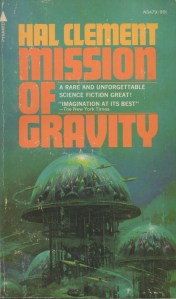
Hal Clement’s Mission of Gravity

Classic Hard Sci-Fi By The Book

Charles Lackland is far from home, holed up in an isolated outpost on the inhospitable planet Mesklin. Inhospitable to humans anyway, but not to the methane-based, centipede-like natives who are adapted to the enormously high and remarkably variable gravity, the fierce cold, and the extreme storms of this gigantic, disc-like planet. Lackland’s mission is to assist a crew of Mesklinite natives on a journey to recover mission data from an unmanned rocket that crashed near one of Mesklin’s poles. With a gravity 700 times that of Earth, the pole is a place no human can survive. But the natives, Captain Barlennan and his methane sea-faring crew of the Bree, can make the journey. Continue reading “Hal Clement’s Mission of Gravity”

Library of America Sci-Fi Smorgasbord

In preparation for the Library of America’s forthcoming volumes of vintage American Sci-fi, they’ve put up an amazing online companion with reviews of the books, additional stories, essays on the historical context, and a gallery of great covers.

If you’re like me and are struggling to sit tight until the books are released, the web site will keep you busy for awhile.

Economics does shape science

Some final observations from Paula Stephan’s provocative book, How Economics Shapes Science (Harvard University Press, 2012):

1) The current incentive structure is creating an inefficient system. The job market for biomedical PhDs has been generally poor for some time now, and it has been getting worse. From the perspective of Deans and established investigators, the system is working beautifully because established scientists are highly productive. But from an economic perspective (and from the perspective of newly trained PhDs), this is a highly inefficient system that relies on cheap, temporary, highly skilled workers with future job prospects that are unlikely to repay the opportunity costs of PhD and postdoc training.

The university research system has a tendency to produce more scientists end engineers than can possibly find jobs as independent researchers. In most fields, the the percentage of recently trained PhDs holding faculty positions is half or less than what it was thirty-three years ago; the percentage holding postdoc positions and non-tenure-track positions (including staff scientists) has more than doubled. In the biological sciences it has more than tripled. Industry has been slow to absorb the excess. A growing percentage of new PhDs find themselves unemployed, out of the labor force, or working part time.

Continue reading “Economics does shape science”

Career outcome numbers in biomedical sciences

Again from Paula Stephan’s How Economics Shapes Science, p. 179-180:

The evidence that problems exist is perhaps even more striking when one studies the over 400 National Institute of General Medical Sciences NIH Kirschstein National Research Service Awards (NRSA) fellows awarded during 1992-1994. Kirschtein fellows are supposedly the very best, selected for their research promise. This particular group of Kirschstein fellows also had the good fortune of launching their careers when the NIH budget was doubling.

What happened to their careers? By 2010, slightly more than a quarter of the former Kirschstein fellows had tenure at a university; 30 percent were working in industry. What about the others? A handful (about 6 percent) were working at a college; 4 percent were research group leaders at institutes. Another 20 percent were working as a researcher in someone else’s lab and a startling 14 percent could either not be located after extensive Google searches or had not published a paper since 1999. This was not exactly what one would expect from “the best” who came of professional age during the doubling of the NIH budget. If times were tough for them, times will be much tougher for those who have graduated since or will graduate in the near future.

That’s remarkable – there are more former fellows who are working as staff scientists in someone else’s lab or who seem to have left science (34% total) than have taken tenure track jobs (~25%), or than have taken jobs in industry (~30%).

Keep in mind that today, a Kirschstein fellowship or some other private fellowship is absolutely a minimum requirement for a faculty position these days.