Science for the People: Cosmology is Hard

sftpThis week, Science for the People is talking about the mindbending science trying to understand the inner workings of the Universe. Astrophysicist Ethan Siegel returns to discuss the BICEP2 experiment, and its search for the fingerprints of cosmic inflation. And they’ll talk to theoretical cosmologist Roberto Trotta about his book The Edge of the Sky: All You Need to Know about the All-There-Is, which explains the history and concepts of cosmology using the 1,000 most common words in the English language.

*Josh provides research help to Science for the People and is, therefore, completely biased.

Food, Remembered: Grandma’s Thanksgiving “Salad”

For my grandmother’s generation of Midwesterners, “salad” was a term used very loosely. “Salad” seemed to mean anything that had (or could have) vegetables in it, especially if the medium was Jell-O. A mid-century Midwestern “salad” made the right way was about 50% Jell-O.

Click image for printable PDF (71KB) version of recipe

Continue reading “Food, Remembered: Grandma’s Thanksgiving “Salad””

Nature Makes Pretty Things, Not Art

B3Jj0KKCEAAKb1H
Nature is an artist & lets paint swirl together in this pic of Saturn’s rings & cloud layers – @NASA 12:23PM 23 Nov 2014

For one moment, I’m going to be that guy who insists on taking a metaphor literally. Artists are not defined by their methods, nor by their ability to make pretty things.

The job of artists is to touch draw us out through sensory experiences in ways that convey understanding, challenge preconceptions, and move us in new, unique, and effective ways. Beauty is but one tool that can serve the artistic purpose.

I cannot define art coherently. I simply know that we need both robotic space probes taking pictures of other planets and creative human beings here on Earth devoted to artistic exploration – and that we conflate the two at our own peril.

Smithsonian’s National Museum of Natural History

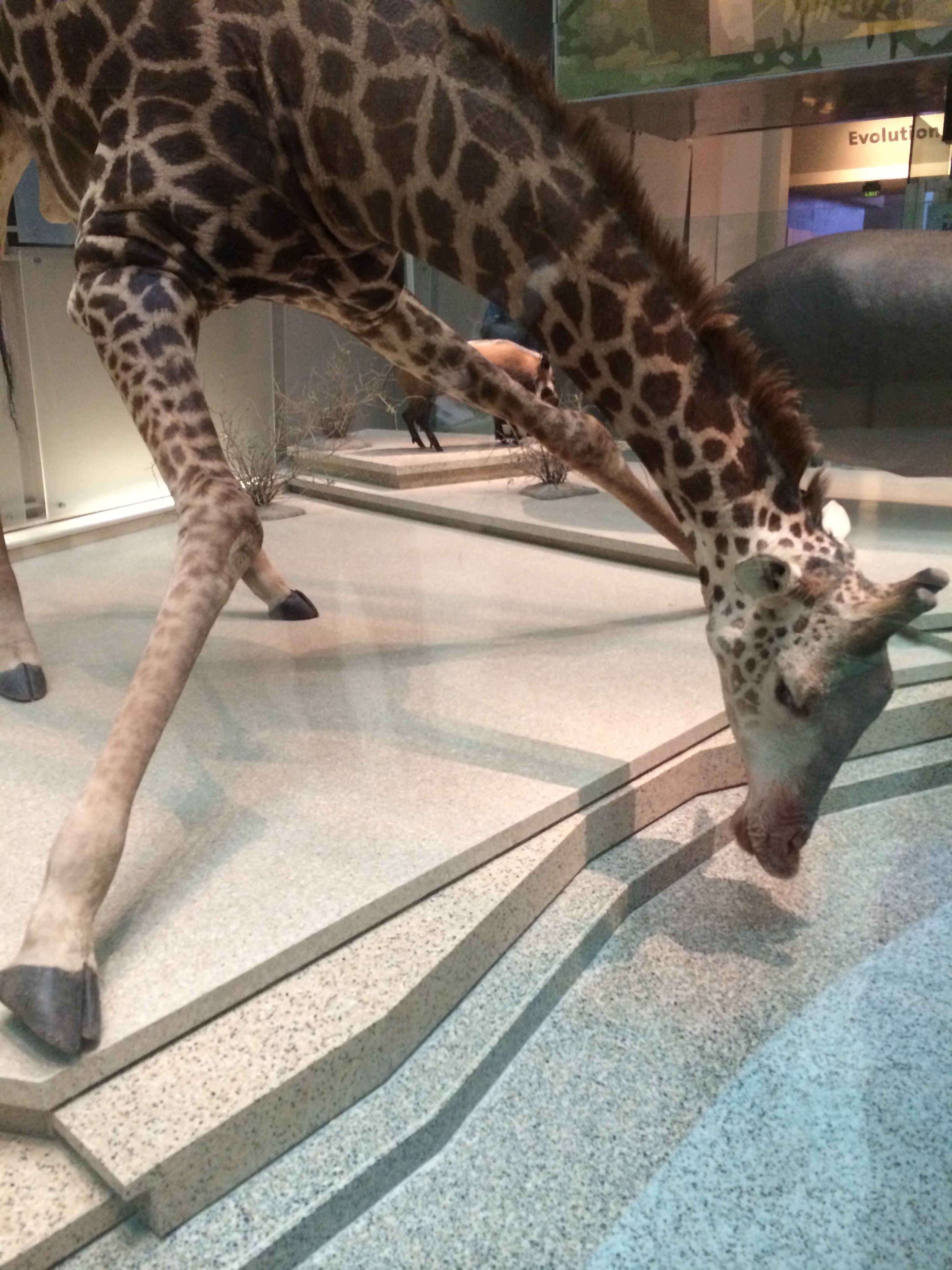
2014-11-22 13.15.29Last week I found myself in various conference venues in and around Washington DC. With just about an hour to spare before my trip back to the airport, I managed to briefly visit the Smithsonian’s National Museum of Natural History.

According to Wikipedia, this is the most-visited museum in North America, and the most-visited natural history museum. It didn’t feel as crowded as some other museums, though. Maybe I got there on a rare quiet Saturday?

The central exhibit of the museum is the African elephant in the foyer. Like all elephants in rooms, it’s quite noticeable and unavoidable. From a floor above, you can learn all about elephants while walking around the balcony that overlooks the central elephant.

2014-11-22 13.06.15

Themed exhibits on the first floor covered life in the ocean, human evolution, and mammals. Topic-wise, the exhibits didn’t differ much from those in other natural history museums I’ve visited, but the displays looked more modern. Continue reading “Smithsonian’s National Museum of Natural History”

Darwin’s Manuscripts

UPDATE 2014-11-25 6:28AM (ET): Grant Young, Head of Digital Content at Cambridge University Library commented to let us know where the Darwin manuscripts stand legally. The unpublished manuscripts remain under copyright to the Darwin Estate until 2039. As Young notes in his comment below, Cambridge University Library is actively working to reduce the copyright period on unpublished works and prefers to release documents as openly as possible. The original post has been modified with the elements that are no longer applicable having been struck out.

The Cambridge Digital Library has simulataneously done a thing that is very cool thing and thing that is a bit uncool. They have digitized and made available online over 30,000 Charles Darwin manuscripts from 1835-1882. That is a very cool thing to do.

The Charles Darwin Papers in the Manuscripts Department of Cambridge University Library hold nearly the entire extant collection of Darwin’s working scientific papers. Paramount among these documents are Charles Darwin’s Evolution Manuscripts, which are being published online at the Cambridge Digital Library and simultaneously at the Darwin Manuscripts Project in collaboration with the Darwin Correspondence Project. This is a conceptually coherent set of over 30,000 digitised and edited manuscript pages, spanning 1835-1882.
Cambridge Digital Library

Continue reading “Darwin’s Manuscripts”