
Van Tassel Sutphen’s The Doomsman (1906)
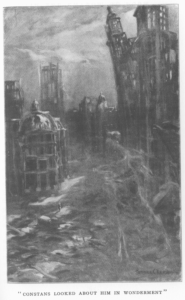 The Doomsman opens in what seems to be the primitive past: A young man sits on the shore of a bay, dressed in a tunic. In the forest behind him are the heavy wooden walls of a stockade, a clue to the defensive nature of life in this sparsely inhabited country. But not everything fits. The young man is looking across the bay at a vague, dark outline of some tall structure, while in his hands he holds a book: A Child’s History of the United States. He is sitting on the shores of New York, looking out at what’s left of Manhattan.
It would make a great opening shot for a movie — a YA post-apocalyptic movie. The Doomsman is, like After London, one of the earliest examples of the post-apocalyptic YA adventure. The plot follows the familiar pattern: A restless boy is trying to understand his society and discover how it fell from its seemingly more glorious and technologically marvelous past. Excitement, danger, and romance ensue; the boy proves his manhood, discovers the secrets of lost technologies, and seeks to win the girl. (The gender pattern here wouldn’t be swapped until decades later.) Much of what appeals to us in present-day YA blockbusters like the Hunger Games is here in Doomsman, in a form that only feels a little dated. Continue reading “Apocalypse 1906: The Origins of the YA Dystopia”








 The Finch and Pea