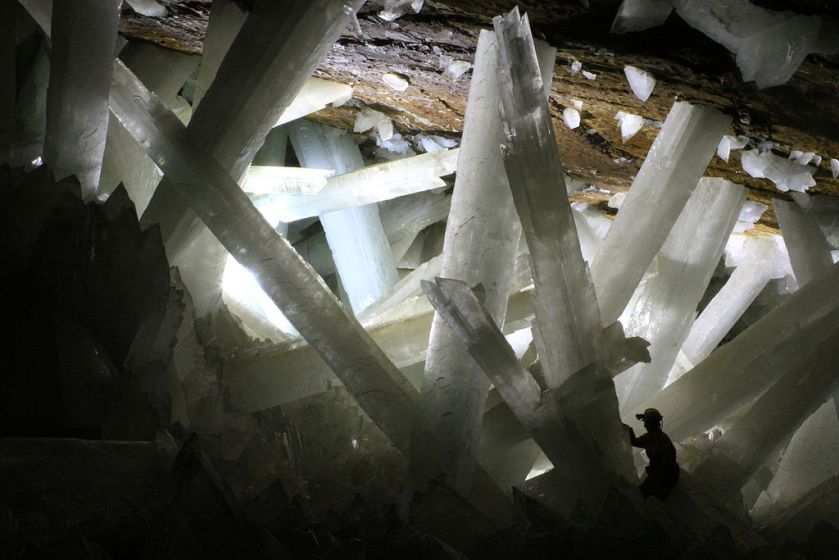
In 2000, a group of Mexican miners was drilling new tunnels for the excavation of zinc, silver, and lead, when they found something even shinier than the metals they were after: an underground cave with enormous crystals, 300 meters underground. These crystals are up to 12 meter (39 ft) high, and are the largest crystals on the planet!
The crystal cave was originally filled with water (in which the crystals were formed), but the miners pumped the water out of the space, revealing the crystals. Once they’re done mining this area, they will stop pumping, and the cave will fill up with water again. In the mean time, while the crystals are exposed to the air, they’re quite fragile and can deteriorate. Either way, the crystal cave is not a permanent space.
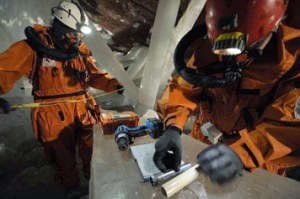 Recognizing the short-lived nature of the cave, a group of researchers and artists set up the Naica project in 2006, with the goal of documenting all aspects of the crystals before they disappear. The scientific team of the Naica project is studying the physical and geological aspects of how the crystals were formed, and looking at microbiology and fossils within the area. So far, they have published several dozen articles. Meanwhile, the “visual rescue” team is working hard to document the caves from all angles before they’ll be lost.
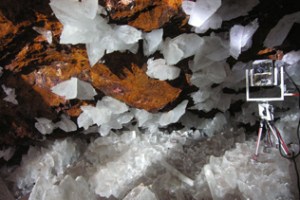 Both the photographers and scientists have had to deal with extreme conditions: temperatures within the cave are about 50 degrees Celcius (Over 120 Fahrenheit). Combined with 100% humidity, humans can only survive in the caves for a few hours, tops. That means the teams have had to develop techniques to take images and measurements without exposing themselves too much to the climate within the caves. The imaging team uses robots, and everyone has to wear special suits to go down there.
It’s not a place most of us will ever got to visit, so the research and documentation efforts are a great way for everyone to learn about the caves. The cave was discovered by accident, and who knows what else is hiding below the Earth’s surface?
Images:
Cave crystals – CC-BY by Alexander van Driessche, via Wikimedia. Robot and scientists images from Naica project website, copyright Naica project.



 The Finch and Pea
