
You can’t make an omelet without breaking some eggs; but you can’t make a quiche without breaking some eggs and sounding pretentious.
Make Stuff Up with Confidence
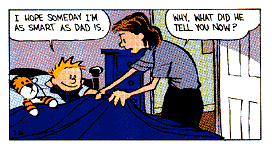
I foresee my lovely spouse having this same conversation with our daughters. To paraphrase a conversation with my younger brother in which we reflected upon our childhood:
Bro: I used to think you knew everything about everything. Finally, I realized that you just made stuff up.
Moi: Yes, but I said it with confidence. . .
I Gotta Pee
Being a parent is phenomesome, but it does have drawbacks. In my humble opinion, chief among these is the fact that a parent of small children no longer gets to decide when they get to use the bathroom. A parent’s body decides when it wants to go, but not when it gets to.
Continue reading “I Gotta Pee”
Thoughts on Phil’s Dick Presentation
Like most public “dick” presentations, Phil Plait’s “Don’t Be a Dick” speech at The Amazing Meeting 8 was controversial.
Whole tomes have been written on this topic already (this post by Daniel Loxton and the endless comments summarize the debate nicely). Continue reading “Thoughts on Phil’s Dick Presentation”
Why We Model
There is still considerable skepticism in many quarters regarding the utility of mathematical models in molecular biology. Those of us who do model are frequently required to justify our activities. The preferred justification is the ‘you can’t argue with success’ rationale, which can be used in cases where you already have a working model on hand that’s generating accurate predictions and yielding useful insights.
Unfortunately, in cases where you have yet to build that model, it is necessary to resort to other, more long-winded justifications for modeling. This Gilman and Arkin review nicely sums up the reasons I typically give for modeling:
The detailed models we examine demonstrate the principal strength of modeling: It is a means to formulate all available knowledge about a system in as precise a manner as possible Continue reading “Why We Model”
 The Finch and Pea