Science Caturday: Kitteh Quake Time!

thekick

It’s almost time for football season! What has that to do with either science or cats, you ask? Bear with us. We’ll get there.

A few weeks ago, Kathryn Schulz published a widely-noticed article in The New Yorker about “The Really Big One,” that is, on the likelihood of a huge earthquake in the Pacific Northwest of the US. The piece pointed out the dense population and poor earthquake-readiness of the area around the Cascadia subduction zone, which includes the city of Seattle, Washington.

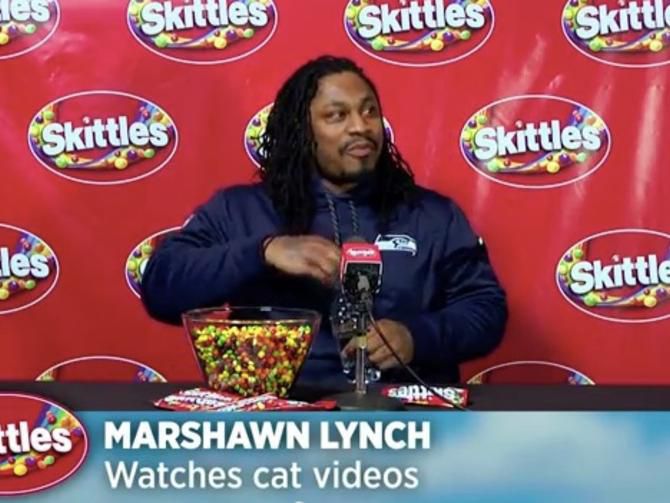
However, at least some scientists in Seattle are preparing for earthquakes, and they’re using their local NFL fans to help them do it. The Seattle Seahawks’ fans are famously rowdy and noisy. After Marshawn Lynch’s “Beast Quake” touchdown in the 2011 NFL playoffs, the crowd’s roars not only shook the Seattle stadium, but also the surrounding ground.

We know this because scientists at the University of Washington in Seattle had placed a sensor just across the street from the stadium. Seismologist John Vidale noticed a clear signal post-touchdown. Vidale realized that the energy of 70,000 fans jumping around for a minute could come close to the energy released by a small earthquake and that athletic events might be a good venue for testing seismic instruments. Football games have the added benefit of being scheduled in advance, unlike earthquakes.

Vidale and his colleagues installed three portable sensors inside the Seahawks’ stadium just before the January 2015 NFL playoff games in Seattle. Somewhat surprisingly, the strongest signal didn’t show up during a game-changing play, but during the halftime show, as the crowd jumped and danced with the music. In addition to testing sensors, the researchers were able to develop software, called QuickShake, to display the seismic recordings on the scoreboard with a delay of just a few seconds. All of this work will help them better measure and analyze seismic activity, and potentially assist in improving building design and earthquake preparedness.

You can learn more about the scientists’ work with the Seahawks here. So that’s the science. Where, you ask, are the cats?
marshawn

Told you we’d get there.

Science for the People: Animal Weapons

sftpThis week, Science for the People is talking about weapons: both the ones that evolve in nature, and those created by humanity. We’ll talk about the arms races that spur the development of horns and claws, warships and nuclear weapons, with Doug Emlen, Professor in the Division of Biological Sciences at the University of Montana, and author of Animal Weapons: The Evolution of Battle.

*Josh provides research help to Science for the People and is, therefore, completely biased.

Vote Jill

by Michael R. Hall
by Michael R. Hall

Not only was the Kickstarter campaign for JILL TRENT, SCIENCE SLEUTH #1 successful, just as your favorite deity intended…Not only was D.M. Higgins, the generalissimo of JILL TRENT, SCIENCE SLEUTH #1, kind enough to include The Frogger and Punkface MacGruder in the book’s dedication…Not only is the comic fantastic and inspiring to my daughters (see illustrations below). Not only was JILL TRENT, SCIENCE SLEUTH #1 so successful that they are making JILL TRENT, SCIENCE SLEUTH #2

But JILL TRENT, SCIENCE SLEUTH #1 is also in the running for a Geekie Award in the Comics & Graphic Novels division. You can vote for them once per day until the voting closes on 31 August. You could choose to vote for another contender, but we cannot promise that Daisy Smythe won’t find you…

IT Witten (All Rights Reserved)
ET Witten (All Rights Reserved)
Jill Trent Inspired
IT Witten (All Rights Reserved)

People’s Republic of Science

sftpNo one does the long form science interview like Science for the People does the long form science interview*. If you have time to listen to Science for the People, then you have time to complete the mere ten questions that make up the Science for the People Listener Survey (if you want, you can save time by skipping the credits where they say I am marginally useful).

Think of it as your civic obligation to keep great science programming coming at your earholes – like voting, except that here your opinion actually matters.

*Probabilistically speaking, this is quite likely to be literally true.

There is No Dark Side

dscovrepicmoontransitfullAccording to NASA, this shot of the far side of the Moon was captured by the Deep Space Climate Observer Satellite as it orbited a million miles above Earth. The “dark side” of the Moon is only figuratively “dark”.

I also feel like the realization that the “dark side” of the Moon has become progressively less mysterious since humanity’s first imaging of it in 1959 kind of ruins the conceit of isolation in Moon for me.

HT: David Grinspoon